Köthen Castle: An Anhalt Palace, Museum, and Concert Venue in Germany


Site at a Glance
- Rating
- 4.3
- Popularity
- Low
- Country
- Germany
- Primary era
- Early Modern
- External website
- Open
- Eras represented
- Medieval, Early Modern, Modern
- Civilizations
- German, Holy Roman Empire
- Site type
- Domestic
- Remains
- Palace
On this page19 sections
History
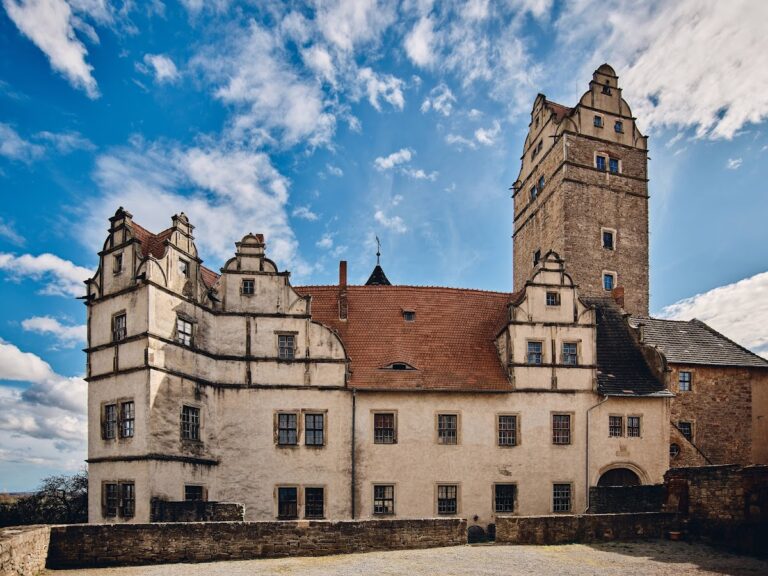
Köthen Castle is a palace complex in Köthen, Germany, developed from medieval fortified sites under the Ascanian dynasty and transformed into a Baroque and later Neoclassical residence. An earlier stronghold stood on an island, while traces of a medieval fortification belong to the Slavic period. A castle complex is first documented in 1396. Albert the Bear, an important twelfth-century Ascanian ruler, brought the earlier stronghold under Ascanian control.
Ascanian residence
Köthen was an important trading center within the Ascanian realm during Albert the Bear’s reign. The castle and its successor palace served as the residence of the Princes and Dukes of Anhalt from 1244 to 1847. From 1603, it was the seat of the Anhalt-Köthen line, a branch of the House of Ascania, the German princely dynasty whose branches ruled territories including Anhalt.
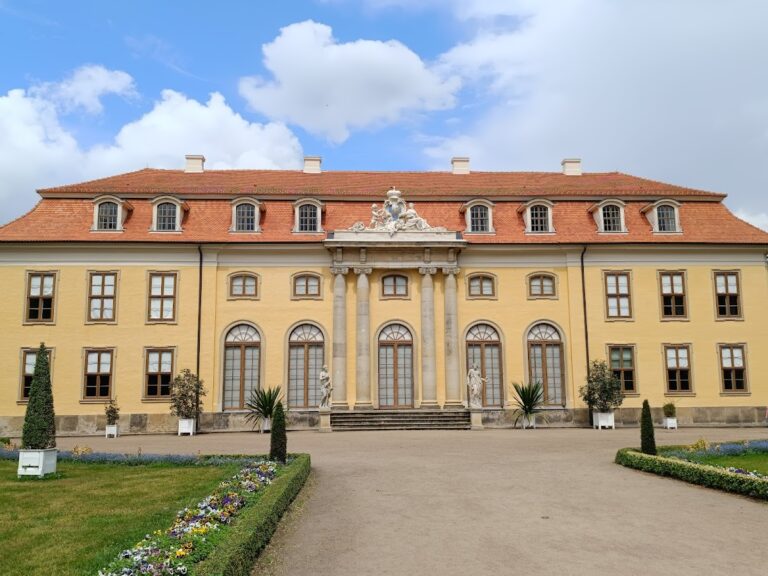
A fire destroyed the castle in 1547. The northern portion survived, while Prince Wolfgang moved his residence to Bernburg. During the late sixteenth and seventeenth centuries, the complex was reshaped as a Baroque palace. The buildings later received Neoclassical interior renovations between 1821 and 1833.
Princely and ducal court
The principality of Anhalt-Köthen became a duchy in 1806. When Duke Henry died in 1847, the Anhalt-Köthen line of the House of Ascania became extinct. The Duke of Anhalt-Dessau inherited the palace, removed its furnishings, and established state offices and the Köthen district court within the complex.
The palace chapel remained in use for worship until 1870. It was then converted into a gymnasium and ceremonial hall for the Ludwigsgymnasium. Earth excavated during the construction of a prison was used to fill part of its interior to courtyard level. This fill was removed between 1961 and 1963, restoring the earlier spatial arrangement, and further restoration followed from 1989 to 1991.
A grammar school opened in the Ludwigsbau in 1878. A prison was also constructed on the eastern side of the palace that year. It was demolished in 1991, allowing the earlier arrangement of the complex to be restored.
Bach and the Köthen court
Köthen Castle is associated with Johann Sebastian Bach, the German Baroque composer and organist who served as court Kapellmeister, the senior musician responsible for a princely court’s musical establishment, to Prince Leopold from 1717 to 1723. Bach’s first wife, Maria Barbara, died in Köthen in 1720. His second wife, Anna Magdalena, worked at the court as a singer when they married in 1721.
During his Köthen years, Bach worked on instrumental compositions including the Brandenburg Concertos and the first book of The Well-Tempered Clavier. The court followed the Reformed tradition, a Protestant branch associated with the Reformation, and did not require regular sacred music. Bach therefore composed secular cantatas for court occasions, including works for Prince Leopold’s birthday and for New Year’s Day. After moving to Leipzig in 1723, he continued writing occasional pieces for the court for several years, until Leopold’s death.
The Fruitbearing Society and scientific collections
The palace became the seat of the Fruitbearing Society in 1629. Founded in 1617 in Weimar to promote the German language, this early German language society gave its members symbolic names and emblems. Ludwig of Anhalt-Köthen was its co-founder and lifelong head.
During the nineteenth century, the palace housed the ornithological collection of Johann Friedrich Naumann, a German ornithologist associated with the systematic study and documentation of birds. The collection was sold to Frederick Ferdinand, Duke of Anhalt-Köthen, and the Naumann Museum was founded in 1835. In 2015, the museum was recognized by the Federal Government as nationally valuable cultural heritage.
War damage and modern stewardship
A bombing raid on Köthen on 20 July 1944 destroyed the northern half of the western wing and the eastern annex of the gatehouse. The damaged ruins were later removed. The palace was owned by the city of Köthen from 1918 and entered the holdings of the state-owned Stiftung Dome und Schlösser in Sachsen-Anhalt in 1997. It is now managed by the Kulturstiftung Sachsen-Anhalt.
The palace chapel, the Spiegelsaal, the courtyard, and other rooms have undergone restoration and adaptive reuse. The Spiegelsaal received general restoration from 2011, while the former riding-hall ruin provided replacement event facilities during the work. Köthen Palace and its gardens form part of Saxony-Anhalt’s Garden Dreams network. The complex now functions as a museum and concert venue, with historic rooms and courtyard spaces also used for events.
Remains
The palace grounds consist of the Schlosspark, an outer area, and an inner area occupying the original castle site. A moat separates the inner area from the rest of the grounds, and three bridges cross it. The complex combines medieval and Renaissance survivals with Baroque and Neoclassical buildings, restored interiors, and carefully adapted ruins.
Outer palace buildings
Princess’s House
The Prinzessinhaus, or Princess’s House, stands beside the entrance to the palace grounds. Built in 1779, it served as the residence of the court marshal until 1847. A court marshal was responsible for aspects of a princely household and its administration. The building is now used for offices and a bus driver’s lounge.
Royal stables
The outer palace area has a horseshoe-shaped arrangement formed by the royal stables, riding hall, and coach house. The royal stables, known as the Marstall, were built and rebuilt during the eighteenth century in the Rococo style according to designs by Emanuel Lebrecht Rothe. The two-storey building has exterior mansard roofs, whose lower slopes are steeper than their upper slopes, and projecting sections above the stable gates. These sections carry escutcheons, or shield-shaped heraldic emblems. Horses were kept privately in the building until 1945, and part of the Bach Museum has occupied its ground floor since 2010.
Riding hall and event center
The Reithalle, or riding hall, was built in 1821 by the ducal building official Gottfried Bandhauer. A fire in the early 1940s left its facade with large round-arched windows and attached volutes. Between 2004 and 2008, a multifunctional event center was inserted into the ruin while retaining the historic exterior walls. The resulting concert hall opened on 29 March 2008.
The modern center includes the Johann Sebastian Bach Hall with 450 seats, the Anna Magdalena Bach Hall with 160 seats, the Maria Barbara Bach Hall with 60 seats, and the Wilhelm Friedemann Bach Hall with 120 seats. It also contains the Café Leopold. Projecting and recessed cream-white fiber-cement panels form the modern facade over the historic exterior walls.
Coach house
The Remisenhaus, or coach house, was built in 1833 by Conrad Hengst according to plans by Gottfried Bandhauer. Together with the riding hall, it forms part of the event facilities. A plaque outside the building commemorates Bandhauer.
Buildings around the inner area
Johann-Georg-Bau
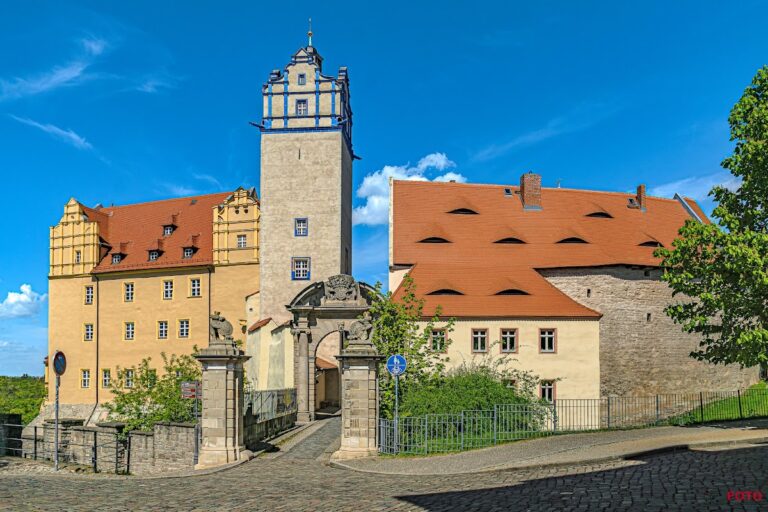
East of the outer buildings, across the moat, stands the Johann-Georg-Bau. It originated as a gatehouse of the medieval castle and was remodeled for Prince John George I in 1597 and again for Prince Emmanuel Lebrecht in 1670. The building retained its Renaissance round arch. It was destroyed during the bombing of 1944 and now houses the Johann Sebastian Bach Music School, which has occupied it since 1984.
Ludwigsbau and Spiegelsaal
The Ludwigsbau was constructed between 1600 and 1608 by Peter and Franz Niuron of Lugano. Its design follows the style of Upper Silesian castles and incorporates Italianate influences. The building contains the former throne room, now called the Spiegelsaal, as well as the Historical Museum, the Bach memorial site, exhibitions on the Fruitbearing Society and the German language, and exhibitions on homoeopathy and the work of Samuel Hahnemann and Arthur Lutze in Köthen. Hahnemann founded homoeopathy, while Lutze was a nineteenth-century physician and homoeopathic practitioner.
Christian Gottfried Bandhauer designed the Spiegelsaal as a throne room approximately two centuries after the Ludwigsbau was built. Its interior has white, green, and ochre stucco decoration and a coffered barrel vault.
Ferdinandsbau and Naumann Museum
Bandhauer designed the Ferdinandsbau, constructed in 1823. Its upper floor houses the Naumann Museum, while the prehistoric collection of the Köthen region has occupied part of the building since 2002. The museum contains approximately 1,300 items in 113 display cases, including taxidermied birds, Naumann’s personal effects, bird engravings, and hunting and fishing equipment. Taxidermied specimens are preserved animals prepared to retain a lifelike appearance.
Palace chapel
Bandhauer also designed the palace chapel, built in 1826 for Duke Ferdinand of Anhalt-Köthen after his conversion to Catholicism. The chapel ensemble includes a stair tower adapted to the towers of the Ludwigsbau. Its organ was made by Johann Christoph Zuberbier for the church at Thurau around 1735 or 1754 and installed in the chapel between 1986 and 1989.
The chapel’s gallery balustrade has four pillars designed by Johann Michael Hoppenhaupt in 1725. They came from the ruined village church at Oberbeuna in the Geiseltal. The complex is completed by the Torhaus, or gatehouse, and the Steinernes Haus, or Stone House.
Stone House and museum displays
The Steinernes Haus now contains the Köthen city archive and museum storage rooms. The Bach Museum occupies most of the former riding hall and part of the royal stables, while a separate Bach memorial site is located in the Ludwigsbau.
Former palace garden
A 1650 engraving by Matthäus Merian depicts the former palace garden with islands, basins, covered walkways, and pavilions. Merian was a seventeenth-century engraver and publisher known for illustrated views of cities and landscapes. The historic garden forms part of the palace grounds and is included with Köthen Palace in Saxony-Anhalt’s Garden Dreams network.