Kloster Petersberg: A Wettin Dynastic Burial Foundation in Germany


Site at a Glance
- Rating
- 4.8
- Popularity
- Low
- Country
- Germany
- Primary era
- Medieval
- External website
- Open
- Eras represented
- Medieval, Modern
- Civilizations
- Holy Roman Empire, Margraviate of Meissen
- Site type
- Religious
- Remains
- Monastery
On this page10 sections
History
Kloster Petersberg, formerly known as Kloster Lauterberg, is a Romanesque monastery and collegiate church in Germany, founded in the twelfth century by the Wettin dynasty as a religious and dynastic burial foundation. It stands on Petersberg, the highest elevation in the Saalekreis. By the late Middle Ages, the hill was called Lauterberg, while the name Petersberg became associated with the monastery and its church.
Before the monastery
The summit may have held a fortified hill settlement and, during the eighth and ninth centuries, a Slavic sanctuary. The hill occupied the highest point of the Slavic-settled region between the Harz and the Oder, and between the Erzgebirge and the Baltic Sea. The later monastery therefore continued an earlier cultic importance while becoming a Christian center in a predominantly pagan Slavic landscape.
Around 1100, the Archdiocese of Magdeburg built a small chapel on the Lauterberg. In 1124, Count Dedo IV of Wettin founded an Augustinian collegiate foundation dedicated to Saint Peter, according to the Lauterberg chronicle, and assigned part of the income from his inherited property to it. The foundation stood near the Wettin family’s ancestral castle and was intended to preserve remembrance of its dead while reinforcing the hill as a religious and ideological center of Wettin authority.
Foundation under the Wettins
Dedo’s pilgrimage to Jerusalem and the establishment of the monastery were also understood as penance for his treatment of his repudiated wife, Bertha. Dedo died on the return journey, so his younger brother Konrad the Great carried out the foundation and is regarded as its actual founder. Konrad, Margrave of Meissen, and his wife Luitgard granted the monastery extensive lands and privileges, including chapels and estates at Löbejün, Ostrau, Hitzkendorf, Salzmünde, Uden, Pfützthal, and Plöt.
Papal confirmation followed on 7 March 1128, placing the monastery under the ownership and protection of the Holy See. The canons received the right to elect their provost freely, although Konrad intervened in elections in 1128, 1137, and 1151. The archbishop of Magdeburg retained spiritual jurisdiction and the right of consecration, while Konrad claimed the office of advocate for himself and his descendants. Missionary work remained an important responsibility until 1224.
The Wettin burial foundation
Construction of the collegiate church began in 1142. Konrad designated Petersberg as the hereditary burial place of his family, and his descendants continued to grant property and rights to the institution. Between 1145 and 1217, ten members of the Wettin family from four generations were buried there. Konrad was the only Margrave of Meissen laid to rest at Petersberg.
Luitgard died in 1145. In November 1156, after arranging the succession and dividing his territories among his five sons with the consent of Emperor Frederick I, Konrad surrendered his secular authority and entered the monastery. Archbishop Wichmann clothed him in a monk’s habit on 30 November 1156. Konrad died three months later, on 5 February 1157, before the church was complete. He was buried at its center, with Luitgard to his right; Konrad’s sister Mathilde, Wichmann’s mother, was later buried on the same side. Three altars endowed by Konrad in 1145, together with the transfer of property from the monastery founded by his parents at Niemegk, further strengthened Petersberg’s role as the family burial foundation.
The collegiate church was completed by 1184. The monastery continued to receive grants, including property mentioned in documents issued by Dietrich I, Count of Brehna, in 1252 and by the Landgrave of Landsberg on 29 July 1275.
Dissolution, fire, and reconstruction
The monastery was dissolved and its property secularized during the Reformation, the sixteenth-century movement that established Protestant churches and led to the suppression of monasteries in many territories. This process took place at Petersberg between 1538 and 1540. The former monastic lands became the Amt Petersberg of the Electorate of Saxony.
On 31 August 1565, lightning struck the church tower. The resulting fire almost completely destroyed the collegiate church and many economic buildings, and seriously damaged the Wettin coffins. The church was restored using the surviving ruins. In 1567, Elector Augustus of Saxony commissioned the sculptor Hans Walther II to create the Domus Sepulturae, a cenotaph or commemorative monument for the dead that did not itself contain the burials, over the Wettin graves.
The Amt Petersberg was sold to Brandenburg-Prussia in 1697 and incorporated into the Duchy of Magdeburg. During the early nineteenth century, Johann Wolfgang von Goethe and the architect Karl Friedrich Schinkel supported the preservation of the increasingly ruined complex. Between 1853 and 1857, the Prussian state financed an almost faithful reconstruction of the collegiate church based on its condition in 1565. The rebuilt church was consecrated on 8 September 1857 in the presence of King Frederick William IV.
During this reconstruction, the cenotaph was moved to the west wall, the sandstone coffins were opened, new grave slabs were made, and the burial chapel was demolished. A major renovation and archaeological investigation from 1965 to 1971 removed elements added during the nineteenth-century restoration and recovered the medieval interior level.
Religious use since the twentieth century
Since March 1999, members of the Communität Christusbruderschaft Selbitz, an evangelical religious community within the Evangelical Lutheran Church in Bavaria, have lived in the former collegiate complex. Sisters joined the resident community in October 2012. The community maintains public prayer and offers retreats and periods of spiritual reflection, while the church also serves as the parish church of Petersberg.
After German reunification, the church was added to the Straße der Romanik, a historical and cultural route linking important Romanesque monuments in Saxony-Anhalt. Since 2014, it has also been a center of the international Coventry Cross of Nails reconciliation community, a Christian movement that originated at Coventry Cathedral after its wartime destruction. The complex is owned by the Kirchliche Stiftung Petersberg. A later extension, begun in 2008 and containing a prayer room, is in use.
Remains
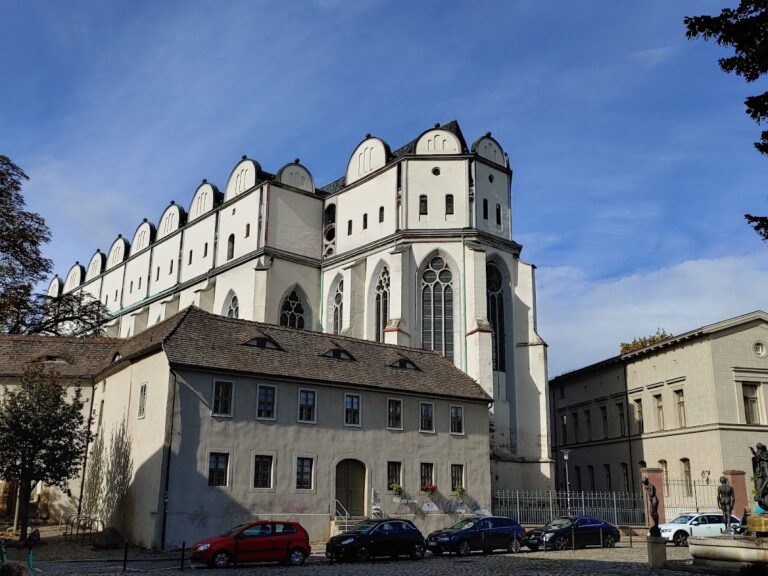
The monastery and Church of Saint Peter occupy the summit of Petersberg. The surviving complex combines a Romanesque three-aisled, cruciform basilica with historic collegiate buildings, archaeological traces of earlier chapels, and later additions. The church’s position along the mountain ridge shaped its unusual proportions: the nave is only slightly longer than the transverse tower, while the side aisles are notably broad. A cloister or canonical enclosure was built against the slope, with several levels of cellars.
Early chapels and the collegiate church
The small, round Romanesque Cappella vetus, meaning “old chapel,” survives in fragmentary form in the monastery cemetery. A separate fragment of a rotunda with a semicircular apse, the rounded end of a church sanctuary, is identified north of the present church. These remains belong to the earlier religious history of the summit and stand in relation to the later collegiate complex.
Church of Saint Peter
The Church of Saint Peter is a Romanesque basilica, a church with a higher central nave and lower side aisles, arranged on a cruciform plan. Its construction began in 1142, it was consecrated in 1146, and it was completed in 1184. The building was severely affected by the fire of 1565. Restoration and reconstruction followed, using the surviving ruins, and the spacing of the piers in the central nave was altered after the fire.
The reconstruction of 1853 to 1857 produced a church closely resembling the medieval Romanesque building. The later restoration between 1965 and 1971 renewed the slate roof, repainted the interior, removed the furnishings installed in 1857, returned the choir floor to its medieval level, and laid new brick paving throughout the church. The present monastery includes the historic collegiate buildings and the later extension containing a prayer room.
Wettin graves and memorials
Ten Wettin burials dating from 1145 to 1217 were placed in two rows beneath the floor of the central nave, between the second and third pairs of piers. Their original positions are now marked by simple stone slabs set into the floor, each inscribed with a name and year of death. During the nineteenth-century reconstruction, the sandstone coffins were opened and the burial chapel was demolished. The cenotaph commissioned in 1567 was relocated to the west wall.
Archaeological work in 1965 to 1971 led to the removal of grave slabs from the central nave. They were arranged along the south and west walls in this order: Luitgard, Konrad the Great, Mathilde, Heinrich I, Heinrich II, Dietrich III, Friedrich I, and Heinrich III. Five nineteenth-century slabs carry life-size reliefs of Konrad, Luitgard, and their three sons. The remaining slabs display crosses with ornamental elements. Another slab, described as dating from the fourteenth century, shows Konrad the Great holding a model of the church.
Nearby sites