Schloss Neersen: A Baroque Palace and Former Water Castle in Germany


Site at a Glance
- Rating
- 4.6
- Popularity
- Medium
- Country
- Germany
- Primary era
- Early Modern
- External website
- Open
- Eras represented
- Medieval, Early Modern
- Civilizations
- Holy Roman Empire
- Site type
- Domestic
- Remains
- Palace
On this page13 sections
History
Schloss Neersen is a castle in Neersen, a district of Willich, Germany. It developed from a medieval stone water castle beside the Niers River into a three-winged Baroque palace built between 1661 and 1669. Its history reflects the contested frontier between the Electorate of Cologne and the Duchy of Jülich, as well as later changes brought by war, industrial use, fire, restoration, and municipal administration.
Medieval origins and the Cologne frontier
The first castle stood on a raised island, or donk, in a wet woodland landscape beside the Niers. A donk is a naturally or artificially elevated area in marshy or flood-prone ground. The river supplied the surrounding moat and ran directly beside the site until it was straightened in 1930. It now flows about one kilometre away, and the name Neersen is probably connected with the former relationship between the settlement and the river.
Neersen entered the sovereignty of the Archbishop of Cologne in 1166, when the County of Liedberg was divided. A hereditary bailiwick held as a Cologne fief was in the possession of the knights of Neersen by 1263. A bailiwick was an administrative and judicial territory governed by a bailiff. The date when the Neersen territory became an independent bailiwick is uncertain.
In 1371 Archbishop Friedrich III of Saarwerden enfeoffed Heinrich IV of Neersen with the bailiwick and expressly named Neersen Castle. The castle stood on the eastern bank of the Niers, which formed the boundary between the Electorate of Cologne, the territory ruled by the Archbishop of Cologne, and the neighbouring Duchy of Jülich. The bailiffs administered the territory, while Cologne troops occupied the castle in wartime. Its military purpose included the defence of crossings over the Niers. Since the frontier was disputed, the bailiffs also regularly had parts of their fief confirmed by the Jülich feudal authority at Heinsberg.
From the Neersen knights to the Virmond family
During the fourteenth century, the knights of Neersen unsuccessfully tried to turn the bailiwick into an independent lordship. When Heinrich VI of Neersen died without a male heir in 1487, the inheritance passed through his sister Agnes von der Neersen to Anton von Palant. A later marriage between Agnes von Palant’s daughter and the Hessian knight Ambrosius von Virmond zu Nordenbeck established a new Virmond line at Neersen in 1502.
The family’s position grew after the Thirty Years’ War, the conflict that began in 1618 and reshaped the political and religious balance of central Europe. Johann von Virmond’s military service at the Battle of White Mountain near Prague in 1620 led Emperor Ferdinand II to raise him to the rank of baron in 1621. The medieval castle had by then become dilapidated, and the family sought a more suitable residence. Money came partly from Cologne payments for supplying armed forces and partly from taxes and wartime contributions imposed on the local population.
The Baroque palace and the end of Cologne rule
Under Adrian Wilhelm von Virmond, the medieval water castle was transformed into a Baroque palace between 1661 and 1669. The work cost 18,139 Reichstalers and used approximately two million bricks. The rebuilding reduced the earlier defensive works but retained a defensible forecourt with ditches and palisades. In 1706 Emperor Joseph I raised Damian Hugo von Virmond to the rank of Imperial Count, a noble rank recognized within the Holy Roman Empire.
In 1720 Ambrosius Franz von Virmond enlarged the palace’s central section by extending it several metres toward the courtyard. This created additional room for staircases. An inventory from 1765 still listed fifteen cannons and one mortar, showing that military equipment remained at the palace after its conversion into a Baroque residence.
Ambrosius Franz von Virmond died in 1744, ending the family’s male line. His childless widow ceded Neersen, Anrath, and the palace to the Electorate of Cologne in 1763 after a lengthy legal dispute, receiving 110,000 gulden in return. Cologne then appointed officials to administer the territory. Weydenhorst held the office in 1766, followed in 1767 by the court treasury councillor Johann Gottfried Mastiaux de Namay. A document of 8 October 1770 named him Administrator Generalis of the Lordship of Neersen.
Mastiaux received the Neuenhofen estate at Bockum as a Cologne fief in 1776 and thereafter appeared in documents as Mastiaux auf Neuenhoven. He entered the imperial knighthood as Edler von Mastiaux auf Neuenhoven on 23 February 1780. That year he transferred his office at Neersen to Josef Lenders for 5,000 Reichstalers.
French occupation, industrial use, and fire
French Revolutionary troops occupied Neersen in 1794 during the War of the First Coalition, the European conflict against revolutionary France. French administrative and judicial reforms introduced in 1798 permanently separated the territory from the Electorate of Cologne. Following the secularization of 1802 in the four left-bank Rhine departments assigned to France by the Peace of Lunéville, Schloss Neersen became state property. It was sold in 1803 to Josef Lenders, the last Cologne official of Neersen.
In 1852 Felix Wilhelm Hüsgen, a manufacturer from Gladbach, leased the building from Lenders’s heirs and established a cotton-wool factory and cotton weaving mill there. On the night of 28 to 29 March 1859, a steam-engine explosion caused a fire that destroyed the palace down to its enclosing walls.
Restoration and municipal use
In 1894 Hugo Lenders, Josef Lenders’s grandson, had the damaged palace put up for auction. Gustav Klemme, a Krefeld manufacturer who had operated a velvet factory in Neersen since 1866, bought the property and restored the palace by 1896, although the west wing was not rebuilt. Emil Crous, a private owner from Viersen, acquired the building for 120,000 Reichsmark in 1928 and repaired it.
After the Second World War, the United States Army’s 5th Armored Division used the palace temporarily as its headquarters. The building was later transferred through the Kempen-Krefeld district to the German Red Cross, which operated it as a children’s recreation home. The newly established city of Willich, incorporating the municipality of Neersen, bought Schloss Neersen in 1970. In 1973 the city decided to renovate the palace and reconstruct the west wing so that the building could serve as the town hall. The work was completed in 1982.
The grounds were restored in 2002 as part of Euroga 2002, a regional horticultural exhibition in North Rhine-Westphalia, using eighteenth-century models. The outdoor Neersen Castle Festival has taken place annually in the palace courtyard since 1984, continuing the site’s cultural use. In 2023, the tower clock made by the J. F. Weule tower-clock factory in 1903 and a Westminster striking mechanism acquired in 1934 were repaired.
Remains
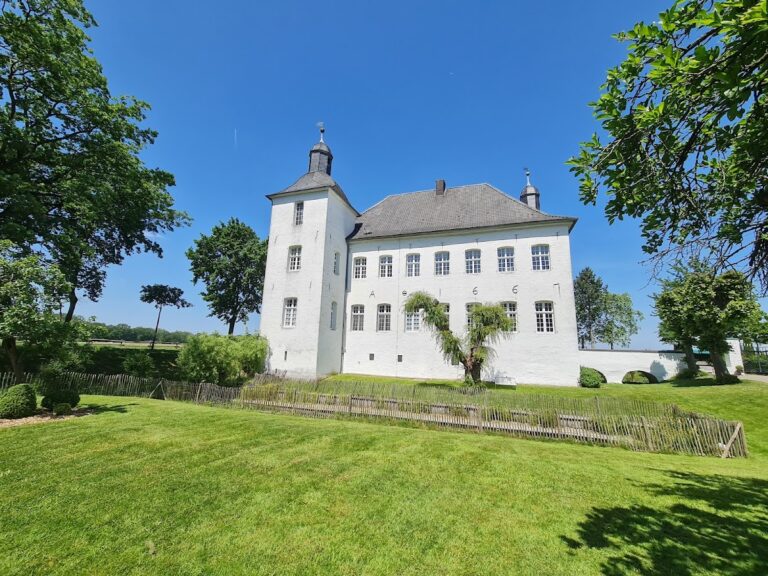
Schloss Neersen preserves the form of a palace that grew out of a fortified lowland castle. The original complex occupied a raised island surrounded by a river-fed moat. Between 1661 and 1669 it was rebuilt as a three-winged Baroque complex with four corner towers. Later restoration followed the surviving enclosing walls after the 1859 fire, while the west wing was reconstructed in the twentieth century. The grounds include a park whose outer areas were reshaped in 2002 according to eighteenth-century models.
Palace and defensive setting
Baroque palace
The palace is a three-winged building arranged around an inner courtyard, with four corner towers inherited in the rebuilt Baroque composition. Its construction between 1661 and 1669 used approximately two million bricks. In 1720 the central block was pushed several metres toward the courtyard to make space for staircases. The 1859 fire left the building standing only to its enclosing walls. Gustav Klemme restored the palace by 1896, but the west wing remained unreconstructed until the rebuilding carried out between the decision of 1973 and the completion of the work in 1982.
Moat and forecourt
The medieval castle was a stone Motte-type lowland fortification. A Motte was a fortified site centred on a raised mound or island, usually protected by a ditch or wet ground. At Neersen, the raised island stood in wet woodland beside the Niers, and the river supplied the moat. Although the Baroque rebuilding reduced the medieval defensive works, the palace retained a defensible forecourt with ditches and palisades. The fifteen cannons and one mortar listed in 1765 indicate that this defensive capacity continued to have a material presence after the transformation into a palace.
Park and surviving mechanisms
Palace park
The palace grounds contain a park whose external areas were restored in 2002 using eighteenth-century models. The park includes a “Park of the Senses” with various stations, among them labyrinths. These landscaped areas form part of the surviving setting around the palace.
Tower clock
A tower clock manufactured by the J. F. Weule tower-clock factory in 1903 remains associated with the palace, together with a Westminster striking mechanism acquired in 1934. Both mechanisms were repaired in 2023.