Palazzo Pubblico: Siena’s Medieval Civic Palace in Italy


Site at a Glance
- Rating
- 4.7
- Popularity
- Medium
- Country
- Italy
- Primary era
- Medieval
- External website
- Open
- Eras represented
- Medieval, Early Modern, Modern
- Civilizations
- Grand Duchy of Tuscany, Italian, Republic of Siena
- Site type
- Civic
- Remains
- Palace
On this page19 sections
History
Palazzo Pubblico, also called the Palazzo Comunale, is a medieval civic palace in Siena, Italy, built approximately between 1297 and 1310 as the seat of the Government of the Nine. The palace still contains Siena’s municipal administration and the Museo Civico, linking its original political function with the preservation of the city’s artistic and civic history.
From scattered government to a civic palace
Before 1280, Siena’s principal political body, the Council of the Bell, met in the curia of San Cristoforo and, for other sessions, in churches or aristocratic palaces. Under the Government of the Fifteen, which ruled from 1280, the city began seeking a more neutral and permanent seat of government.
A first nucleus of the future palace existed by 1284. It mainly comprised the customs house and the mint, known as the Bolgano, whose building faced Piazza del Mercato. After the Government of the Nine came to power in 1287, it acquired adjoining houses, and construction gained decisive momentum in 1297. The new palace was oriented toward Piazza del Campo rather than toward the earlier market-facing building.
The palace stood between Piazza del Mercato and Piazza del Campo, with its principal facade directed toward the latter square. Municipal regulations controlled the appearance of buildings facing the piazza, encouraging a unified architectural ensemble. Construction was first directed by Conte di Rinfredo and, from 1299, by a master named Giovanni, who appears in documents as a miniaturist and calligrapher.
Expansion under the Government of the Nine
The central section initially rose above two lower side wings. The left wing contained the podesta’s rooms, while the right wing belonged to the Government of the Nine. The podesta was a chief magistrate with judicial and administrative responsibilities in a medieval Italian commune. The palace was substantially complete by about 1308, although the left wing remained unfinished. The podesta’s residence was added there between 1325 and 1330, and the Cortile del Podestà was completed in 1325.
The Government of the Nine moved into the completed palace in 1310. A second-floor loggia facing Piazza del Mercato was finished by 1350. The date of the central body’s third and final floor remains uncertain: it may belong to the original construction of 1297 to 1310, or it may have been added in 1326. A southern extension beside Piazza del Mercato was built between 1327 and 1330. Its first floor contained prisons, while the upper floors housed the Great Council Hall, completed between 1330 and 1342.
Torre del Mangia was built between 1325 and 1348 and joined the palace at its side. Its travertine crown followed a design by Lippo Memmi. The tower was the tallest in Italy at the time. The Cappella di Piazza was built at its base in 1352 to 1354 as an offering of thanks to the Virgin Mary after the plague that struck Siena in 1348. A Renaissance canopy was added to the chapel by A. Federighi between 1468 and 1470.
Alterations after Florentine rule
The former Great Council Hall became the Teatro dei Rinnovati in 1560, after the Florentine conquest. Following two fires, Antonio Bibbiena reconstructed the theater in 1753. It was later remodeled and restored in 1951, and it remains a theater within the palace complex.
A mid-fifteenth-century painting by Sano di Pietro shows the palace before the final upper stories of the two side wings and the left belfry had been added. Carlo Fontana added these elements in 1680, retaining the original style and balancing the surrounding buildings. The palace’s rooms continued to serve the various magistracies that administered Siena. They now include municipal offices, the mayor’s offices, representative rooms, the municipal council chamber, and the Museo Civico.
A civic program in painting and sculpture
The Government of the Nine began commissioning major artists to decorate the palace during the fourteenth century, before the architecture was fully complete. The resulting frescoes, paintings, and sculptures expressed the government’s political program and preserve a detailed record of medieval civic society. Simone Martini worked in the palace from 1315 to 1331, Ambrogio Lorenzetti from 1335 to 1345, Lippo Vanni from 1352 to 1373, Bartolo di Fredi from 1390 to 1393, Taddeo di Bartolo from 1406 to 1414, Sano di Pietro from 1439 to 1461, and Sodoma from 1529 to 1539.
The Sala del Mappamondo, also called the Sala del Consiglio, was used for meetings of the city government. Its earliest securely surviving decoration dates to 1314. The Sala dei Nove, or Sala della Pace, served the Government of the Nine. Between 1338 and 1339, Ambrogio Lorenzetti painted there the Allegory and Effects of Good and Bad Government, a cycle that presents contemporary Sienese ideas about civic order and political responsibility.
The Sala dei Priori, also called the Sala della Balìa, contains a cycle on the life of Pope Alexander III, a twelfth-century pope from Siena whose papacy was involved in conflict with Emperor Frederick Barbarossa. Spinello Aretino and his son Parri Spinelli painted the cycle in 1407, while Martino di Bartolomeo decorated the vaults with sixteen virtues in 1408. The Sala del Concistoro became the meeting room of Siena’s municipal consistory during the second half of the seventeenth century, acquiring its current name from that function.
The palace also acquired later historical meanings. The Sala del Risorgimento was decorated after the death of Victor Emmanuel II and dedicated to the Risorgimento, the nineteenth-century movement that led to the political unification of Italy. Its historical paintings were directed by Luigi Mussini and produced chiefly by Tuscan, particularly Sienese, artists.
Restoration and continuing use
A late nineteenth-century restoration sought to recover the palace’s medieval appearance while preparing rooms formerly occupied by the city administration for public access. The Museo Civico was established in the palace during the 1930s. Its collections include numerous works of the Sienese school, while the building continues to function as a seat of municipal government. The Cortile del Podestà was restored at the beginning of the twentieth century, and its stairway was restored in 1980. The originals of Jacopo della Quercia’s Fonte Gaia sculptures, once displayed in rooms on the second floor, were later transferred to the Santa Maria della Scala museum complex.
Remains
Facade, tower, and courtyard
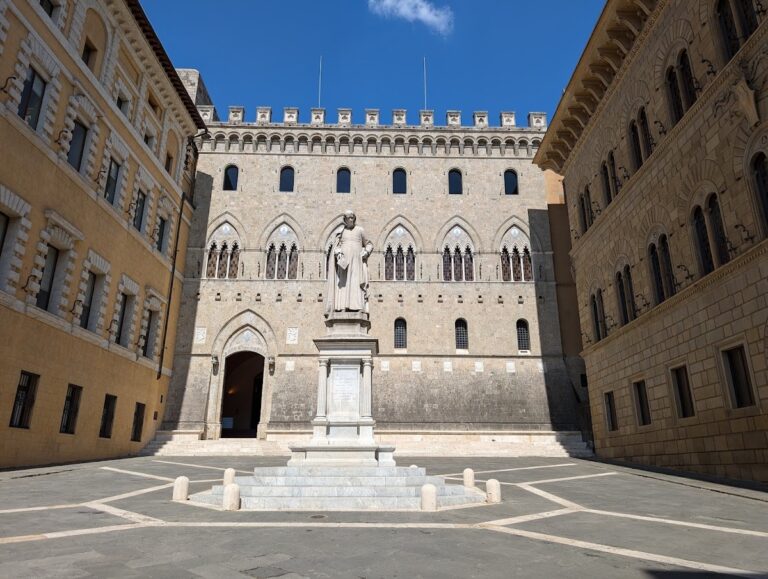
Palazzo Pubblico is organized around a central body and two side wings on Piazza del Campo, with the building extending toward Piazza del Mercato. The slightly concave main facade faces the piazza. Its central body has four architectural levels, one more than the three levels of the side wings. The lower facade is built of stone, described in one account as travertine, while the upper sections are brick. The change from stone to brick occurs above the first level of triforas, windows divided into three openings.
Arcades frame the lower portals and large windows. The triforas have three Gothic arches resting on slender columns, with white-and-black Sienese shields between the smaller arches and the main pointed arch. A cornice of hanging arches and a Guelph crenellated parapet finish the upper facade. This type of crenellation has square merlons rather than the forked profile associated with Ghibelline battlements. Two summit bell chambers are currently empty; the left chamber was added in the eighteenth century to create symmetry.
Medieval scaffold-beam holes remain scattered across the facade. They accommodated the horizontal wooden beams used during construction. Other openings have been interpreted as defensive dropping apertures, from which stones could be released during disturbances. At the center of the facade, a large disk dated 1425 bears the Christogram, a monogram representing Christ, devised by Bernardino of Siena and painted by Battista di Niccolò. Beneath it is the Medici coat of arms, installed after Florentine rule began in 1560.
Marble shields between the triforas represent Siena and the Lion of the People. A small statue of Saint Ansanus stands above the right-hand door, while two Roman she-wolves flank the Lion of the People below it. Another she-wolf was placed on a column at the building’s right corner in 1459. Beside the tower, the Cortile del Podestà is built entirely of fired brick. It is arcaded on all four sides and has large pointed triforas on the first floor. The courtyard contains the remains of the Statue of the Mangia and gives access to the palace and the stairway of Torre del Mangia.
Entrance rooms and administrative interiors
Sala delle Lupe and adjoining offices
The right portal opens into an atrium containing bronze bells by Giacomo Cozzarelli, brought from the Palazzo del Magnifico. A vestibule leads to the Sala delle Lupe, which is divided into four bays and takes its name from two weathered fourteenth-century stone she-wolves on the left wall. The room also contains gargoyles attributed to Giovanni Pisano, a statuette of Moses by Antonio Federighi, and a 1446 fresco by Sano di Pietro depicting Saints and Blessed Pietro Alessandrino, Ambrogio Sansedoni, and Andrea Gallerani.
The former Biccherna, Siena’s historic financial office, contains a 1445 Coronation of the Virgin with Saints Catherine and Bernardino of Siena by Sano di Pietro and Domenico di Bartolo. The painting covers an analogous work by Lippo Vanni from 1352, which was destroyed by fire. The room also retains seventeenth-century vault frescoes and a fifteenth-century inlaid bench. The present office of the municipal secretary general contains Sodoma’s Resurrection, painted in 1535 and transferred from the Sala delle Lupe.
Cappella dei Nove and Sala del Biado
The Cappella dei Nove preserves frescoes associated with Simone Martini, including a Blessing Christ with cherubim in the vault and Evangelists on the side walls. Parts were repainted during the second half of the fourteenth century. Works by Bartolo di Fredi, dating to about 1370, depict Blessed Andrea Gallerani, Saint Anthony Abbot, and a fragmentary Annunciation. The Sala del Biado contains an exterior Eagle of the Empire by Sodoma and Vecchietta’s large Madonna of Mercy with angels and saints, dated 1457.
Rooms of government and civic virtue
Sala dei Priori and Sala dei Cardinali
The Sala dei Priori is divided into two sections by an arch and covered with frescoes. Its wooden inlaid door is by Domenico di Niccolò, and its carved and inlaid bench is by Barna di Turino, dated 1410. The Sala dei Cardinali, also called the Anticamera del Concistoro, contains detached fourteenth- and fifteenth-century frescoes transferred from exterior walls and other rooms. One group above the entrance, attributed to Ambrogio Lorenzetti, shows Saints Catherine of Alexandria, John the Evangelist, and Augustine with a devotee.
Other works in the Sala dei Cardinali include a late fourteenth-century Madonna and Child with Saint Catherine of Alexandria and another saint, together with its sinopia, the preparatory underdrawing for a fresco. An original fresco of Saint Paul by Martino di Bartolomeo dates to about 1370, while a Madonna and Child is attributed to Matteo di Giovanni and dated to about 1470. A display case holds carved and inlaid chests, voting urns, and the pike of the Captain of the People, a medieval civic magistrate representing the interests of the non-noble population.
Sala del Concistoro
The Sala del Concistoro is entered through a marble portal by Bernardo Rossellino dated 1446. Domenico Beccafumi painted its vaults intermittently from 1529 to 1535 with allegories of civic virtues and their practice in Greek and Roman antiquity. The program connects ancient examples with patriotism, justice, and concord. Inlaid wooden door panels are attributed to Domenico di Niccolò, and a seventeenth-century Judgment of Solomon, attributed to Luca Giordano, hangs above the door.
The vestibule contains a detached Madonna and Child by Ambrogio Lorenzetti, dating to about 1340 and formerly in the Loggia dei Nove. It also holds a gilded sculpture by Giovanni di Turino, dated 1429 to 1430, showing a she-wolf suckling the twins. The sculpture came from the column at the palace entrance, and its base bears shields of the city, Siena’s three historical divisions, and contemporary military companies. The Antecapella contains frescoes by Taddeo di Bartolo, dating to about 1415, with mythological and Roman historical subjects, as well as goldwork, a devotional pax from about 1390, the Golden Rose of Pope Pius II from 1462, and the fifteenth-century helmet of the Captain of the People.
Palace chapel
The chapel contains frescoes by Taddeo di Bartolo depicting scenes from the Life of the Virgin, saints, Evangelists, prophets, and virtues, begun in 1407. Its wrought-iron screen was made in 1437 by Giacomo di Giovanni and his son Giovanni, while the carved and gilded wooden lamp dates to 1435. The altar, designed by Marrina, contains Sodoma’s Holy Family with Saint Leonard, painted in 1530 and transferred from Siena Cathedral in the seventeenth century.
Domenico di Niccolò made the chapel’s carved and inlaid choir between 1415 and 1428. Its twenty-one stalls are arranged along the walls. The organ was made by Giovanni di Antonio, called il Piffaro, between 1519 and 1525. Its richly carved case has entirely mechanical transmission, one forty-four-note keyboard, and a twelve-note pedalboard permanently coupled to the manual. Restored in 1983 by Pier Paolo Donati, it is the oldest known organ equipped with a tremulant.
Major painted rooms
Sala del Mappamondo
The Sala del Mappamondo is the largest and most famous room in the palace. Simone Martini’s Maestà, painted between 1312 and 1315, shows the Virgin enthroned with the Child, saints, angels, and apostles beneath a canopy bearing Sienese heraldic emblems. The kneeling Sienese patron saints Ansanus, Savinus, Crescentius, and Victor appear with two angels.
The fresco traditionally identified as Guidoriccio da Fogliano at the siege of Montemassi is dated 1330, although its date and authorship have been questioned. It may be a fifteenth-century copy of a lost work by Simone Martini. Beneath it is a castle-taking scene, possibly representing Giuncarico, attributed to Duccio di Buoninsegna and dated 1314. A rotating world map by Ambrogio Lorenzetti once occupied the room and gave it its name. The map has disappeared, but its pivot and marks from its movement remain on the wall.
The room also contains Lippo Vanni’s Victory of the Sienese at the Battle of Val di Chiana, dated 1363, and a painting of the Sienese victory over the Florentines at Poggio Imperiale near Poggibonsi. That battle was fought on 8 September 1479, and the painting was made by Giovanni di Cristofano and Francesco d’Andrea in 1480. Images of revered Sienese saints appear on the pilasters, including Saint Catherine of Siena by Vecchietta, dated 1460, Saint Bernardino by Sano di Pietro, dated 1450, and works by Sodoma showing Blessed Bernardo Tolomei, Saints Ansanus, and Victor.
Sala dei Nove
The Sala dei Nove contains Ambrogio Lorenzetti’s extensive cycle of the Allegory and Effects of Good and Bad Government, painted in 1338 to 1339. Parts of the frescoes are damaged, particularly on the wall devoted to Bad Government. Personifications of abstract ideas carry their names beneath them, while two broad landscapes show the effects of government on the city and countryside.
The scenes of good government include civic processions, trade, crafts, building, agriculture, security, justice, moderation, generosity, wisdom, courage, and peace. The opposing scenes center on tyranny and its associated vices, with defeated Justice at the tyrant’s feet. Together with Beccafumi’s civic allegories in the Sala del Concistoro, the cycle makes the palace’s rooms a connected sequence of political and moral imagery.
Upper floors, collections, and theater
The Sala dei Pilastri displays fourteenth- and fifteenth-century works, including a painted Cross by Massarello di Gilio dated 1306, Saints Stephen, Mary Magdalene, and Anthony Abbot by Martino di Bartolomeo from the same year, and a fragment of a predella, the lower section of an altarpiece, showing the Preaching and Miracle of Saint Bernardino by Neroccio di Bartolomeo from about 1465. A stained-glass fragment of Saint Michael the Archangel is attributed to Ambrogio Lorenzetti. A stairway to the second floor is decorated with a 1481 Madonna by Neroccio di Bartolomeo Landi.
The second-floor loggia is supported by four pillars and overlooks Piazza del Mercato and the southern part of Siena. The Sala del Capitano del Popolo, now used for municipal council meetings, contains Amos Cassioli’s Oath of Pontida and Provenzano Salvani in the Sienese Camp, together with late sixteenth-century lunettes depicting Sienese history. Other rooms contain prints by Jacques Callot and Stefano Della Bella, paintings from the seventeenth and eighteenth centuries, portraits, maps, documents concerning Siena and the Palio, and wooden and plaster models. The uppermost floor of the central body is called the Marcolina.
The Museo Civico occupies the first floor. Its Quadreria, rearranged in 1985, displays chiefly Sienese works from the sixteenth to eighteenth centuries, including objects from the Spannocchi collection and Sodoma’s sinopia for a Madonna and Child with saints, dated 1537 to 1539. The Sala del Risorgimento contains nineteenth-century frescoes and sculptures by artists including Pietro Aldi, Amos Cassioli, Cesare Maccari, Enea Becheroni, Giovanni Dupré, and Tito Sarrocchi.
The Teatro dei Rinnovati occupies the former Great Council Hall. Its auditorium has four tiers of boxes and an ornate stage opening, preserving the later theatrical use of one of the palace’s principal historic spaces.