Palacio de Sobrellano: A Neo-Gothic Palace in Comillas, Spain


Site at a Glance
- Rating
- 4.5
- Popularity
- Medium
- Country
- Spain
- Primary era
- Modern
- External website
- Open
- Eras represented
- Modern
- Civilizations
- Spanish
- Site type
- Domestic
- Remains
- Elite Residence
On this page8 sections
History
Palacio de Sobrellano is a Neo-Gothic palace in Comillas, Spain, commissioned by Antonio López y López, the first Marquis of Comillas, and built between 1881 and 1888. López intended the building to express his newly elevated social position and to encourage King Alfonso XII, who ruled Spain from 1874 to 1885, to make Comillas a royal summer destination.
Construction and royal connections
The Catalan architect Joan Martorell i Montells designed the palace around 1878. Construction began in 1881 under the direction of Cristóbal Cascante and reached completion in 1888. The building was prepared to receive Alfonso XII, and López ordered the installation of electric lighting for the occasion. The work was not finished in time, so the king stayed at Casa Ocejo during his visit. The palace later became the first building in Spain to use electric light, although its inauguration took place several years after the death of the first marquis.
The Sobrellano complex
The palace forms part of the Sobrellano complex, which also includes a chapel-pantheon and an associated park. Together with the chapel-pantheon, the palace was declared an Asset of Cultural Interest in the monument category in 2002. It is also associated with the Coastal Route of Saint James, a pilgrimage route along Spain’s northern coast to Santiago de Compostela, and with a World Heritage historic complex.
Comillas and the marquisate
Palacio de Sobrellano helped establish Comillas as a setting for the work of important Catalan modernist architects and artists. Other works connected with this cultural development include Gaudí’s El Capricho, the Comillas kiosk, the Pontifical University, and the cemetery. The palace’s mural cycle records events linked to Antonio López’s marquisate, including the inauguration of the Seminary of Comillas in 1887, the blessing of the chapel-pantheon in 1881, a naval review in the Port of Comillas during the royal visit of 1881, and the embarkation at Barcelona of Catalan volunteers aboard the steamship España. The ship was lent by López’s Compañía Trasatlántica, through which he supported the king during the Ten Years’ War, an 1868 to 1878 Cuban war of independence against Spanish rule.
The Government of Cantabria is the present owner, and the palace functions as a museum visited through guided tours.
Remains
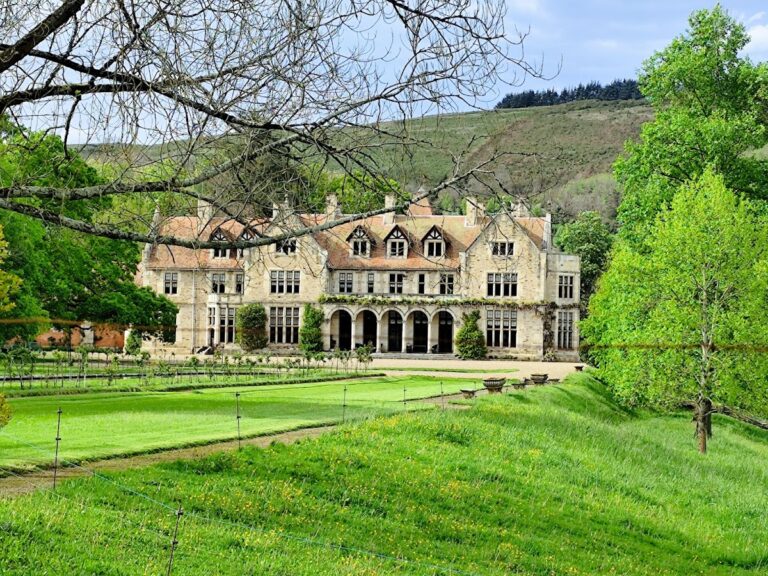
The surviving Sobrellano complex is organized around the rectangular Neo-Gothic palace, its neighboring chapel-pantheon, and the associated park. The palace façade is built from Carrejo stone and includes open galleries framed by trefoil arches and colonnades. Their columns end in finials shaped as fleurs-de-lis, crowns, and winged horses, made by Joan Roig.
Palace interiors
The interior combines carved materials, furnishings, paintings, and stained glass. Furniture by Antoni Gaudí, a Catalan architect and designer associated with Catalan modernisme, occupies the palace, while Eduardo Llorens supplied paintings. American oak and ebony form the floors, and walnut was used for the doors. The central hall, also called the throne room, is the most richly decorated interior, with an elaborate coffered ceiling, gold-leaf wall decoration, and stained glass made in the workshops of Eudaldo Amigó.
Mural cycle
Eduardo Llorens painted the palace’s mural cycle. Its scenes portray the principal events associated with the marquisate of Antonio López y López, giving the interior a visual record of the family’s public associations and the building’s connection with Comillas’s late nineteenth-century history.
Chapel-pantheon
The chapel-pantheon beside the palace follows an English and Central European Perpendicular Gothic design. This late form of English Gothic architecture is characterized by strong vertical lines, large windows, and elaborate tracery. Antoni Gaudí made its furnishings, while modernist sculptures were produced by Joan Roig, Josep Llimona, Venancio Vallmitjana, and Agapito Vallmitjana.
Nearby sites