Zatonie Palace: Baroque Manor and Classical Residence in Poland


Site at a Glance
- Rating
- 4.8
- Popularity
- Medium
- Country
- Poland
- Primary era
- Modern
- Eras represented
- Early Modern, Modern
- Civilizations
- German, Habsburg, Holy Roman Empire
- Site type
- Domestic
- Remains
- Manor House
On this page7 sections
History
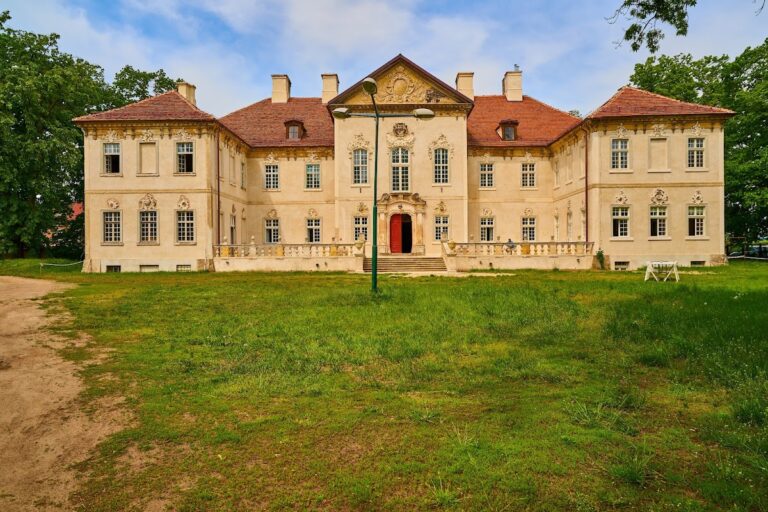
Zatonie Palace is a historic residence in Poland, located in Zielona Góra. Balthazar von Unruh built it in 1689 as a Baroque manor, an early-modern European style known for elaborate ornament and dramatic forms. The estate later became associated with several noble families and underwent major transformation during the nineteenth century.
Estate ownership before 1809
From the sixteenth century until 1809, the estate and palace passed successively through the Kittlitz, Johnston, Prittwitz, Schweinitz, and Friedrich August von Cosel families. In 1809, ownership transferred to the Biron family of Courland. Peter Biron, Duke of Sagan, acquired the property as a dowry for his youngest daughter, Dorothea de Talleyrand-Périgord.
Dorothea de Talleyrand-Périgord and the nineteenth-century rebuilding
Dorothea moved to Zatonie only in the 1840s. Her residence there from 1840 to 1844 marked the most distinguished period in the palace’s history, and King Frederick William IV of Prussia, who ruled from 1840 to 1861, visited the estate with his wife in 1841.
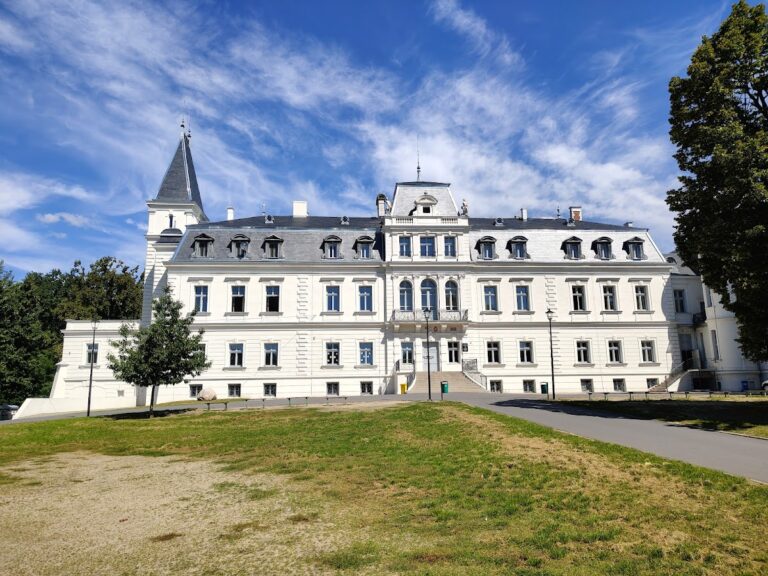
In 1842 and 1843, the palace was rebuilt in the Classical style, a revival of forms derived from ancient Greek and Roman architecture. The redesign is attributed to W. Gurlt, a princely building official from Otyń. After Dorothea died in 1862, the property passed to her younger son, Alexandre Edmond, marquis de Talleyrand-Périgord.
During the early 1870s, Alexandre Edmond ordered further work on the palace and its adjoining orangery. The alterations followed designs by A. Jaekel, and the orangery was rebuilt in a late-Classical form. Karl Rudolf Friedenthal acquired the estate in 1879. After his death, ownership passed to his daughter, Renata von Lancken-Wakenitz.
Destruction and preservation
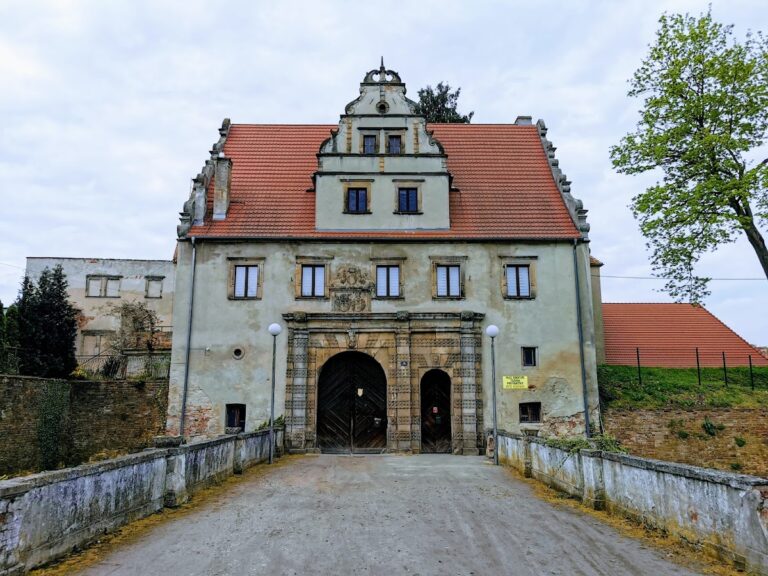
Silesia included Zatonie until 1945, when Soviet troops burned out the palace. The building was not reconstructed, and the orangery also remained in ruins. The palace ruins were secured and opened to visitors in 2018. A later project focused on preserving and using the historic park landscapes of Branitz and Zatonie, while the palace remains protected as a registered monument in Poland.
Remains
Palace building
The palace was a two-storey rectangular building. The rebuilding of 1842 and 1843 added a new section and raised the structure by an additional level or mezzanine. Its flat roof was concealed behind a parapet. At the center of the parapet, a cartouche carried the initials “RF,” referring to Rudolf Friedenthal, together with the coat of arms of his wife, Fanny von Rosenberg, whose design included roses. Four vases decorated the corners. After the 1945 fire, the building survived as a secured ruin rather than a reconstructed residence.
Park, orangery, and grotto
The landscape park was begun during Dorothea’s residence at Zatonie. Its design is probably attributable to Peter Joseph Lenné, a prominent nineteenth-century Prussian landscape designer, although Karl Friedrich Schinkel, a leading Prussian architect and designer, is also associated with changes to the original estate, the greenhouse and orangery, and the creation of the park.
During the nineteenth century, the park extended eastward into woodland. This area was called “Johannen-Wiese” after Dorothea’s sister, Pauline von Sagan. An orangery stood beside the palace and was rebuilt or replaced during the nineteenth-century alterations. It now survives as a ruin alongside the burned palace. A grotto is also situated within the historic park.
Nearby sites