Saint Hedwig Cathedral in Zielona Góra: A Medieval Gothic Co-Cathedral


Site at a Glance
- Rating
- 4.6
- Popularity
- Low
- Country
- Poland
- Primary era
- Medieval
- External website
- Open
- Eras represented
- Medieval, Early Modern, Modern
- Civilizations
- German, Habsburg, Holy Roman Empire, Kingdom of Prussia
- Site type
- Religious
- Remains
- Cathedral
On this page12 sections
History
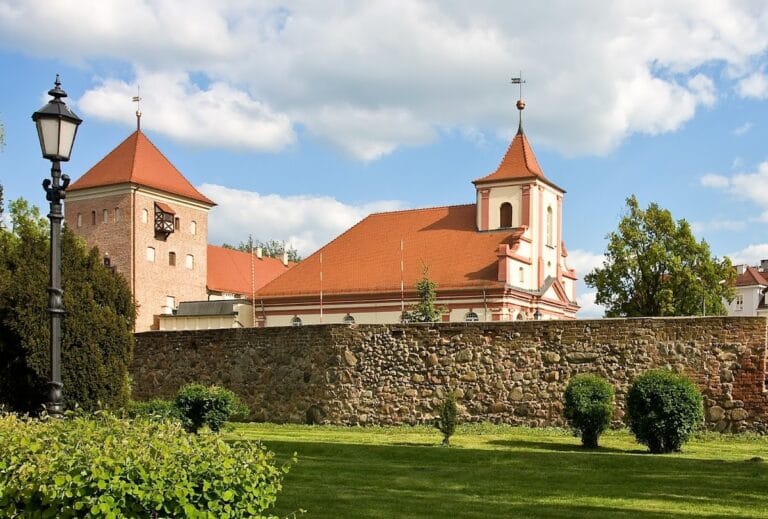
Saint Hedwig Cathedral in Zielona Góra, Poland, is a Gothic brick church founded by the medieval dukes of Głogów between 1272 and 1294. Duke Konrad I of Głogów began the construction and dedicated the church to his grandmother, Saint Hedwig of Silesia, a thirteenth-century Christian duchess canonized in 1267. His son, Henry the Głogowczyk, completed the building, which was consecrated on 3 October 1294. Konrad I was buried inside the church. It is the oldest surviving historic monument in Zielona Góra and was identified as the town’s principal parish church in 1310.
Medieval parish church
The dukes of Głogów and Żagań retained the patronage of the main parish church until 1427. In that year, Duke Henry IX transferred the patronage to the Augustinian canons’ monastery in Żagań. Augustinian canons followed the Rule of Saint Augustine and could serve as parish clergy, linking the church’s administration with a wider religious institution.
A fire destroyed the church in 1419. The brick hall form was constructed or rebuilt after the disaster. In a hall church, the nave and side aisles are of broadly comparable height, creating a unified interior space. This rebuilding established an important phase in the church’s physical development, although later fires and alterations changed its medieval appearance.
Reformation and Catholic restoration
After Paul Lenberg, the last Augustinian parish priest, converted to Lutheranism, the church passed to Protestant use in 1544. The Reformation was the sixteenth-century religious movement that produced Protestant churches. During the Thirty Years’ War, control of the church became contested, as did disputes over the use of the cemetery associated with the Evangelical Church of the Holy Trinity.
The church returned to Catholic use in 1651, three years after the Peace of Westphalia, the series of treaties concluded in 1648 that ended the Thirty Years’ War. Fires had continued to affect the building, occurring in 1582, 1627, and 1651. The 1582 city fire destroyed the vaulting, while the damage of 1651 led to a reconstruction that lasted approximately twenty-five years.
The post-fire reconstruction altered the church’s proportions and appearance. Former Gothic windows were replaced with smaller semicircular openings, the walls were raised, and the single gabled roof that had covered the whole church was replaced by separate roofs over the main nave and side aisles.
Collapse, rebuilding, and modern ecclesiastical history
In 1776, the long-cracked tower collapsed. Its fall brought down parts of the chancel and the north aisle walls, as well as sections of the vaults. Rebuilding was completed in 1780 and produced the church’s present overall form. The tower was reconstructed in a Classical style in 1832.
From 3 to 5 May 1952, Stefan Wyszyński, Archbishop and Primate of Poland, stayed in Zielona Góra and administered the sacrament of confirmation in the church. The building entered monument protection on 31 January 1952.
In 1992, Pope John Paul II reorganized the Zielona Góra–Gorzów diocese, moved its seat from Gorzów Wielkopolski to Zielona Góra, and raised the former parish church of Saint Hedwig to co-cathedral status on 7 June. A co-cathedral shares cathedral status within a diocese with another cathedral. The first episcopal ingress in the history of the Zielona Góra co-cathedral followed on 12 September 1993, when Bishop Adam Dyczkowski assumed office. The Zielona Góra Collegiate Chapter of Saint Hedwig was established at the co-cathedral that same year.
Later religious and commemorative changes continued to shape the church. Bishop Stefan Regmunt blessed the bronze main entrance doors in 2012. The restored Gethsemane Chapel was blessed in 2014; from 1968 to 2008, it had served as a place of prayer for the local Greek Catholic community. On 16 October 2017, during commemorations of the 750th anniversary of Saint Hedwig of Silesia’s canonization, Bishop Tadeusz Lityński blessed a statue of the saint beside the co-cathedral. On 13 August 2022, Adrian Put, parish priest of the co-cathedral parish, received episcopal ordination there, marking the first episcopal consecration held in Zielona Góra.
Remains
Gothic plan and surviving fabric
Saint Hedwig Cathedral is a three-aisled Gothic brick hall church with a polygonally closed chancel, a tower placed to the side, and an adjoining sacristy. Its interior contains groin vaults, while the side aisles have stellar vaults. Surviving Gothic elements include the elevations, buttresses, south portal, pointed-arch windows, arcades between the aisles, the chancel arch, and several internal portals.
The building’s roof reflects the reconstruction after the eighteenth-century tower collapse and earlier fires. Its low, divided form differs from the earlier arrangement and disrupts the proportions of the medieval church. The present tower is a four-storey Classical structure topped by a terrace and dome, with an upper octagonal stage dating from 1832.
Interior furnishings and devotional features
Main altar and liturgical furnishings
The main altar is a triptych depicting the mysteries of the Rosary and was consecrated in 1978. The church also contains predominantly Neo-Gothic altars, Late Gothic sculptures of Saint Hedwig and Saint Anne, and numerous epitaphs. Baroque and Renaissance tomb slabs survive inside and outside the building, while relics of Saint Hedwig of Silesia are associated with the church.
Gethsemane Chapel
The Gethsemane Chapel preserves fragments of wall frescoes showing scenes from Gethsemane. The fragments were uncovered on the chapel walls during restoration and displayed after the chapel’s 2014 consecration.
Olive Chapel and wall painting
A Renaissance wrought-iron grille marks the entrance to the Olive Chapel. In the south aisle, a sixteenth-century wall painting depicts the Church of the Holy Sepulchre in Jerusalem.
Organ
The church’s organ was built in 1912 by Schlag & Söhne and is housed in a Baroque case. It has 30 stops, two manuals, and pedals. Its controls include couplers for II/I, I/P, and II/P, a super-octave coupler for II/I, and settings for tutti, crescendo, manual-II release, register cancellation, and tremulant.
Monuments beside the church
A statue of Saint John of Nepomuk stands beside the south side of the co-cathedral and is regarded as the oldest monument in Zielona Góra. Saint John of Nepomuk was a fourteenth-century Bohemian priest and martyr who became a widely venerated Catholic saint, particularly associated with confession and bridges. The statue of Saint Hedwig erected beside the church in 2017 commemorates the cathedral’s patron saint.