Château des Arcis: A Historic Noble Residence in France


Site at a Glance
- Rating
- 4.8
- Popularity
- Very Low
- Country
- France
- Primary era
- Early Modern
- External website
- Open
- Eras represented
- Medieval, Early Modern, Modern
- Civilizations
- French
- Site type
- Domestic
- Remains
- Castle
On this page12 sections
History
Château des Arcis is a historic noble residence in France, located at Les Arcis in the commune of Meslay-du-Maine, in the Mayenne department. Mentioned from the fourteenth century, it developed as a landed estate whose ownership was shaped by inheritance, marriage, and successive transfers between noble families.
From the Nepveu inheritance to the Cervon family
In 1363, Robert Le Vexel, who also held La Rochère and the Tertre de Vimarcé, assigned Les Arcis as part of the inheritance of his elder sister Perronnelle Le Vexel. She was married to Macé Courtin, lord of Soulgé-le-Courtin. Their daughter, Marguerite Courtin, married Jean Nepveu, lord of Clavières, Rochefaiteau, Bois-Rousseau, and Beauvais, who also held Les Arcis.
Jean Nepveu was heir to Les Arcis around 1391. Through his daughter Marie Nepveu and her marriage to Guillaume de Cervon, the estate entered the Cervon family. That family retained it for several centuries, making Les Arcis the centre of a durable aristocratic lineage.
Within the Cervon family, Hector de Cervon transferred Les Arcis to Guyon de Cervon. Guyon married Françoise des Écotais on 13 April 1501, and their son Simon de Cervon inherited the estate. Simon also enlarged his landed interests through his marriage to Françoise de Bouillé.
The Cervon barony
After François de Cervon died around 1565, Charles de Cervon inherited the family property and became its most prominent and wealthiest representative. He died on 18 July 1622. His period of ownership was closely connected with the religious and architectural development of Les Arcis.
Charles’s elder son, René de Cervon, had Les Arcis raised to a barony by an act of 16 July 1629. A barony was a noble territorial jurisdiction held by a baron, and the change gave the estate a higher institutional status within the Cervon holdings. René expanded it through the acquisition of La Cropte and La Rochère and through his marriage to Catherine de Vauclin, which brought him the Taillis estate near Vitré. He died on 3 January 1635.
Urbain de Cervon, René’s principal heir and an ordinary gentleman of the king’s chamber, brought his newly married wife, Charlotte Harel, to Les Arcis on 21 February 1637. A gentleman of the king’s chamber held an office within the royal household. Charlotte later remarried and died at Les Arcis; she was buried in the chapel on 29 January 1701.
Other members of the family held influential positions. Joseph de Cervon was a councillor at the Parliament of Rennes, the sovereign judicial court of the ancien régime, and married Claude de Vollant and later Françoise-Thérèse de Champion. On 9 July 1662, he married Catherine Moysan, the widow of another councillor of that court.
Catherine de Cervon, widow of Pierre de la Dufferie, married Jean-Baptiste de Montesson on 25 October 1685. Their son, Jean-Baptiste de Montesson, lord of Les Arcis, died in Paris in 1769. He was buried in the Saint Sebastian Chapel on 8 August, following a solemn service at the parish church of Saint Peter in Meslay-du-Maine.
Religious foundations and the Saint Sebastian chapel
A religious benefice was founded on 1 March 1412 by Jean Nepveu in the church of Meslay, where his father was buried. A benefice was an endowed ecclesiastical foundation supported by assigned revenues. This foundation provided three masses each week and a rent of 10 livres, charged to properties at Les Pins de Saint-Pierre-sur-Erve and La Réhorie in Saulges.
The bishop of Le Mans, Adam Châtelain, confirmed the foundation on 26 July 1413. Simon de Cervon and Françoise de Bouillé enlarged the chaplaincy on 28 October 1557 by adding two weekly masses.
Charles de Cervon later built a chapel north of the château and transferred to it the services previously celebrated at the Saint Sebastian altar of the parish church. Pope Paul V, who occupied the papal office from 1605 to 1621, granted a plenary indulgence to visitors on the feast of Saint Sebastian in a bull dated 2 June 1612. A plenary indulgence was a formal remission of the temporal penalties associated with sin under specified religious conditions.
Charles de Beaumanoir solemnly consecrated the chapel on 25 September 1615 in the presence of local nobility and a large crowd. He also administered confirmation there. The family vault stood at the entrance to the sanctuary, the area around the chapel’s altar.
Transfers after the Cervons
After the last representative of the senior Montesson line died, Les Arcis was sold for the first time rather than passing by inheritance. It went to Joseph Duchemin, a banker from Laval, who had married Jacquine-Renée Coustard.
Marcel Avril de Pignerolle became lord of Les Arcis through his marriage to Jacquine-Anne Duchemin. In 1775, he acquired the estate jointly with Joseph Rousseau de Monfrand, the husband of Marie Duchemin de la Jarossaie. When seizure of the estate was threatened in March 1793, Madame Duchemin de la Jarossaie argued that it was her separate property under a partition agreement dated 16 May 1773. The estate was preserved and returned to the Pignerolle family.
Arsène Avril de Pignerolles died at Château des Arcis in 1815. His descendants included Arsène II Marie Avril de Pignerolle, a politician, and Charles Marcel Avril de Pignerolles, a neo-Classical painter. At the end of the nineteenth century, the estate entered the Raguenet de Saint-Albin family, which retained it until 2003. It subsequently passed to new owners.
Nineteenth-century alterations were carried out for M. Raguenet de Saint-Albin under the direction of Louis Garnier. The château has been registered as a historic monument since 28 February 2006, a form of French heritage protection that recognizes historical or architectural importance and places the building under statutory oversight. A registration order dated 24 April 2025 replaced the earlier order.
Remains
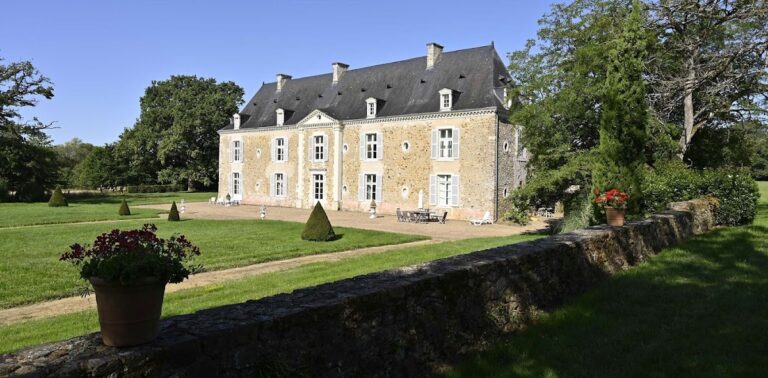
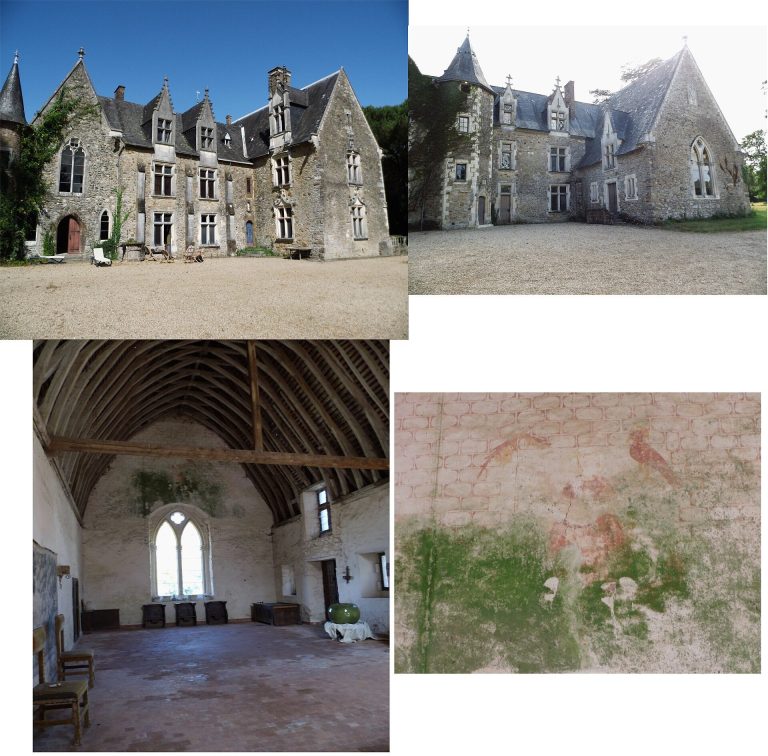
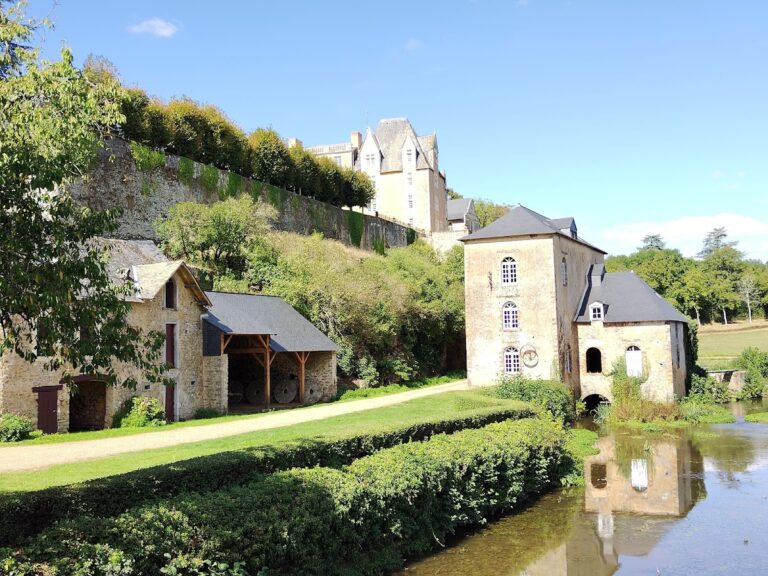
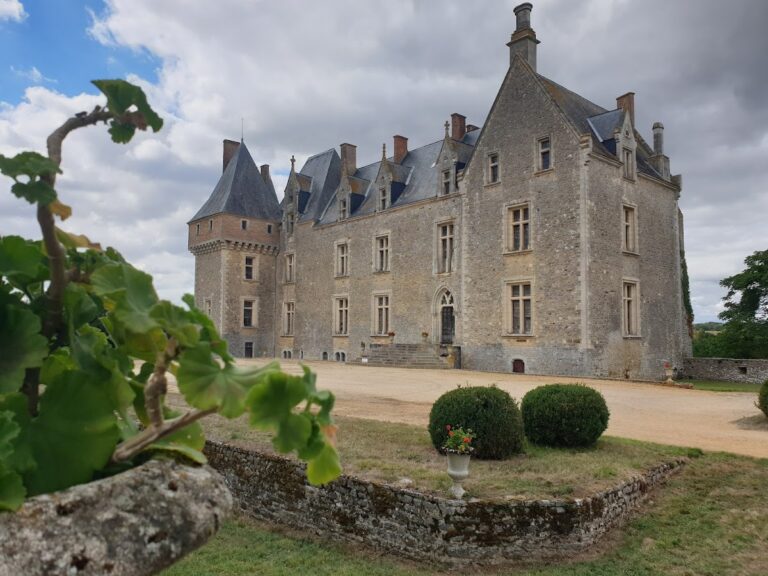
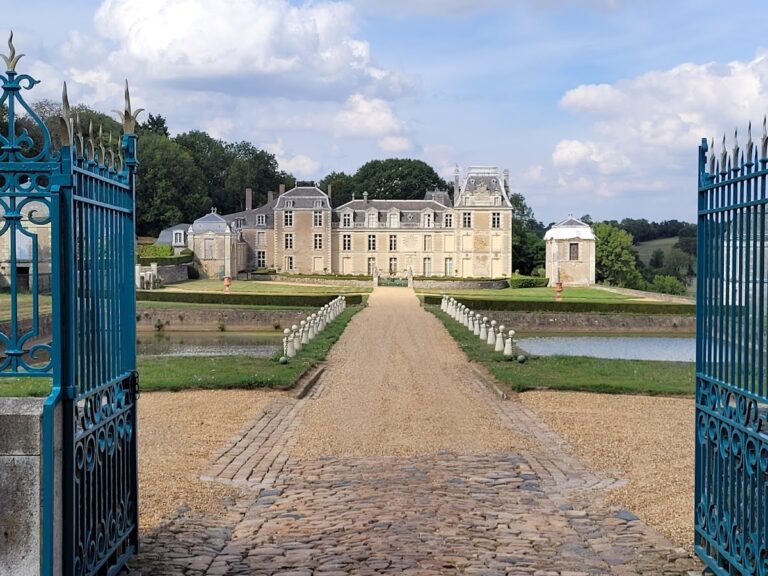
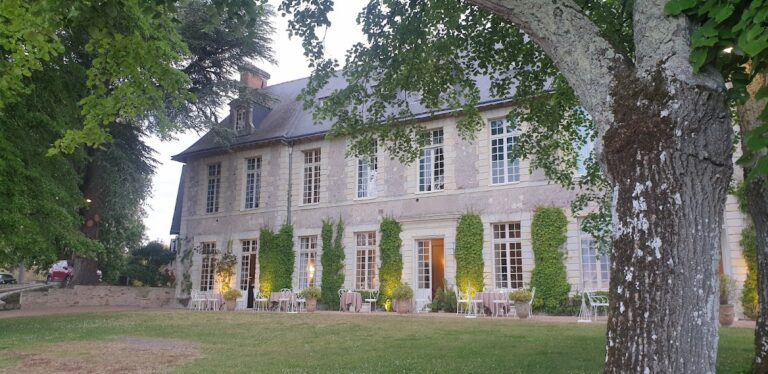
Château des Arcis is arranged around a large courtyard, with the principal residence along the rear and ancillary buildings extending along the left side. Broad, deep moats surround the ensemble and are fed by the Laurière and Arsis streams. The garden-facing façade is imposing, while the surviving buildings combine the medieval and early modern fabric of the residence with later alterations.
Courtyard and residential buildings
Entrance pavilion
An isolated pavilion controls the entrance to the courtyard. It dates from either the fifteenth or sixteenth century, and its ground floor contains a room with a ribbed vault, a ceiling formed by intersecting stone ribs. During the nineteenth century, this room was converted into a domestic chapel. The pavilion is flanked by a tower with a curved, ogee-like roof.
Principal building and service range
The pavilion or keep and the large building containing the carriage sheds and stables date from the period of Charles de Cervon. They retain almost intact the form of the former château of Les Arcis. Part of a turret with cut sides remains embedded in the building between the kitchen and dining room.
For M. Raguenet de Saint-Albin, Louis Garnier directed the construction of a pavilion in the angle formed by the two residential wings. Work at the end of the nineteenth century also revealed the foundations of exterior towers that had been destroyed. These foundations remain visible at the bottom of the moats.
Chapel, avenues, and woodwork
Saint Sebastian chapel
In the early seventeenth century, Charles de Cervon laid out several tree-lined avenues in the grounds. At the end of one avenue toward Meslay, he built the Saint Sebastian Chapel north of the château. The chapel contained three altars dedicated to Saint Sebastian, Our Lady, and the Holy Cross.
Its furnishings and religious associations reflected the family’s patronage. Charles de Cervon enriched the chapel with relics of Saint Sebastian, Saint Émérance, Saint Lawrence, and Saint Aignan. He obtained them through his relative and friend Dom Jean Girard, a monk who served as claustral prior of the abbey of Saint-Calais and parish priest of Notre-Dame in that town. The chapel also contained the family burial vault at the entrance to its sanctuary.
Present chapel woodwork
The present chapel contains notable sixteenth-century woodwork traditionally said to have come from the church of Préaux. This surviving material forms part of the chapel’s later physical and decorative history, alongside the religious foundation established by the Cervon family.