Varennes-l’Enfant Castle: Medieval Lordship and Modern Château in France


Site at a Glance
- Rating
- 4.2
- Popularity
- Very Low
- Country
- France
- Primary era
- Modern
- Eras represented
- Medieval, Early Modern, Modern
- Civilizations
- French
- Site type
- Domestic
- Remains
- Castle
On this page13 sections
History
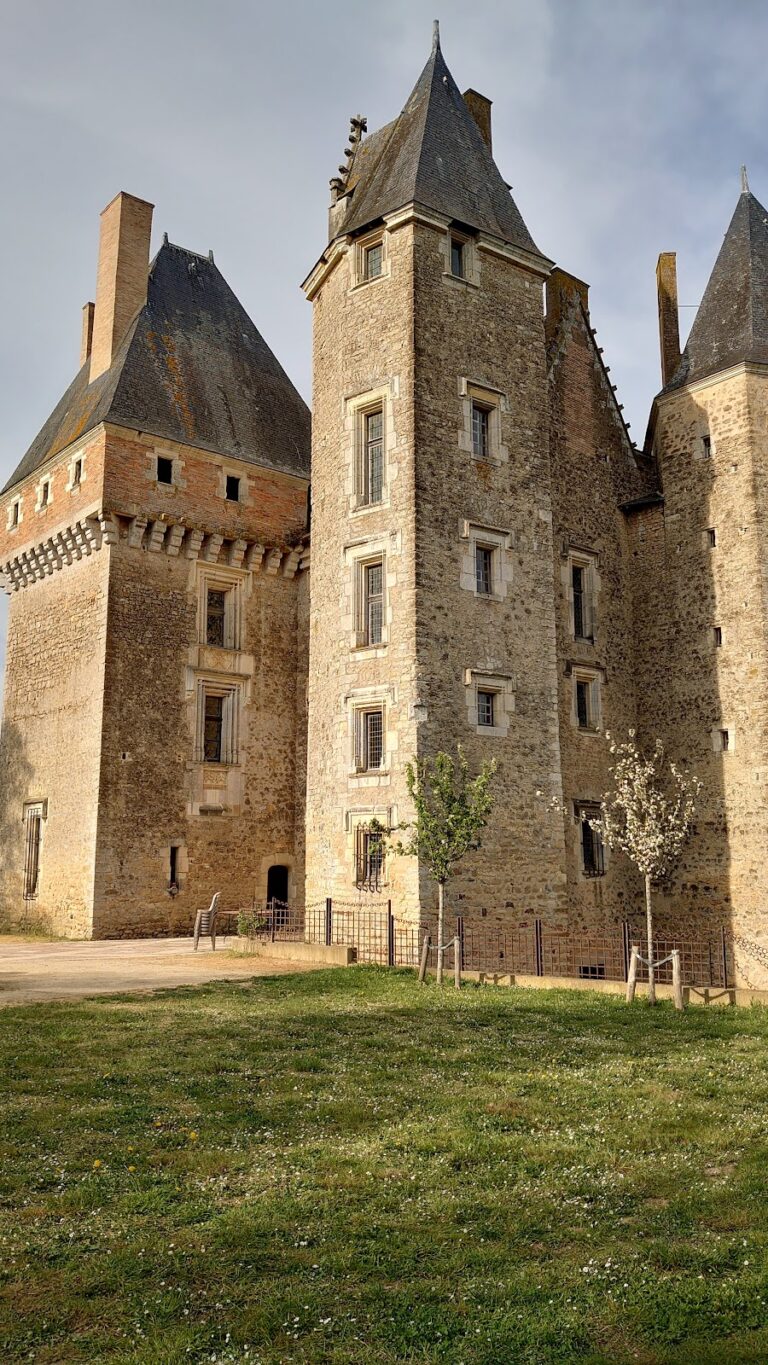
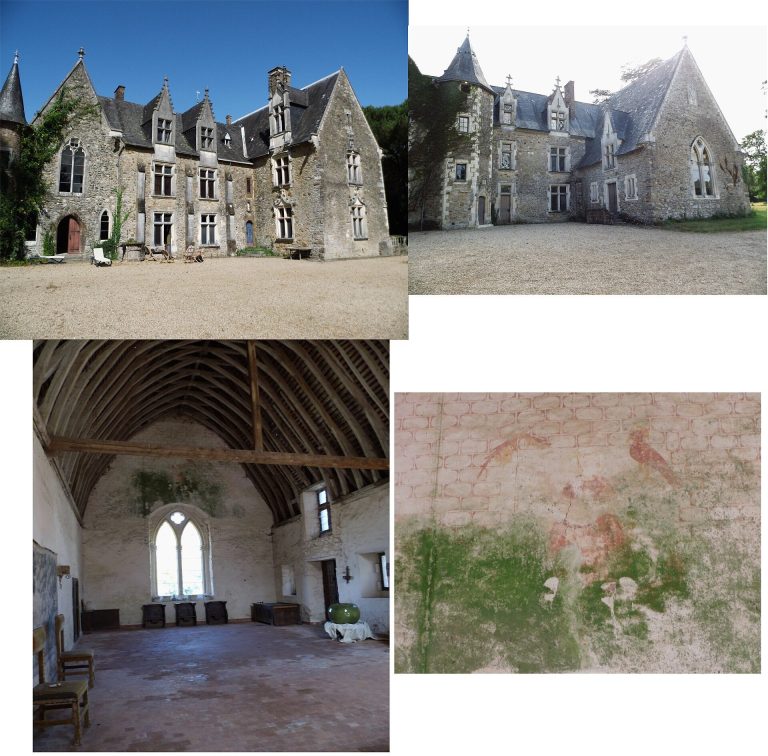
Varennes-l’Enfant Castle is a historic castle in France, situated at Épineux-le-Seguin in the Mayenne department, about 2.5 kilometres from the village. Its history reaches back to a medieval lodging and lordship, while the present château was built from the 1850s on the foundations of the earlier castle in an antique style with military architectural character.
Medieval lordship
Foulques L’Enfant founded the Varennes priory in 1207 and rendered homage to the Bishop of Le Mans in 1226. Varennes was then a châtellenie, a lordship organized around a castle and administered by its lord. Through the barony of Touvoie, it remained a vassal of the Bishop of Le Mans from the thirteenth to the sixteenth century. The lord owed fifteen days of military service at his own expense and a further eight days funded by the bishop when entering the diocese, while the bishop owed protection in return.
A charter of 1226 names among Varennes’s vassals the lords of La Motte, Chantepie, La Macheferrière, Martigné at Avessé, La Glacerie, and Souligné, along with Juhel de Tillie and Guillaume d’Epaulfort. The châtellenie of Poillé was joined to Varennes at the beginning of the fourteenth century. The L’Enfant family continued to hold the lordship, including Séguin L’Enfant, who made a feudal declaration for the estate in 1403, and Hardouin L’Enfant, who described the castle and its domain in 1487.
From châtellenie to barony
Varennes appears in successive descriptions as a lodging in 1403, the castle of Varennes in 1474, and the châtellenie of Varennes in 1539. Around 1570, François de la Chapelle-Troussière caused it to be raised to a barony, a higher-ranking feudal lordship. The change placed the lord’s homage under the Count of Maine rather than the Bishop of Le Mans. François also rebuilt or enlarged the castle.
During the closing phase of the Wars of Religion, the sixteenth-century conflicts between Catholics and Protestants in France, Georges Le Clerc attacked François de la Chapelle-Troussière at Varennes. François escaped, but his wife and children were captured and ransomed. The castle was devastated in the assault.
Later lords and revolutionary upheaval
The succession of lords passed from the L’Enfant family to Jean, Antoine, François, and Philbert de la Chapelle-Troussière, then to Claude and Henri-Charles de Beaumanoir, and later to the La Châtre family. Claude de Beaumanoir married Renée de la Chapelle-Troussière in 1615. His estate and castle were seized by creditors after his mother’s death. Claude died in 1676, and his daughter Marie-Claude de Beaumanoir became his principal heir, although she did not become lady of Varennes. Henri-Charles de Beaumanoir, Marquis of Lavardin, held the barony until his death in 1701.
Louis-Charles de La Châtre-Nançay inherited the estate through the La Châtre succession and was killed at the Battle of San Pietro in 1734. In 1775, Charles-Louis de La Châtre gave Varennes and its dependencies to his son Claude-Louis. Claude-Louis and his wife, Charlotte-Louise-Aglaé Bontemps, had their names engraved on a bell at Épineu in 1780. They divorced in January 1793, and Charlotte-Louise-Aglaé married the Marquis of Jaucourt on 9 January 1799.
The castle was confiscated and sold as national property, the revolutionary-era sale of property taken from the Church, the Crown, or émigrés. René-Étienne Perrier bought it for 44,800 livres and occupied it in 1818. The former owner, then a minister of state, bought it back in 1820 for 100,000 francs in the name of Louis-Joachim du Boisjourdan. Du Boisjourdan sold it two years later to Étienne-Louis Le Monnier de Lorière, who created the modern château.
The estate also figured in violence during the revolutionary period and its aftermath. On 17 March 1796, a fierce combat took place in the village between the company of Jean-Daniel Œhlert and that of Marin-Pierre Gaullier. In 1820, a coal mine and lime kiln near the mill belonged to the estate. About 200 insurgents, some of whom may have taken part in the affair at Chasnay, were surprised there by two detachments, and several were killed.
The modern château
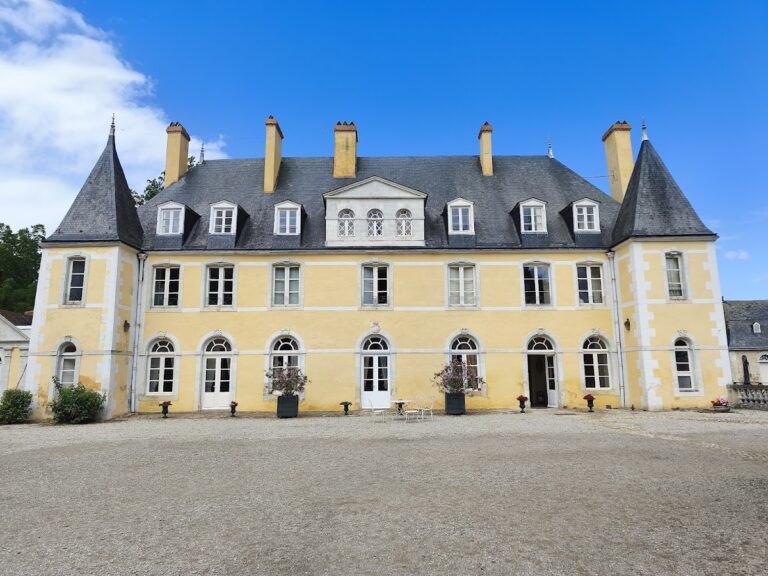
From the 1850s, the Albaret family built a modern château over the foundations of the earlier castle. The new residence adopted an antique style while retaining a military architectural character, linking the later house physically to the medieval site.
Remains
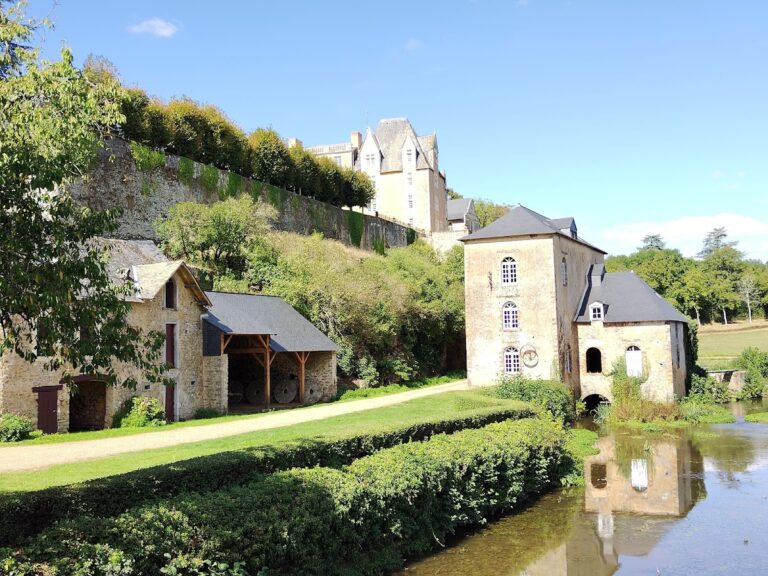
The surviving complex brings together the foundations of the earlier castle, the later residence, associated religious buildings, and the landscape of the former domain. The medieval site occupied a built area beside the Trulon River, with defensive ditches and water-related features forming part of a larger estate of cultivated ground, meadows, woodland, gardens, orchards, and mills.
Castle complex and domain
Earlier castle
In the thirteenth century, Varennes consisted of a lodging and its associated domain on a built site. Hardouin L’Enfant’s 1487 description included the castle, the châtellenie, and the lodging of Varennes, together with moats, ditches, gardens, orchards, mills, a pond, a fishery, and the river. These elements covered six journaux, an old French measure based generally on a day’s work of land, with its exact size varying by locality.
By 1688, several irregular buildings enclosed a courtyard. The entrance on the south side had a drawbridge and a plank, while dry ditches protected the site. A large vaulted staircase had angled sections, and the complex included a court for jeu de longue paume, a traditional long-court ball game. A small chapel stood within the castle grounds, with part of its roof collapsed by that date.
Estate landscape
The medieval domain included cultivated land, meadows, woodland, hedges, rabbit enclosures, pasture, the Trulon River, and a pond. It also contained a second lodging at Épineu, a compulsory-use oven and wine press, vineyards, fisheries, mills, warrens, and the lord’s parish rights. In 1530, the estate included a mill on the Trulon, the farmsteads of La Cour, La Perrière, and Les Granges, the La Morinière estate, and the Bois d’Épineu woodland, measured at one hundred journaux. A Saint-Martin estate appears in the 1403 description.
Modern château
The modern château occupies the foundations of the earlier castle. One room preserves a monumental ancient wood-panelled feature around a fireplace, restored with care. Its exposed joisted ceilings and visible parquet flooring retain elements of the interior character of the later residence.
Religious buildings and tombs
Priory chapel
The priory chapel contains the tombs of the lords of Varennes, beginning with Foulques L’Enfant, who died in 1362. Tombs attributed to periods before the seventeenth century were made retrospectively, and their epitaphs contain errors. A more substantial monument commemorates Claude de Beaumanoir and his wife. It stands on four columns and bears black-marble coats of arms, with their deaths given as 6 February 1654 and 27 March 1672.
Hermitage of Saint-Philbert
On a rocky point beside the river stood the Hermitage of Saint-Philbert. It comprised a small chapel, a heated room, an upper granary, and an adjoining oven. The hermitage was probably associated with Philbert de la Chapelle. Another chapel stood farther away in the village, separate from the chapel within the castle complex.