Château d’Issou: A Classical Estate in France


Site at a Glance
- Rating
- 4.3
- Popularity
- Low
- Country
- France
- Primary era
- Early Modern
- External website
- Open
- Eras represented
- Medieval, Early Modern, Modern
- Civilizations
- French
- Site type
- Domestic
- Remains
- Elite Residence
On this page9 sections
History
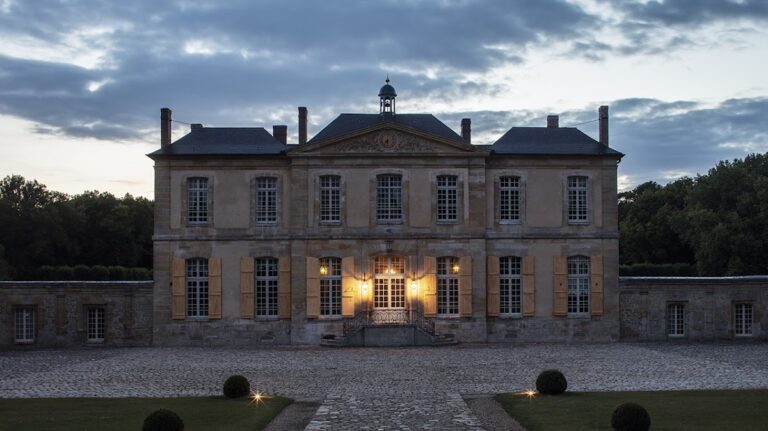
Château d’Issou is a historic estate in Issou, France, whose present classical château was built in the eighteenth century on a site occupied by a medieval castle. A castle stood here by about 1399, followed by a sixteenth-century feudal manor. The estate later became an aristocratic residence associated with court society and remained in private ownership until the twentieth century.
The medieval fief and the De Dampont family
Between the fifteenth and seventeenth centuries, the fief of Issou belonged to the De Dampont family. A fief was a feudal estate held under obligations to a superior lord, while a seigneur was the lord who exercised authority over it. One member of the family served as governor of Pontoise in 1612.
In 1665, Nicolas de Dampont, the last descendant of his line and without an heir, sold the lands and manor to his son-in-law, Charles de Gaillarbois, seigneur of Marcouville. The fief passed in 1720 to François-Gédéon de Giffart, seigneur of Hanneucourt and Gargenville, for 160,000 livres. He sold it for 70,000 livres to Pierre-François de Seré de Rieux, a lieutenant in the French Guards, through an act dated 3 August 1724. The French Guards were an elite infantry regiment of the French monarchy.
The eighteenth-century château
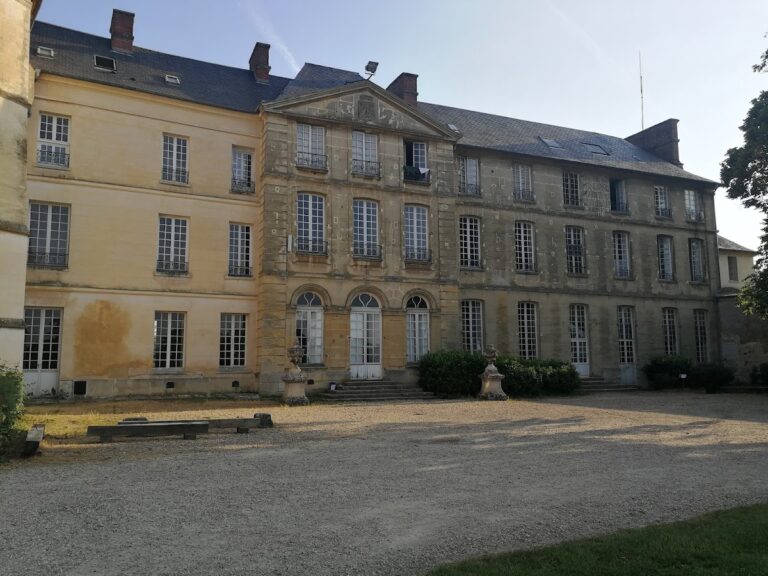
Shortly after his marriage, Pierre-François de Seré de Rieux ordered the present château in the classical style of the period. Jean-Baptiste Leroux, an architect known for hôtels de plaisance, may have designed it. Such residences were intended chiefly for leisure and display rather than military defense. Seré de Rieux sold the newly completed château in 1728 to François-Nicolas Fillion de Villemur, receiver-general of the finances of Paris.
The property was resold in 1743 to Claude Pierre, marquis de Sabrevois, and acquired in 1751 by the duke of Bouillon, who lived at Château de Montalet in the same commune. Charles-Godefroy de la Tour d’Auvergne, grand chamberlain of King Louis XV, made Issou a residence appreciated by various ambassadors and by Madame de Pompadour. A grand chamberlain was a senior officer of the royal household. Madame de Pompadour, born Jeanne Antoinette Poisson, was a prominent companion and patron of the arts at Louis XV’s court. In 1739, the wife of the French ambassador to the Swedish court called the place “the most beautiful place in the world.”
In 1764, the château was sold to the marquis de Mathan, a captain in the French Guards. He retained it until his death in 1790. Because he had no direct heir, the estate then passed through five successive owners before being purchased in 1850 by Boreel de Mauregnault, chamberlain to the king of the Netherlands.
Nineteenth- and twentieth-century ownership
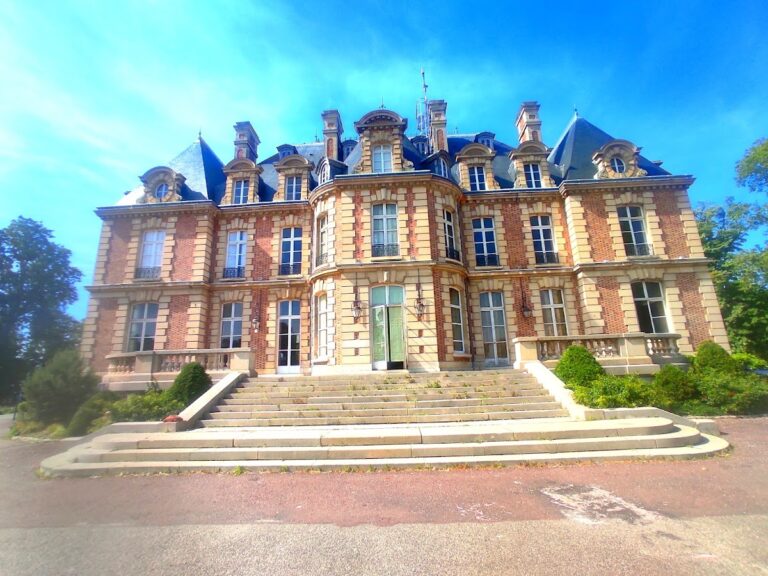
The château was enlarged in 1857 and given two pavilions. It was put up for auction in 1865, and Gaston-Marcellin Dejean, Vicomte de Jean, eventually bought it for 227,000 francs in 1873. He served as mayor of Issou from 1884 to 1892.
After the Vicomte de Jean’s death, Mr and Mrs Chaperon acquired the château in 1903 and completely renovated it in an eighteenth-century style. Paul Chaperon installed electricity and created a chemistry-and-photography workshop using Georges Balagny’s newly developed film process. In 1904, Mrs Chaperon acquired the last lot of orange trees from the Hôtel Héron de Moulins. Their considerable size and weight made them prominent features in photographs of the château from that period.
German troops requisitioned the château during the Second World War. It remained the property of the Chaperon couple until Marie Chaperon, née Thonier-la-Rochelle, died in 1976 and donated it to an association. The commune of Issou subsequently acquired the property definitively. The château has been abandoned since 1976 because of insufficient financial resources.
Protection and conservation
The park has been listed by the Yvelines department since 1974 and covers eleven hectares. In 2018, the château was among 269 sites selected to receive proceeds from France’s heritage lottery. This support enabled the installation of a waterproof tarpaulin and protection for the openings. In 2020, the Association of Friends of Château d’Issou considered the building to have been removed from immediate danger. The château is now owned by the commune of Issou.
Tradition associates the round dovecote with Madame de Pompadour’s motto, “Horas Non Numero Nisi Serenas,” meaning “I count only the serene hours.” That attribution is legendary. Another disputed tradition claims that the château was given in 1903 by its last owner as a wedding present to his young wife.
Remains
The estate combines an eighteenth-century classical château with surviving elements connected to the earlier castle and manor, two later pavilions, and an eleven-hectare park. The building was enlarged in 1857 and renovated in 1903 in an eighteenth-century style. Its present condition is very poor: all floors have collapsed, the roof leaks, the facades are cracked, and all windows are broken.
The classical château
The main building dates from the eighteenth century, probably beginning after Pierre-François de Seré de Rieux acquired the estate in 1724 and reaching completion by 1728. Its classical design belongs to the period’s aristocratic residential architecture. The 1857 enlargement added two pavilions, while the 1903 renovation reworked the building in an eighteenth-century style.
Earlier structures
The earlier castle and sixteenth-century manor are represented by a square tower and a round dovecote. A dovecote housed pigeons and could also indicate the status of a seigneurial estate. The round structure traditionally carries, or is said to have carried, the motto associated with Madame de Pompadour, although the attribution remains contested.
Park and modern equipment
The château’s associated park covers eleven hectares and forms part of the estate’s surviving landscape. The early twentieth-century electrical installation and Paul Chaperon’s chemistry-and-photography workshop formed part of the building’s modern technical and functional equipment. The large orange trees acquired by Mrs Chaperon in 1904 also became recognizable elements in photographs of the property from that period.
Nearby sites