Château de Montjoye: A Historic Château and Estate in France

Site at a Glance
- Rating
- 3.6
- Popularity
- Very Low
- Country
- France
- Primary era
- Modern
- Eras represented
- Modern
- Civilizations
- French
- Site type
- Domestic
- Remains
- Elite Residence
On this page8 sections
History
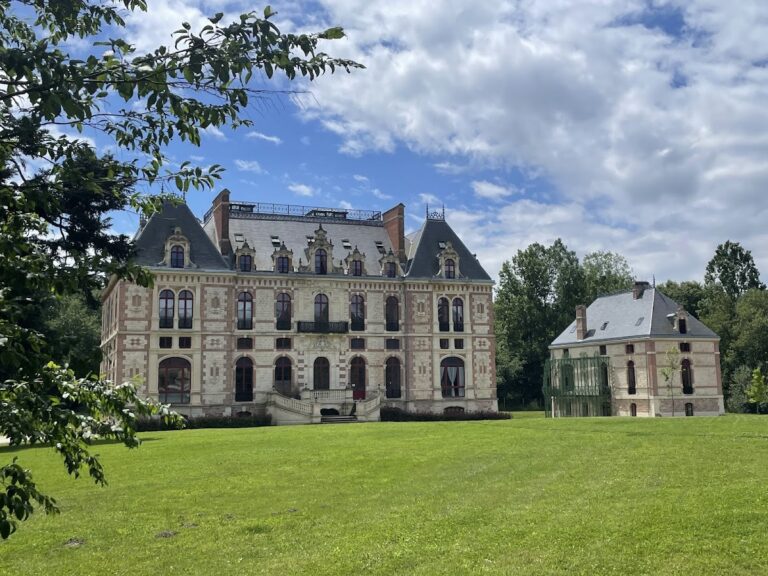
Château de Montjoye is a nineteenth-century château in France, located at Clairefontaine-en-Yvelines near Rambouillet in the southern Yvelines. It grew from a hunting pavilion built around 1830–1840 and was enlarged by successive owners until it became a substantial country estate.
From hunting pavilion to château
The first building on the site was a modest hunting pavilion commissioned by the daughter of Madame Groscot de la Chapelle. It was associated with the nickname “Mon Jouet.” As later owners extended the pavilion, the property gave its name to the locality, which was subsequently called Montjoye and, at the beginning of the French Third Republic, was sometimes written Montjoie. The name also appeared in population-census registers.
Charles Loreau and his wife, Louise Drollon, took possession of Montjoye in 1876. In 1890, the estate passed to Baron João Ferreira Dos Santos Silva de Santos and his wife, Henriette Julie Cornélia Landau. Their ownership is associated with the first construction of the château as it developed beyond the original pavilion.
The Standish estate
Lord Henry Noailles Widdrington Standish and his wife, Hélène Aldegonde Marie de Pérusse des Cars, purchased the château on 27 and 31 July 1894 for 200,000 francs. Hélène Standish financed the purchase from her dowry. In 1899, she enlarged the property by acquiring a building from the La Voisine estate.
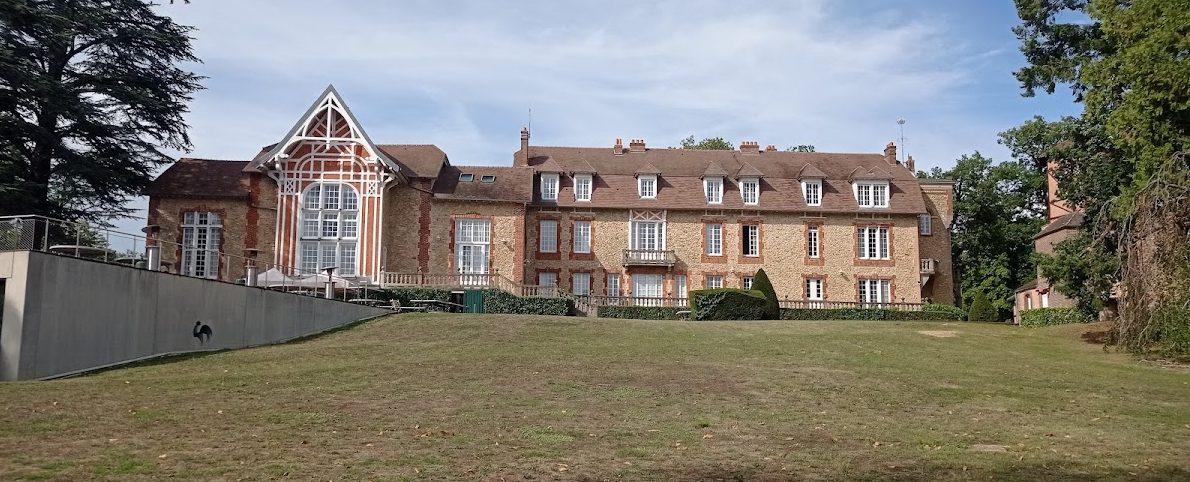
Henry Standish later undertook major works at Montjoye, including the transformation of the southern facade in 1908. The work gave this side of the residence a British character through a large bay window and painted woodwork. Standish was also a major benefactor of the new church at Clairefontaine.
During the couple’s absences, three families served and lived at the estate. Henri Chauvin was the gamekeeper, Claude Moufflet the concierge, and Alphonse Désquilbé the gardener. During the First World War, a conflict fought from 1914 to 1918, Henry and Hélène Standish helped care for French and British wounded arriving in Rambouillet. They paid for convalescents to stay at Montjoye between 1914 and 1918.
The Lazard period
The 39-hectare estate was put up for sale in June 1920, with the purchaser required to take over an adjoining farm. André Lazard bought the château, park, and surrounding woodland at auction on 29 June 1920 for 1,100,000 francs. In September of that year, he expanded the holding by purchasing the four-hectare Le Rosier Clair farm.
Lazard used Montjoye chiefly as a hunting estate. He developed the gardens, established stables and a pheasant-breeding operation, and commissioned an orchid greenhouse. To meet the estate’s growing demand for electricity, he installed a generating plant. Montjoye continued to use direct current until it was connected to the public electricity network in 1958.
Later ownership and national football centre
After Lazard died in 1931, the estate was jointly held by his daughters, Simone and Marie-Louise Lazard, and his widow, Georgette Alice Bertier, until 1938. Bertier then owned it alone until her death in 1971. Her daughters, Alice and Louise Giusti, inherited the property and held it from 1971 to 1981. Their children became its owners until 1983.
On 19 December 1983, the Fédération française de football acquired the entire Montjoye property. France’s national governing body for association football then made the estate the Centre technique national Fernand-Sastre, the federation’s national football centre.
Remains
Château de Montjoye occupies the crest on the northern side of the valley, in a position dominant over the commune of Clairefontaine. The present residence reflects its gradual development from a modest hunting pavilion through successive enlargements. Its grounds include the château, a park, surrounding woodland, developed gardens, and associated estate buildings.
The residence
The southern facade retains the character introduced by Henry Standish’s 1908 alteration. A large bay window and painted woodwork form the principal features of its British-style treatment. An eastern extension contains a stone staircase serving the upper floors. This extension uses millstone masonry, made from rough, hard siliceous stone commonly used in buildings in the Paris region, while the other staircases are wooden.
The interior included decorated salons. One salon and its continuation contained numerous paintings, forming part of the château’s furnished domestic spaces.
Park and estate features
The park contains a semicircular-headed portal reassembled in 1914 from the former abbey church of Notre-Dame-de-Clairefontaine. The estate also comprised stables, a pheasant-breeding facility, and an orchid greenhouse, alongside its gardens, woodland, and adjoining farm. Part of the domestic staff lived at the nearby Bruyères property.
Nearby sites