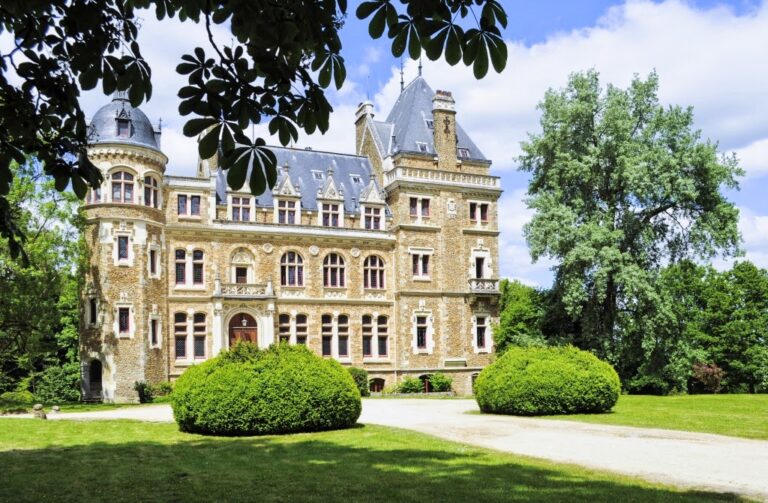
Château de La Celle-les-Bordes: A Louis XIII-Style Residence in France


Site at a Glance
- Rating
- 4.4
- Popularity
- Very Low
- Country
- France
- Primary era
- Early Modern
- External website
- Open
- Eras represented
- Early Modern, Modern
- Civilizations
- French
- Site type
- Domestic
- Remains
- Elite Residence
On this page11 sections
History
Château de La Celle-les-Bordes is a historic residence in France, commissioned between 1610 and 1614 in the Louis XIII style, an early seventeenth-century French form associated with brick, stone, slate, and varied rooflines. Its history reaches back to 1363, when Pierre de Harville acquired the fief of La Celle, a landed estate held within the feudal system. By then, nothing remained of the monastery founded by Saint Germain, a Christian saint and bishop venerated in France. The estate stayed with the Harville family for more than three centuries.
The Harville estate
Claude de Harville, Lord of Palaiseau and Champlan, inherited the fief and commissioned the present château during the reign of Henry IV. The king, who ruled France from 1589 to 1610, protected Claude de Harville and appointed him State Councillor, a senior royal adviser, and Vice-Admiral of France, a high naval office. The principal building belongs to this early seventeenth-century phase.
Claude de Harville’s grandson, Claude Antoine de Harville, commissioned the large kennel, probably in 1717. His son, Anne François de Harville, was the last male descendant of the family. After Anne François died, the estate passed to his daughter Anne Adélaïde de Harville. In 1743 she married Eusèbe Félix Chaspoux de Verneuil, Grand Cupbearer of France, a ceremonial royal household office associated with serving the king’s wine.
Inheritance and nineteenth-century ownership
Their daughter, Anne Isabelle Michelle Chaspoux de Verneuil, inherited La Celle-les-Bordes. Her first husband, Louis Victoire Lux de Montmorin-Saint-Hérem, governor of Fontainebleau, was killed during the September Massacres of 1792. These killings during the French Revolution targeted prisoners and suspected royalist or counter-revolutionary figures in Paris and elsewhere. Anne Isabelle nevertheless refused to emigrate and retained the estate.
She married the Marquis d’Aloigny in 1807. He became mayor of La Celle in 1816, and in 1817 she donated the estate to Jean-Baptiste d’Aloigny, her husband’s son from an earlier marriage. Jean-Baptiste held it until 1842, when he exchanged it with Jean-Louis Dupuy of Neufchâtel-en-Bray. Dupuy’s properties were sold at auction on 7 May 1843.
At that auction, Géraud de Crussol d’Uzès, the 11th Duke of Uzès, acquired woodland in Bullion between La Celle-les-Bordes and Bonnelles and later built the Château de Bonnelles there between 1847 and 1849. The lots containing Château de La Celle-les-Bordes went to Vincent Cibiel, deputy for Aveyron from 1837 to 1848. Cibiel retained the château until 1861, when he gave it as a dowry to his daughter Louise Claire Cibiel for her marriage to Arthur de Marsay. The couple sold it on 13 October 1864 to the Marquise Louis de Rougé, born Alexandrine Célestine de Crussol d’Uzès.
The Uzès hunting centre
After the marquise died in 1866, the château was sold at auction on 14 May 1870 to Emmanuel de Crussol d’Uzès, then Duke of Crussol. When his father died in 1872, Emmanuel owned both La Celle and Bonnelles. After Emmanuel’s death in 1878, his widow, the Duchess of Uzès, devoted the two estates to hunting with hounds, a mounted form of hunting in which a trained pack follows game by scent.
The Duchess led the Rallye-Bonnelles hunting team from 1880 until her death in 1933. Founded by her husband in 1872, the team made La Celle an important centre for this activity. Its kennel housed about sixty tricolour dogs with black, white, and tan coats, while the château’s rooms gradually accumulated more than 2,000 deer-antler trophies associated with the team.
Later ownership and protection
Financial difficulties after the Duchess of Uzès died led to the sale of the estate. Her grandson, Pierre de Cossé-Brissac, the 12th Duke of Brissac, acquired the château. His son sold it to Thierry Gobet in 2004. Château de La Celle-les-Bordes has been registered as a monument historique since 1966, a French heritage designation for places recognized for historical or architectural importance.
Remains
Residence and construction
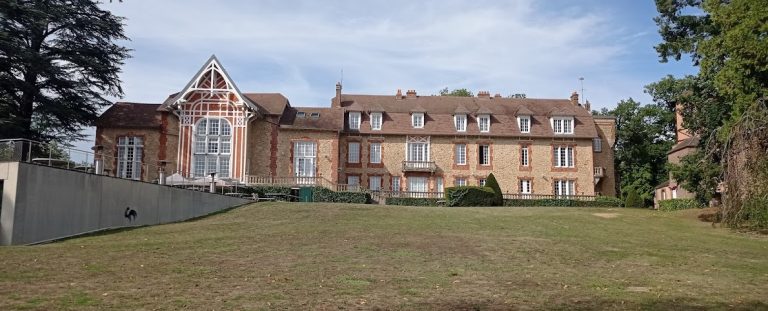
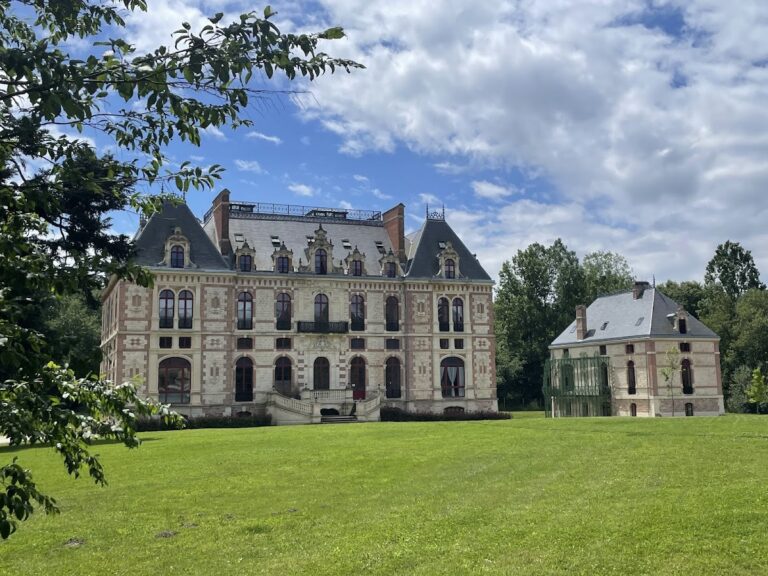
The château stands at the bottom of a valley on soft, sandy ground and rests above substantial vaulted cellars. Its original seventeenth-century construction is represented by the principal building on the right side of the courtyard. Étampes sandstone and brick made from clay found in Île-de-France form the walls. Flat tiles and slate cover the roofs, while stone chainwork frames the doors and windows. The wall surfaces alternate between smooth plaster and exposed brick, a combination characteristic of the Louis XIII style.
Inside, a large straight-flight staircase and a second staircase with a wooden balustrade connect the building’s levels. Exposed beams and joists remain visible in the ceilings, and the fireplaces carry painted decoration.
Courtyard buildings
The former kennel
The building at the rear of the courtyard, opposite the entrance, is the former kennel, probably erected in 1717 for the hunting pack. It has a broken roof of the type known as a Mansard roof. The building’s purpose was tied to the later hunting history of the estate, which housed the Rallye-Bonnelles pack.
The southern building
A slightly later building stands on the southern side of the courtyard, facing Saint-Germain Church. Its position and later date distinguish it from the principal Louis XIII-style construction.
The stables
The stables close the courtyard on the left. They belong to a regional nineteenth-century style and were restored and enlarged in 1936.
Nearby sites