Espeyran Castle: A Historic Estate and French Archives Repository


Site at a Glance
- Rating
- 4.4
- Popularity
- Low
- Country
- France
- Primary era
- Modern
- External website
- Open
- Eras represented
- Modern
- Civilizations
- French
- Site type
- Domestic
- Remains
- Castle
On this page13 sections
History
Ancient occupation beside the Rhône
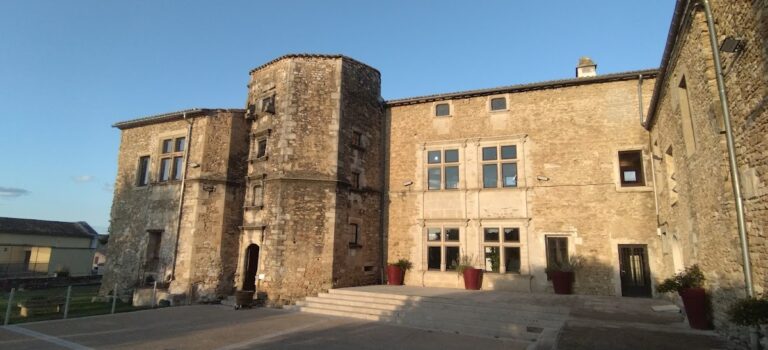
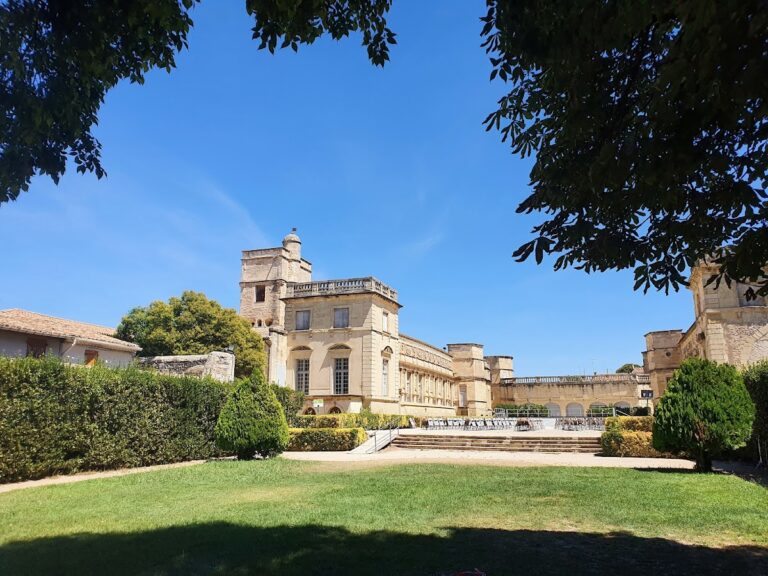
Espeyran Castle is a historic estate near Saint-Gilles in France, whose present residence is principally a late-nineteenth-century building in Neo-Renaissance and Second Empire styles. The wider estate has a history extending across 27 centuries and includes the castle, a park, the archaeological reserve at L’Argentière, and the Centre national du microfilm et de la numérisation.
Archaeological interest at Espeyran began in the nineteenth century with the discovery of tombs, funerary stelae, and other objects. Research at L’Argentière in 1909 indicated an ancient settlement beside a branch of the Rhône, possibly the place called Heraclea in ancient literature, although that identification remains uncertain. Excavations led by Jean Sablou in 1961 revealed Roman-period buildings that reused a capital with a Gallo-Greek inscription. Further work by Guy Sauzade in 1970 and 1971, Michel Py in 1975, and Réjane Roure during the 2000s established occupation from the Protohistoric period onward. An ancient altar from the estate was also described by Émile Espérandieu in his study of Roman Gaulish reliefs.
A commercial trading post arose beside a Rhône branch in the sixth century BC. It remained active until the second century AD and continued to attract activity until the fourth century AD. Large quantities of Mediterranean imports and products from Massalia, the Greek colony at present-day Marseille, indicate extensive commercial exchange. The abundance of Massalia pottery has encouraged the interpretation that Espeyran may have been a Greek-founded trading post, perhaps the Rhodanousia mentioned in ancient literary sources. That identification is not secure.
The abbey estate
During the Middle Ages, Espeyran belonged to the abbots of Saint-Gilles, the heads of the abbey who directed its religious and administrative affairs. A papal bull, a formal document issued by the pope, confirmed this status on June 28, 1119. It described a territory organized around a church dedicated to Saint Felix. The abbots built a summer residence there toward the end of the twelfth century, but Raymond VI, Count of Toulouse, destroyed it in 1195 during a dispute with the abbey over its revenues. He was excommunicated in 1196. The abbots later retained the estate and managed its woodland.
The Sabatier family estate
The abbey’s possessions became national property in 1791. Guillaume Sabatier, a banker living in Paris, then acquired Espeyran and the Blanquet estate. Vines were planted at Espeyran from 1796 under the initial management of Ventujol. After Ventujol died in 1808, his sister Marie inherited the estate and ran it with her nephew Jean-Baptiste-Félix. Their deaths in 1818 transferred the property to Jean-Baptiste-Félix’s widow, Hermine Fournier de Servant.
Hermine’s eldest son, Frédéric, took possession when he reached adulthood and developed Espeyran as both an agricultural property and a leisure estate centered on hunting and horse breeding. From the early 1840s, he reorganized the castle and park, built stables, and established a racetrack, riding arena, and horse bath. The residence became a regular family and social setting for Frédéric, his wife Félicie, their relatives, and guests, while the marshes, woodland, and plains supported hunting for small and large game.
Frédéric died in 1864. Until his son Guillaume came of age, Félix Sabatier managed the estate and modernized its agricultural operations. New grape varieties helped the family withstand the phylloxera crisis, an insect infestation that devastated European vineyards during the nineteenth century. Guillaume Sabatier d’Espeyran owned Espeyran from 1864 and married Claire d’Orgeval in 1879. Soon afterward, he commissioned a major renovation that created the estate’s definitive nineteenth-century appearance.
Transfer to the French state
In 1939, Espeyran passed to Guy Sabatier d’Espeyran, Guillaume’s third son. After meeting the novelist, essayist, and archivist André Chamson, Guy donated the park, castle, furnishings, and L’Argentière archaeological reserve to the National Archives in 1963. The central microfilm repository was established on the estate in 1973. It is now the Centre national du microfilm et de la numérisation, attached to France’s interministerial archival service.
The French state has owned the estate since 1963. The castle’s institutional role is the conservation of microfilms and digital images for the French Archives network. It was listed as a historic monument on October 2, 2009, and received the Maisons des Illustres designation from the Ministry of Culture in 2013. Since 2010, archival work has been accompanied by a program presenting the estate to school groups and visitors.
Remains
The castle
Nineteenth-century exterior
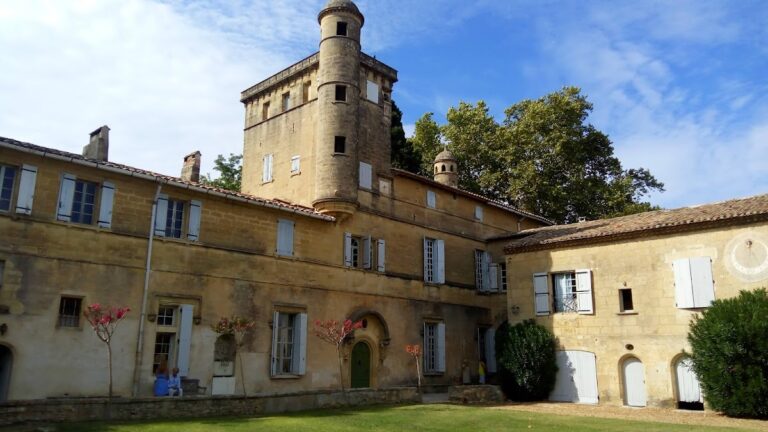
The surviving castle is chiefly the result of Guillaume Sabatier d’Espeyran’s late-nineteenth-century renovation, directed by the architect Charles Perrier. A second floor was added beneath a mansard slate roof, a roof with two slopes on each side and a steeper lower slope. This replaced the earlier flat roof shown in a watercolor preserved at the castle. Two towers were added or arranged during the same transformation, giving the residence its present late-nineteenth-century form.
Interior rooms and chapel
The ground floor was reorganized with a chapel at the western end and a large salon at the eastern end. Designed in the Louis XVI style, an eighteenth-century French neoclassical manner based on symmetry and restrained classical decoration, the salon has a painted ceiling and two overdoor panels by Eugène Devéria. The chapel contains stained-glass windows showing Saint Clare and Saint Guillaume, the patron saints regarded as the spiritual protectors of the owners. Numa Boucoiran, a painter from Nîmes, created their designs.
Decorative collection
The interiors, original furnishings, and decorative schemes have remained intact since the end of the nineteenth century. Their program reflects the owners’ interest in hunting and their social position through painted hunting scenes, animal sculptures, and portraits of horses. Frédéric commissioned the Devéria brothers to decorate an antechamber and also employed Numa Boucoiran and Charles Paulin François Matet.
Estate grounds and archaeological reserve
Equestrian facilities
The nineteenth-century development of the estate included stables, a tack room, a racetrack, a riding arena, and a horse bath. The stable, tack room, and horse bath survive and remain visible as parts of the estate’s former horse-breeding and racing facilities.
L’Argentière archaeological reserve
The archaeological reserve at L’Argentière preserves remains associated with occupation from the Protohistoric period through the Roman period. These include buildings, a reused inscribed capital, an ancient altar, funerary stelae, tombs, and substantial ceramic material. The pottery includes Mediterranean imports and products from Massalia, providing physical evidence for the trading activity that took place beside a branch of the Rhône. The reserve forms part of the Espeyran estate alongside the castle, park, and buildings of the national microfilm and digital-image conservation center.