Église Saint-Césaire d’Arles: Former Augustinian Convent Church and Parish

Site at a Glance
- Rating
- 4.1
- Popularity
- Very Low
- Country
- France
- Primary era
- Medieval
- Eras represented
- Medieval, Early Modern, Modern
- Civilizations
- County of Provence, French, Holy Roman Empire
- Site type
- Religious
- Remains
- Church
On this page21 sections
History
Église Saint-Césaire d’Arles is a southern Gothic church in France, begun by the Grands Augustins, Augustinian friars, around 1450 as part of their convent. Its adjoining cloister was built with the conventual church, while the Saint Joseph Chapel was completed and consecrated in 1479. The building later became a parish church dedicated to Saint Caesarius of Arles, the bishop who held office from 502 to 543.
Augustinian foundation and expansion
The Grands Augustins established their convent in Arles in 1258. The present church belongs to a later building phase, beginning around 1450, when the religious community created a new conventual church and cloister. The Saint Joseph Chapel formed part of this development and was consecrated in 1479, a date preserved on its commemorative stone plaque.
The church was enlarged in 1492 and again in 1511. These works shaped the medieval building that served the Augustinian community and the surrounding district. Before the French Revolution, the old borough later called La Roquette was divided between the parishes of Sainte-Croix and Saint-Laurent. Its population consisted chiefly of boatmen, fishermen, and farmers and was described as relatively poor.
Fire, rebuilding, and reconsecration
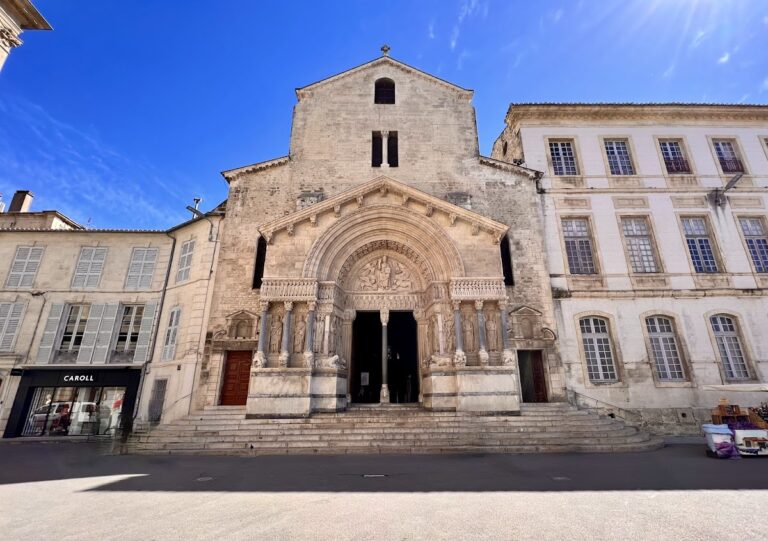
A fire in 1627 destroyed the westernmost bay and its two side chapels. A new and notably plain west facade was erected in 1628. After the restoration, Archbishop Gaspard du Laurens reconsecrated the church under the joint dedication of the Virgin Mary and Saint Augustine. The facade later acquired Neo-Flamboyant decoration during the nineteenth century.
The church also acquired commemorative associations during the seventeenth century. In 1638, a permanent Mass was founded for Honoré Quiqueran de Beaujeu, a knight and senior officeholder of the Order of Saint John of Jerusalem, also known as the Order of Malta. His tomb in the church contains his heart, while his body was buried in the Chapel of Saint John at the order’s grand priory, now the Musée Réattu.
Revolutionary disruption and parish use
During the French Revolution, the two parish churches of La Roquette and the Grands Augustins convent were sold as national property. After Catholic worship was restored, the municipality bought back the former conventual church in July 1826. On 24 September that year, Archbishop Pierre-Ferdinand de Bausset-Roquefort established it as a parish dedicated to Saint Caesarius.
The church was affiliated with the Archdiocese of Aix-en-Provence and became the only still-consecrated parish church in La Roquette. Its furnishings were partly dispersed during the Revolution and later reassembled with objects from the abandoned boatmen’s parishes of Saint-Laurent and Sainte-Croix. This history accounts for the recurring presence of Saint Peter, the Virgin of the Boatmen, Notre-Dame de Bon Voyage, Saint Nicholas, and Saint Clement among its images and furnishings.
Nineteenth-century changes and modern protection
The present sacristy was built in 1843. In 1885, alterations to the choir led to the disappearance of the presbyterium, the area reserved for clergy around the altar, built in 1643. The church was entered on France’s register of historic monuments on 19 March 2014, giving legal protection to the building and its protected furnishings.
Saint-Césaire continues to host Catholic worship, including a weekly Thursday Mass and the Shepherds’ Midnight Mass. It is currently closed for work after stones fell from one of its interior vaults. The former Augustinian convent church therefore remains both a historic monument and a parish church whose later use grew from the reorganization of worship after the Revolution and the Concordat.
Remains
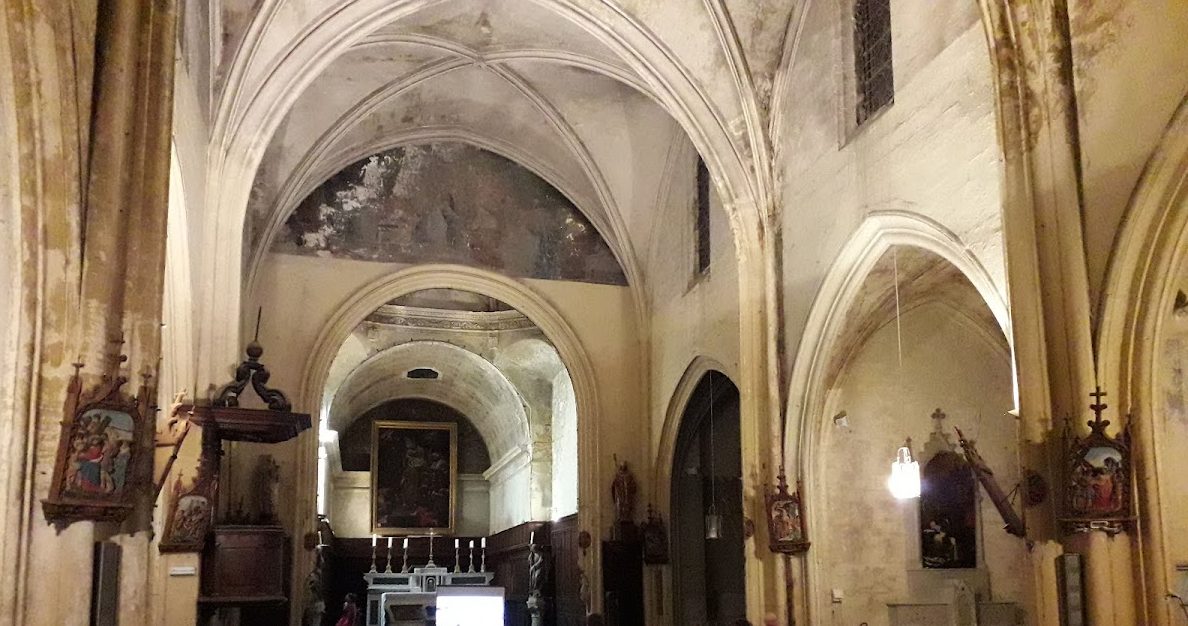
Saint-Césaire is organized as a southern Gothic church with a four-bay nave, side aisles, chapels, an ante-choir, and a narrow choir. The nave is covered by rib vaults, which are vaults supported by intersecting masonry ribs. The church has no true transept. Beyond the triumphal arch, an octagonal dome with a lantern, a small raised structure that admits light, forms the ante-choir built after the fire of 1627 and contains the high altar. The narrow choir behind it has a barrel vault and reflects alterations made in the early nineteenth century.
Church structure and surviving fabric
Nave and west facade
The nave now has four bays and is flanked by side aisles divided into independent chapels. The west facade, rebuilt in 1628 after the fire, retains traces on both sides of the portal showing where the chapels attached to the destroyed western bay once stood. Its later Neo-Flamboyant decoration belongs to the nineteenth century.
Cloister and paving
On the south side, the western cloister gallery and a small part of the northern gallery survive, incorporated into the buildings of the Jean-Buon nursery school. Inside the church, the central and side aisles preserve engraved coats of arms and epitaphs in their original paving. The paving is heavily worn but remains intact, and Saint-Césaire is described as the only church in Arles to have retained this feature in that condition.
Chapels and devotional furnishings
Saint Joseph Chapel
The Saint Joseph Chapel contains baptismal fonts beneath a stone altarpiece showing the Baptism of Christ. At its eastern end is an older stone altarpiece from the seventeenth century, with three statues added considerably later. The stone plaque recording the chapel’s completion and consecration in 1479 is protected as a historic monument.
Chapel of Saint Thérèse of the Child Jesus
This chapel contains a painting attributed to Jean-Baptiste Marie Fouque, Saint Caesarius at the Bedside of the Prefect of Ravenna. The painting is protected as a historic monument.
Chapel of the Sacred Heart
The Chapel of the Sacred Heart contains the stone inscription that records the foundation of the permanent Mass in 1638. It also holds the tomb containing Honoré Quiqueran de Beaujeu’s heart, a polychrome marble altar surmounted by a large crucifix, and a polychrome statue of Saint Nicholas. The church’s polished wooden pulpit, dating from the eighteenth century, is also protected as a historic monument.
Saint Peter Chapel
The Saint Peter Chapel contains an anonymous seventeenth-century painting of the Coronation of the Virgin, protected as a historic monument. A small door in its eastern wall, near the choir, leads to a vestibule and then to an exterior exit. Above and on the reverse side of the door is a stone statue of Saint Clement leaning on his anchor. The statue dates from the late seventeenth or early eighteenth century and is protected as a historic monument.
Chapel of the Virgin
The Chapel of the Virgin contains a fine but considerably deteriorated fresco and an anonymous seventeenth-century Virgin of Mercy, which is protected as a historic monument. Its floor tomb belongs to Sister Isabellet, a Carmelite known as “the little saint of La Roquette,” who died on 22 June 1826.
Chapel of Saint Anthony of Padua
This chapel contains an anonymous seventeenth-century painting of Saint Thomas Aquinas Writing under the Inspiration of Saints Peter and Paul, together with another protected painting representing Saint Nicholas. Both paintings are protected as historic monuments.
Chapel of Saint Anne
The Chapel of Saint Anne contains two paintings associated with Notre-Dame de Bon Voyage. One, attributed to Jean-Baptiste Marie Fouque, includes a view of the port of Arles from Trinquetaille in its lower register. The other is an 1816 ex voto, an image offered in fulfillment of a vow or in thanksgiving for divine assistance, showing the Virgin with Saint Nicholas on her right and Saint Roch on her left. Both paintings are protected as historic monuments.
Chapel of the Souls in Purgatory
An elegant eighteenth-century wrought-iron screen encloses the Chapel of the Souls in Purgatory. Inside are Jean-Baptiste Marie Fouque’s Purgatory, painted in 1863, and a polychrome carton-stone group of Saints Mary Jacobé and Salome in their boat. Carton-stone is a molded composite material made to imitate stone. The screen, painting, and sculptural group are protected as historic monuments.
Choir and organ
Choir furnishings
The choir is lined with eighteenth-century walnut paneling and contains three white-painted celebrants’ seats. Its large painting of the Martyrdom of Saint Lawrence was painted by Trophime Bigot in 1638 and formerly belonged to the high altarpiece of Saint-Laurent Church. An eighteenth-century polychrome marble high altar is also preserved there. The paneling, painting, and altar are protected as historic monuments.
Mader organ
The church’s organ was built in 1866 by François Mader, an organ builder from Marseille. The instrument remains almost unaltered, with only the Euphone and Voix humaine stops replaced. Its case is made of northern wood in the Neo-Gothic style, and its pipes are cut to modern pitch, with A3 at 435 Hz. The keyboards have limewood keys faced with ivory for the naturals and ebony for the sharps.
Yves Cabourdin of the Manufacture d’Orgues de Carcès restored the organ in 1992. The work enlarged the pedalboard to thirty notes, extended the Grand-Orgue pedal coupler, rebuilt the soundboards and lantern reservoir, and repaired and revoiced the pipes according to Mader’s aesthetic. A Récit coupling was added and the original wind tremulant restored. The two missing stops were replaced by a 1873 Mader Voix humaine from the organ at Barjols and a Zimmermann euphone. In 2013, the Mader instrument was the only large organ in good condition in Arles.