Abbey of Saint-Gilles: A Benedictine Pilgrimage Monastery in France
Site at a Glance
- Country
- France
- Primary era
- Medieval
- Eras represented
- Medieval, Early Modern
- Civilizations
- County of Toulouse, French
- Site type
- Religious
- Remains
- Monastery
On this page18 sections
History
Foundation and early monastery
The Abbey of Saint-Gilles is a former Benedictine monastery in Saint-Gilles, France, whose foundation tradition reaches back to the seventh century; its surviving church is a Romanesque pilgrimage building begun around 1116. A legend says that the hermit Saint Giles was accidentally wounded while the Visigothic king Wamba was hunting. Wamba then gave Giles land for a monastery, where Giles became abbot. The story also tells of Giles travelling to Rome to obtain papal jurisdiction and of two cypress doors, miraculously brought to the monastery with images of the apostles. An 814 record instead identifies a small religious house dedicated to Saint Peter at the site, then under the authority of the bishop of Nîmes.
The community followed the Benedictine rule and came under the pope’s direct authority in 879. The monastery’s dedication changed to Saint Giles in the ninth century, while the first signs of his cult date to about 925. Growing devotion to the saint drew pilgrims. Between about 882 and 911, the monastery was under the guidance of Amelius, an archdeacon who later became bishop of Uzès. In 961, Raymond, count of Rouergue and marquis of Gothia, left half his estate to Saint-Gilles and the Abbey of Saint-Baudille. Pilgrims included Adacius, abbot of Figeac, who stopped there on his way to Rome in 988, and Robert the Pious, who visited during a pilgrimage in 1019–1020.
Counts of Toulouse and the Cluniac connection
Toulouse’s ruling family developed an interest in the monastery after Count William Taillefer married a daughter of the count of Provence in the late tenth century. Monks resisted the family’s control. A papal bull issued between 1012 and 1024 threatened William and his mother, Adelaide of Anjou, but the abbey nonetheless became part of the counts’ patrimony. In 1037, Count Pons included it in the dowry he arranged for his wife, Majora.
In 1042 or 1044, nineteen bishops from southern France assembled at Saint-Gilles. The meeting was led by Raimbaud, archbishop of Arles, and Léger, archbishop of Vienne, with representatives of Guifred, archbishop of Narbonne. The council proclaimed the Truce of God, a church movement intended to limit violence and protect churches and other sacred places. One rule forbade lay attacks on churches and hostile acts within thirty paces of them.
Countess Almodis and her younger son Raymond, later Raymond IV of Toulouse, gave the abbey to Cluny in 1066 while retaining certain rights of use. Cluny was a major Benedictine abbey in Burgundy and the centre of a broad network of monasteries. Around 1076, Pope Gregory VII confirmed or put the donation into effect, bringing Saint-Gilles into that network. Raymond was the first in his family recorded using the title count of Saint-Gilles, in 1066; members of the family continued to bear it through Raymond VI.
Pilgrimage, rebuilding, and conflict
As preparations for the First Crusade, a major military expedition to the eastern Mediterranean called by Pope Urban II, gathered pace, Raymond IV promised in 1090 to give up his rights over the abbey. He formally renounced his claims at Clermont in 1095 and Nîmes in 1096. In 1095 or 1096, Urban II established a protected boundary around Saint-Gilles and prohibited actions within it that would harm the monks’ property. The counts continued to dispute the abbey’s independence and sought authority over the town, its growing ports, and the annual fair held on the saint’s feast day.
Conflict intensified under Bertrand of Saint-Gilles in 1105–1108 and under his half-brother Alphonse Jordan in 1117 and 1119–1123. The counts pressed for a continuing role in managing the abbey, a share of offerings made by pilgrims, and lordship over the town. In their struggle with the community, they resorted to pillage, destruction, forced oaths, exile, murder, and imprisonment. The First Lateran Council, a major council of the Western Church held in 1123, specifically named Saint-Gilles among the sanctuaries that required protection.
Around 1116, the monks demolished three earlier churches dedicated to Saint Mary, Saint Peter, and Saint Giles and began rebuilding the abbey church. Its arrangement provided an upper church for pilgrims to circulate in and a lower church reserved for the monks. The community obtained full exemption from the local bishop’s authority in 1119 and again in 1132. In 1132, Pope Innocent II also ended the abbot of Cluny’s authority over Saint-Gilles. Building proceeded in stages, with work interrupted by political and religious instability. After 1125, pressure from the counts eased, although the wider conflict over rights and control continued.
The relics of Saint Giles attracted large crowds and brought the abbey substantial income. The librarian Pierre Guillaume compiled a book of miracles around 1121–1124, which a later writer expanded around 1160–1166. Saint-Gilles became a major western Christian pilgrimage destination served by seven principal routes. These included the Régordane route from Le Puy-en-Velay and a route from Arles toward Santiago de Compostela. The town was also a Rhône embarkation point for journeys to Rome and the Holy Land, and served as the French kingdom’s easternmost port for those journeys until that role passed to Aigues-Mortes in 1248.
The abbey’s connections extended to religious orders and merchants. The Hospital of Saint John of Jerusalem, a religious order that cared for pilgrims and later became known as the Hospitallers, was established before 1113 and developed into the Grand Priory of Saint-Gilles. The Templars, a Catholic military order, established themselves around 1140 on both sides of the paved road. In 1178, 130 money changers were recorded within the abbey enclosure and in the houses of the military orders. Saint-Gilles also made agreements with merchants from Genoa and Pisa dating from 1108 or 1109 to 1174.
Pope Urban II and other popes and their representatives supported the abbey through visits and confirmations of its rights. Its abbots gained the personal privilege of wearing a mitre, a ceremonial headdress, in 1154, and the privilege became perpetual in 1208. In 1163, a diploma from King Louis VII recognized the abbot’s judicial authority and right to collect tolls to the extent that the count had granted them. The pope granted indulgences to visitors in 1154, a remission of temporal punishment for sin intended to encourage pilgrimage. In 1136, Pierre de Bruyant, described as a heretic, was burned in front of the church.
Royal authority and later medieval decline
In 1208, a follower of Count Raymond VI murdered the papal legate Pierre de Castelnau, an official acting on the pope’s behalf. The abbey received the legate’s body. In 1209 and 1210, Raymond VI performed public penance in the lower church, before the legate’s burial place and the sarcophagus of Saint Giles. Following a judgment by papal representatives in 1210, the abbey acquired the counts’ rights over the town and its territory. The conflict with the Toulouse dynasty was formally settled in 1226, when the townspeople submitted to King Louis VIII.
Louis IX stayed at Saint-Gilles for a month in July 1254 and returned in 1270. Pope Clement IV granted an indulgence in 1265 to support offerings for construction of the church. Financial problems delayed completion until the fourteenth century, with further work continuing in later centuries. The abbey was affected by the Hundred Years’ War, plague, and the Western Schism, a period when rival claimants divided the Western Church. Internal disputes and financial difficulties contributed to its decline in the fifteenth century. Under the commendatory system, lay abbots who were not monks and did not live at the monastery held the abbacy. From 1472, the French king appointed them. In 1506, Pope Julius II granted an indulgence to pilgrims whose offerings would help complete the church.
Secularization, destruction, and preservation
On 17 August 1538, Pope Paul III secularized the abbey, converting it into a secular chapter, a body of clergy outside a monastic community, while retaining its abbatial dignity. During the Wars of Religion, conflicts between Catholics and Protestants in France, Huguenots devastated the abbey in 1562. The crypt and western façade survived, and the church was converted into a fortress. On 20 July 1622, the Duke of Rohan ordered its demolition to prevent its use by Catholics. The approaching royal army halted the destruction before it was complete.
Beginning in 1650, commendatory abbots and monks of the Congregation of Saint-Maur, a Benedictine reform movement, repaired and modernized the site. They reorganized monastic life according to Counter-Reformation principles, the Catholic Church’s response to the Protestant Reformation, and restored and partly completed the church. Pope Pius VI suppressed the abbey and its chapter in 1777, and the collegiate church became a parish church. In August 1791, during the French Revolution, the remaining monastic buildings were sold as national property. The abbey was used as barracks and a prison; monks were dispersed or imprisoned, and the remains of the old choir were demolished.
Archaeological and historical interest revived in the nineteenth century, and restoration began. The church received French historic-monument protection in 1840. The tomb of Saint Giles was rediscovered in 1865, and pilgrimage to it resumed in 1965. Excavations between 1970 and 1982 examined areas south of the cloister precinct, the crosswise part of the church called the transept, and the north aisle of the choir, the area near the altar traditionally used by clergy. Further investigations below ground took place from 2004 to 2010. The site forms part of the UNESCO World Heritage property Routes of Santiago de Compostela in France, inscribed in 1998. Its surviving remains also received French historic-monument protections in 1984, 2014, and 2018.
Remains
Abbey church
West façade
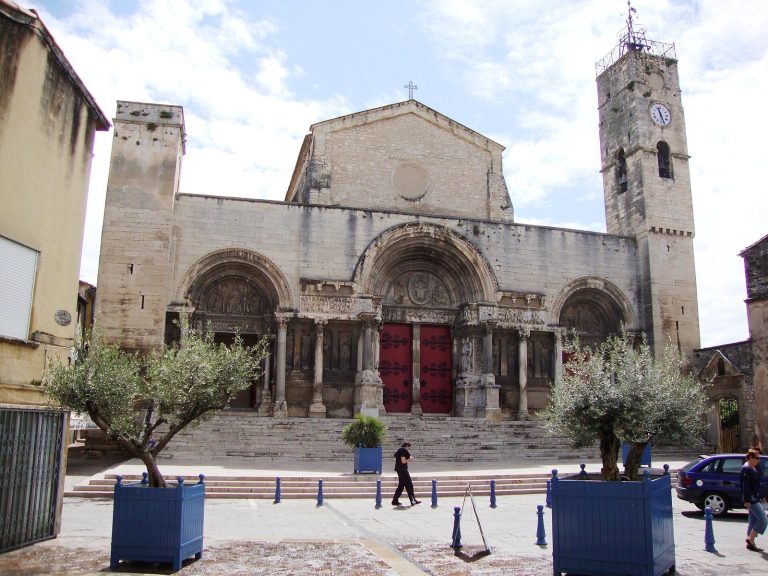
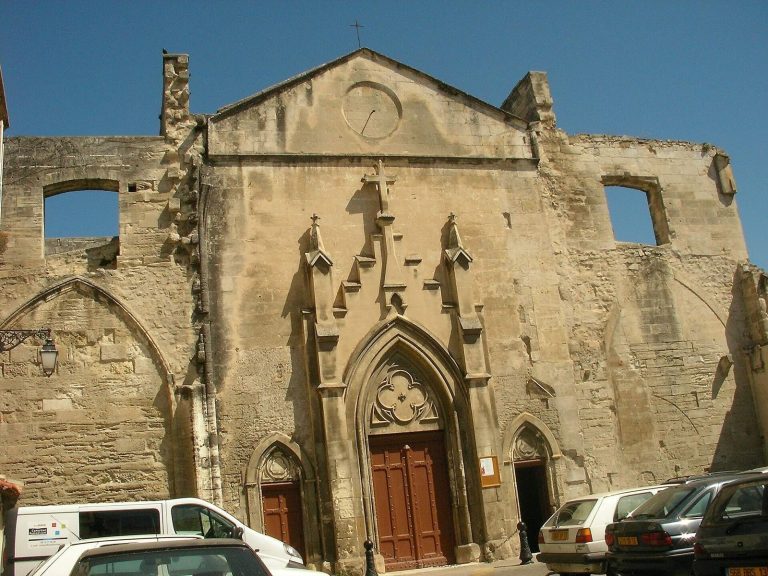
The Romanesque church façade is a monumental sculpted composition organized around three doorways, with the central portal larger than the two flanking it. The date of the façade is debated, with proposed dates ranging from the first half of the twelfth century to the beginning of the thirteenth. The left doorway has the Adoration of the Magi in the sculpted panel above it and the Entry into Jerusalem on its horizontal lintel. Christ in Majesty occupies the central panel, while a lower frieze running along the side walls between the portals shows scenes from the Passion. The right portal depicts the Crucifixion, with scenes after the Resurrection below, including Christ appearing to the women and the apostles.
Reused Roman columns and large figures of Saint Michael, the twelve apostles, and angels fighting demons occupy the spaces between the doorways. Old Testament figures and nonreligious scenes appear lower on the façade, alongside animal imagery. Classical-inspired decoration once covered its upper part but has disappeared. Roman influence is visible in the sculptural compositions, including the scenes in the frieze.
Upper church
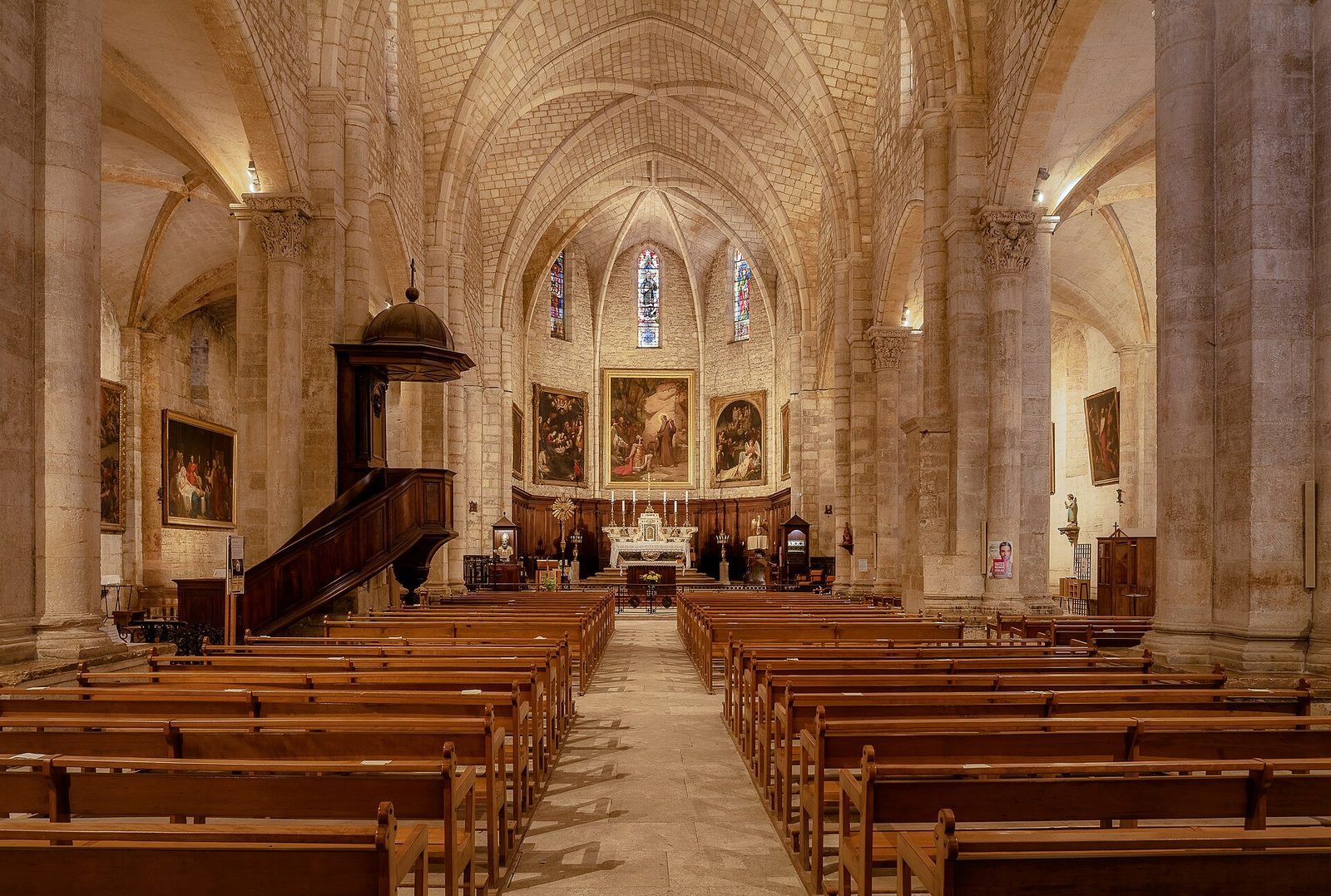
The church has three aisles separated by columns, with the central aisle rising above the side aisles. Groin vaults, formed where two curved ceilings intersect, cover the aisles. The upper church includes a nave and two apses, the rounded spaces at the ends of the church. Its present form largely reflects the seventeenth-century reconstruction, while massive pillars with ornate Corinthian-style capitals retain a classical character.
Crypt
The crypt, an underground chamber used for burial and the veneration of relics, extends beneath the full nave, from the façade to the choir. Dating to the early eleventh century, it measures about 50 by 25 metres. The tomb of Saint Giles stands at its centre, and fragments of the saint’s relics remain there.
Former choir and bell tower
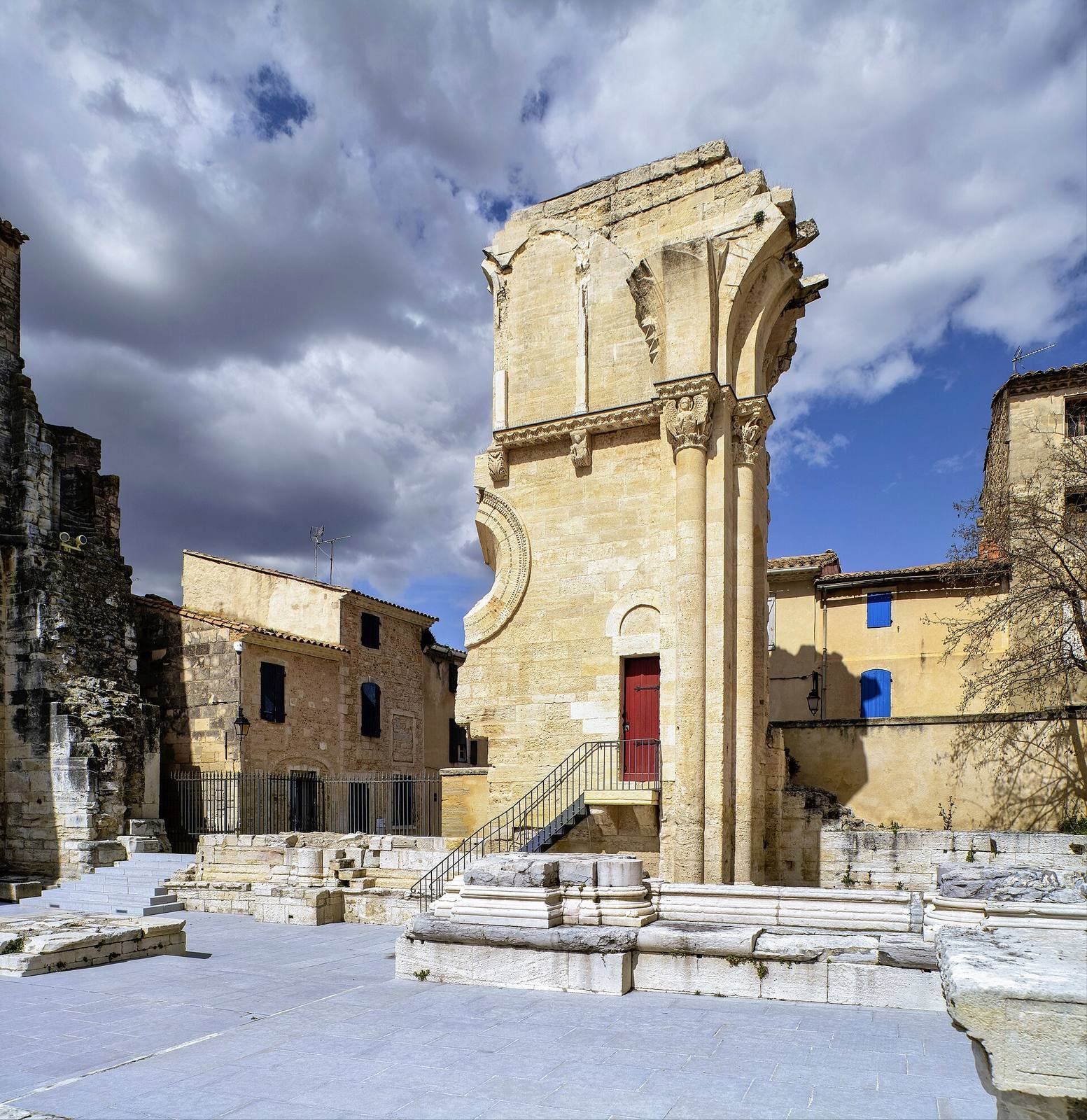
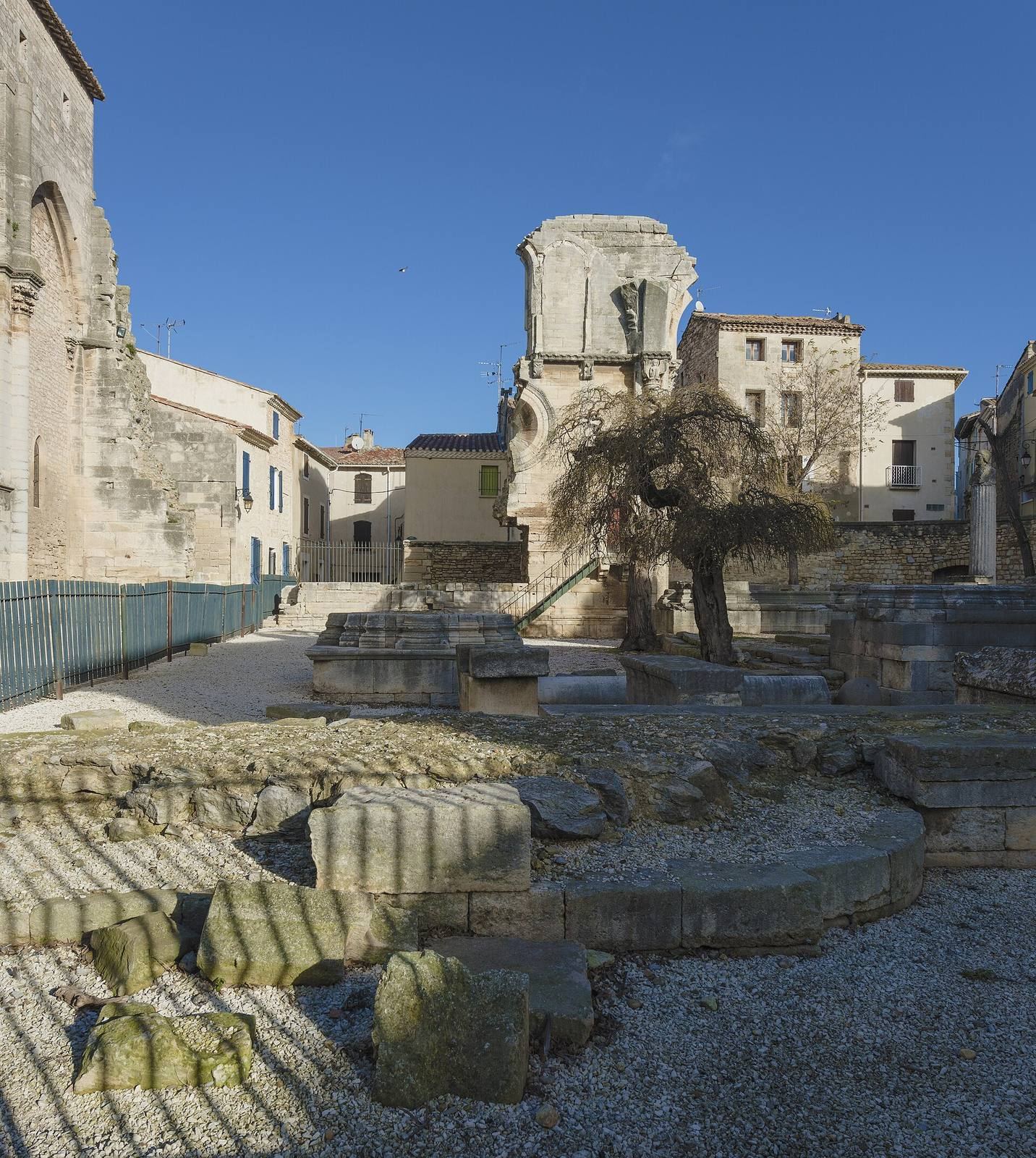
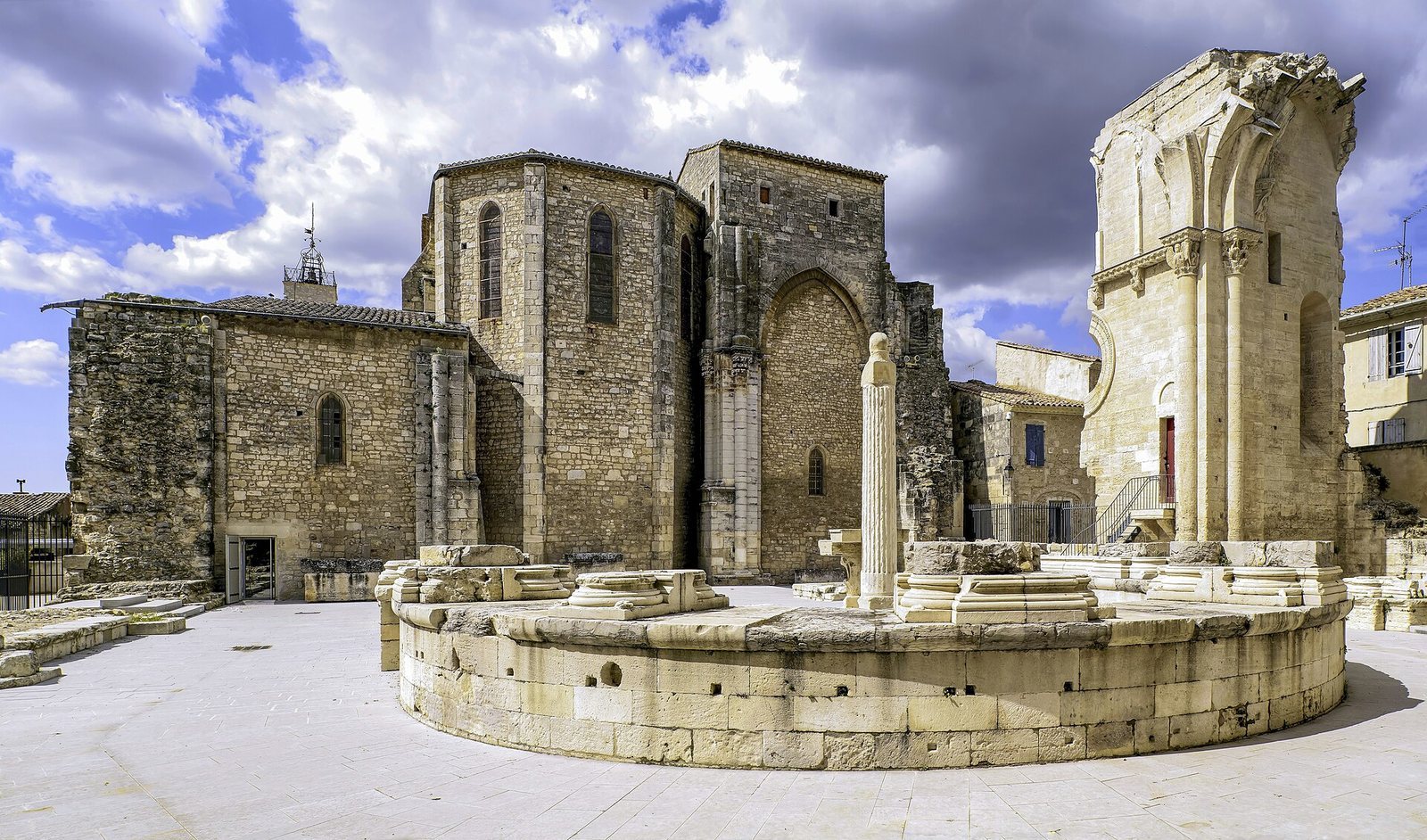
The original church was planned to extend about 98 metres, compared with roughly 50 metres for the present church. Behind the apse are remains of the former choir, including a wall with a spiral staircase. The staircase, now free-standing, dates to the twelfth century and consists of stone steps projecting from their support. An eighteenth-century bell tower also survives.
Monastic buildings
Vaulted rooms by the former cloister
On the former cloister site, around a garden east of the church, a room is divided into three bays, or sections. Two bays retain their walls and groin vaults. The masonry and roof of the third bay are modern. A room with a barrel-shaped vaulted ceiling adjoins it.
North cloister wall
A long wall on the north side of the cloister court rises about six to seven metres and preserves traces of arches near its base. Its central portion was removed to form a passage into the garden. The wall has Romanesque windows and a large later window divided by vertical and horizontal stone bars, dating to the fifteenth or sixteenth century.
Hall below the cloister
Below the cloister court to the west is a large hall, probably the former refectory. Its long interior is divided into three bays by rib vaults, ceilings supported by projecting stone ribs, and crosswise arches. A doorway on the south side, dating to the seventeenth or eighteenth century, opens onto a small courtyard.
Medieval cellar
The medieval abbey cellar lies below the church square, near the crypt, and dates no later than the early thirteenth century. The large building is divided into three bays. It connects eastward and from south to north with a gallery remodeled in the seventeenth century, as well as with the western gallery of the cloister.
Buildings south of the church
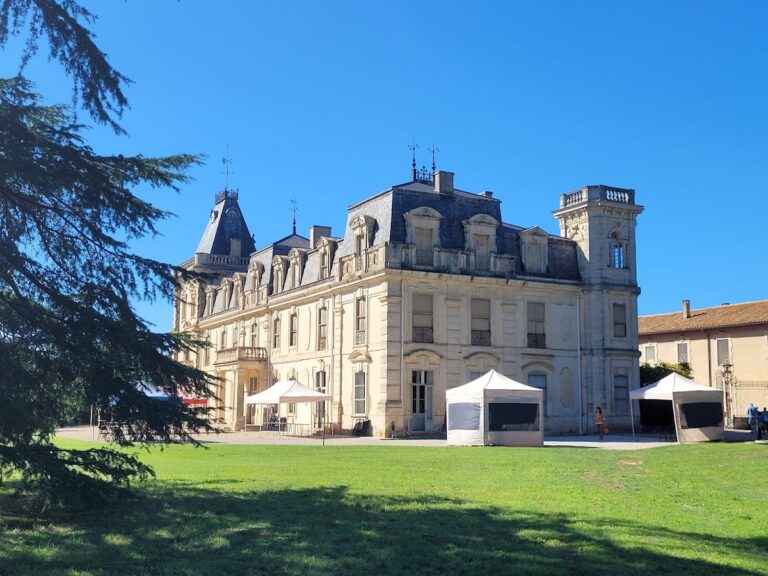
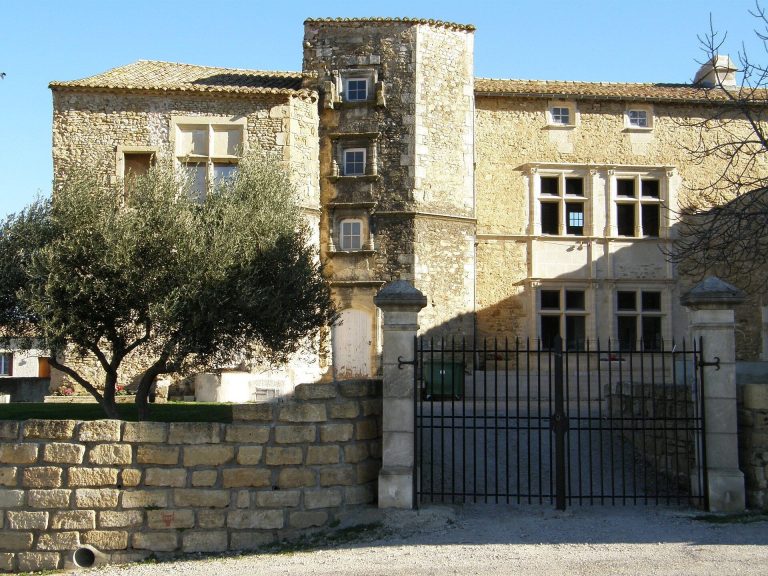
Substantial remains of the monastic buildings survive south of the church, incorporated among later houses.