Château de Sainte-Croix-en-Bresse: A Historic Noble Residence in France
Site at a Glance
- Rating
- 5
- Popularity
- Very Low
- Country
- France
- Primary era
- Unclassified
- Eras represented
- Unclassified
- Civilizations
- Unclassified
- Site type
- Domestic
- Remains
- Castle
On this page8 sections
History
Château de Sainte-Croix-en-Bresse is a historic château in France, beside the Solnan in the Louhannaise Bresse. Its origins are linked to the medieval lords of Sainte-Croix, and its ownership passed through the counts of Burgundy-Mâcon, the d’Antigny, Vienne, Hochberg, Orléans-Longueville, Champlécy, and d’Artagnan families before reaching the Renouard de Fleury line.
The Medieval Lords of Sainte-Croix
The first lords of Sainte-Croix appear to have been the counts of Burgundy-Mâcon. Scholastique of Champagne, the wife of Guillaume IV, count of Mâcon and Vienne, was recorded as lady of Sainte-Croix, apparently through her dower from her husband. Their daughter Béatrice inherited Sainte-Croix and other lordships. Around 1219, she married Hugues III d’Antigny, and their son Henri established the branch of the d’Antigny family that held Sainte-Croix until it became extinct at the end of the fourteenth century.
Through the marriage of Marie d’Antigny, lady of Sainte-Croix and Sellières, to Hugues VI or VII de Vienne around 1354, the lordship entered the Vienne inheritance. Their son, Hugues or Huguenin VII or VIII de Vienne, inherited Sainte-Croix and numerous other estates from his mother and her aunt Jeanne d’Antigny. In 1390, he left these possessions to his half-brother Guillaume de Vienne.
The Vienne and Hochberg Inheritances
Guillaume II, III, or IV de Vienne, known as Guillaume the Wise, held Sainte-Croix from 1390. The House of Vienne was a major noble family whose branches controlled many lordships in Burgundy and the Franche-Comté, placing Sainte-Croix within a broad network of estates. Guillaume was closely associated with the dukes of Burgundy and became the first knight of the Order of the Golden Fleece on 10 January 1430. This prestigious chivalric order had been founded in the fifteenth-century Burgundian sphere.
Guillaume the Wise was succeeded in 1437 by his son Guillaume III or V de Vienne, known as Guillaume de Bussy. Jean de Vienne followed him in 1456, and Jean’s sister Marguerite de Vienne held the inheritance until her death around 1477 or 1478. In 1447, she had brought Sainte-Croix, Louhans, Seurre and Saint-Georges, Villangrette, Montpont, Arc-en-Barrois, Châtillon-sous-Maîche, and Chagny to her husband, Rodolphe de Hochberg, count of Neuchâtel. Their son Philippe de Hochberg succeeded them during the second half of the fifteenth century.
Orléans-Longueville and D’Artagnan Ownership
The estate passed to the Orléans-Longueville family through the marriage in 1504 of Jeanne de Hochberg, countess of Neuchâtel, to Louis I d’Orléans-Longueville. The succession included François d’Orléans-Longueville in 1543, Léonor d’Orléans-Longueville in 1551, Henri I d’Orléans-Longueville in 1573, and Henri II d’Orléans-Longueville in 1595.
Henri II sold the property to Charles de Champlécy in 1623 or 1626. It later passed to Charles’s granddaughter Anne-Charlotte de Champlécy. In 1659, she married Charles de Batz de Castelmore d’Artagnan, the seventeenth-century French military officer whose reputation inspired the fictional hero of Alexandre Dumas’s novels. Louis II de Batz, count d’Artagnan and baron of Sainte-Croix, succeeded in 1709, followed during the first half of the eighteenth century by his son Louis-Gabriel d’Artagnan.
The Marquisate and Later Ownership
In 1741, Louis-Gabriel sold the château to Jean-François-Joseph de Venant, lord of Iverny, who restored it. The lordship was raised to a marquisate in 1744, meaning that it became a territorial lordship held by a marquis. In 1759, the château and its furnishings were sold to Claude-François de Renouard de Fleury, who was confirmed as marquis in May 1764. His descendants retained the property into the present. During the twentieth century, it became the property of the count of Varax through the Mazenod family.
Remains
Main Composition
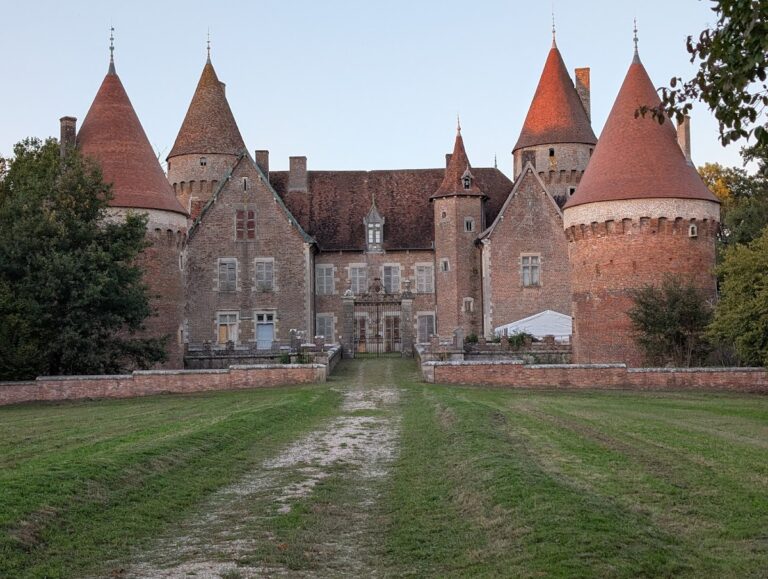
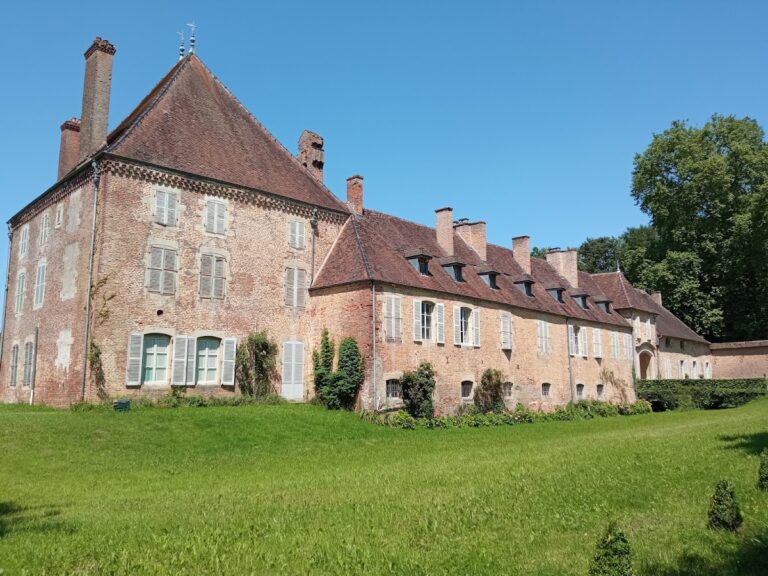
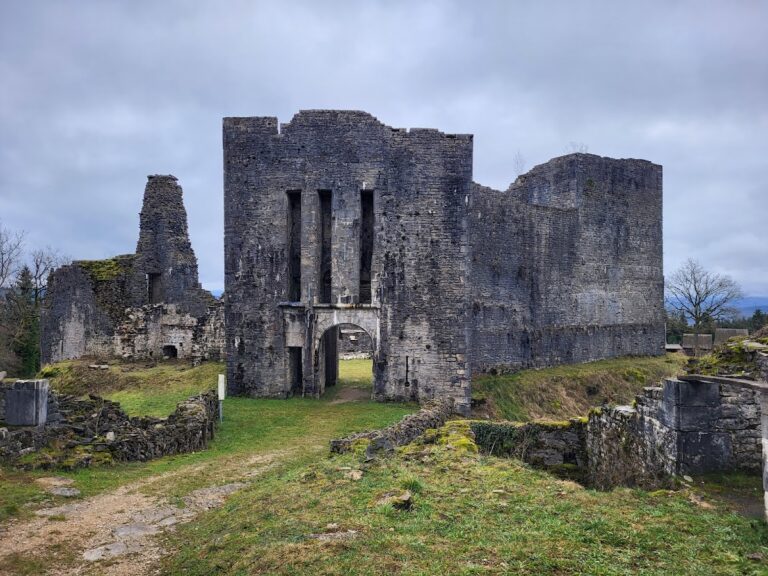
The château stands beside the Solnan and is arranged around a rectangular main residential building. Pavilions occupy its corners, giving the residence a balanced, compact composition. The pavilions are connected by a single-storey range placed against the eastern facade. This eastern building carries a terrace fitted with a wrought-iron balustrade, adding an open architectural element to the residential complex.
Balconies and Facades
Small balconies occupy the angles formed between the corner pavilions and the central residential building. They are supported by trompes, vaulted or corbelled architectural devices that project into an angle and carry a structure above. On the western facade, the central entrance has a pointed arch framed by alternating courses of ochre and black stone. A small window above it has an accolade-shaped lintel, while the other openings use segmental-arch lintels.
Nearby sites