Haus Ober-Frohnrath: A Medieval Noble Seat in Aachen


Site at a Glance
- Rating
- 4.5
- Popularity
- Very Low
- Country
- Germany
- Primary era
- Early Modern
- Eras represented
- Medieval, Early Modern
- Civilizations
- Holy Roman Empire
- Site type
- Military
- Remains
- Castle
On this page7 sections
History
Haus Ober-Frohnrath is a medieval noble seat in Aachen, Germany, at the northern edge of the Richterich district, north of Horbach. It was an Electoral Cologne fief, meaning property held from the territory governed by the archbishop-elector in return for feudal obligations. The site is first mentioned in 1112 in the Annals of Rolduc, a medieval monastic chronicle associated with Rolduc Abbey, under the name Haus Fronerothe in the parish of Richterich.
From medieval estate to Electoral Cologne fief
During the tenure of Engelbert II of Falkenburg, Archbishop of Cologne, Ober-Frohnrath and other estates in the Falkenburg and Limburg territories came under Electoral Cologne. From the fourteenth century, these holdings were administered by the Electoral Cologne feudal chamber at Heerlen, an office responsible for overseeing such properties.
In the fifteenth century, the estate was known as the Hove van Overstvroinraide and belonged to the nobleman Roland von Obbendorp. In 1477, ownership lay with Johann Hurth van Schoeneck of Burg Ringsheim and his wife, Johanna von Birgel. Johann held the hereditary marshalship, a high-ranking court or ceremonial office passed through a noble family.
Sixteenth- and seventeenth-century ownership
In 1524, Junker Doin, lord of Frankenberg, received Ober-Frohnrath as a fief. He was Adam von Merode-Frankenberg, who also possessed Frankenberg Castle and served as advocate over Burtscheid Imperial Abbey. An Imperial Abbey was a monastery with direct status within the Holy Roman Empire rather than subordination to a territorial prince.
In 1540, Adam’s heiress, Elisabeth von Merode, called Frankenberg, and her husband, Hermann von Buer, divided her parents’ inheritance with other heirs. They received 500 gold florins and Ober-Frohnrath, which they then leased out. Their great-grandson Johann von Buer and his wife, Maria von Scheidt, called Weschpfennig, sold the Ober-Frohnrath farm in 1637 to Imperial Colonel Gottfried Baron von Friesheim and his wife, Katharina Amya. Gottfried von Friesheim was still an Electoral Cologne vassal in 1681.
Later ownership and preservation
Johann von Thenen, an Aachen citizen-captain, bought Ober-Frohnrath in 1738. He bequeathed the house to his descendants, who still owned it in 1885. For many decades afterward, the property was held by the Hogen family. The present building complex is protected as a monument, and the castle was renewed during the twentieth century.
Remains
Castle layout and setting
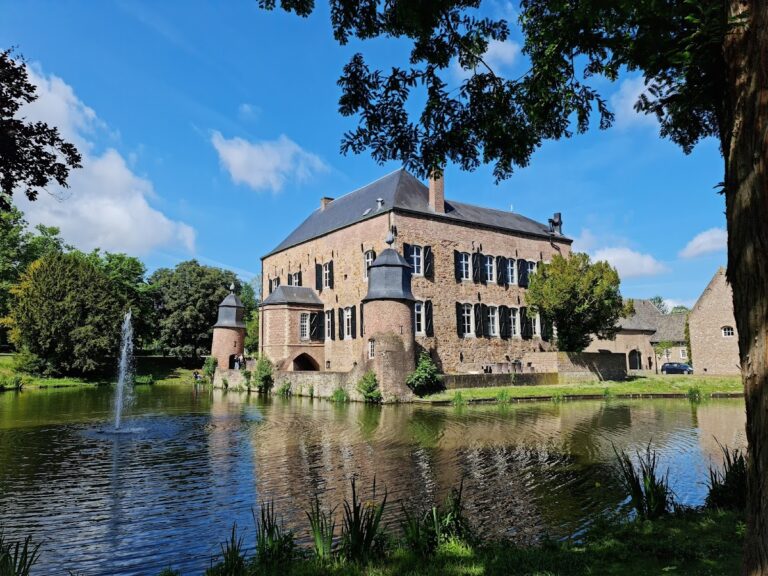
Ober-Frohnrath was a lowland castle, a fortified residence built on relatively level terrain, with a rectangular plan. Its original arrangement included a manorial residence, a consecrated chapel, and four towers. The estate was still surrounded by water on two sides at the end of the nineteenth century. The house stood within an associated estate measuring 293 Morgen, a traditional land unit whose exact size varied by region.
Surviving building complex
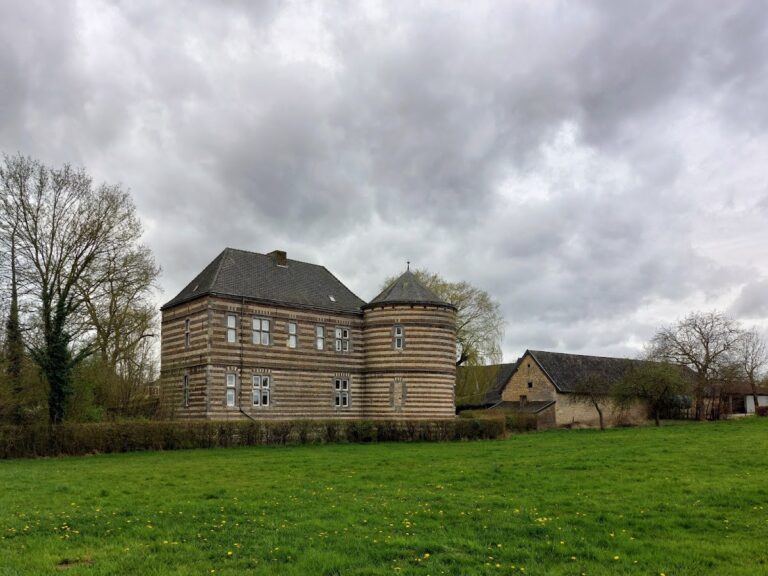
The surviving complex consists of four wings dating from the sixteenth and seventeenth centuries. The north wing bears the year 1646. Two towers on the street frontage survive from the castle’s towered arrangement, while the building complex reflects the later phases of construction and renewal that shaped the present form of Haus Ober-Frohnrath.
Nearby sites