Portilla/Zabalate Castle: A Medieval Fortress and Settlement in Spain


Site at a Glance
- Rating
- 5
- Popularity
- Very Low
- Country
- Spain
- Primary era
- Medieval
- External website
- Open
- Eras represented
- Medieval
- Civilizations
- Kingdom of Navarre
- Site type
- Military
- Remains
- Fortified Town
On this page7 sections
History
Portilla/Zabalate Castle is a hilltop fortress-and-settlement complex in Zambrana, Álava, Spain, built by Sancho III the Great in the eleventh century as the castrum of Portiella. A castrum was a fortified settlement or stronghold that could serve military, administrative, and residential purposes. Portiella became a territorial and administrative center of the Kingdom of Pamplona during the expansion of Navarrese influence toward the County of Castile.
Navarrese foundation and royal control
The castle and its settlement formed part of Sancho III’s territorial expansion across northern Iberia. The fortress remained under royal ownership, but important local and regional aristocratic families administered it. This arrangement brought public authority and private aristocratic power together within a stronghold that had military, administrative, and residential functions.
Conflict between Navarre and Castile
Portilla became a point of resistance during Alfonso VIII of Castile’s invasion of Basque territory in 1199–1200. The fortress was not conquered during the invasion, but in 1200 it passed to Castile through an exchange in which Castile transferred the fortress of Miranda de Arga in Olite.
The site continued to witness confrontations between Navarre and Castile. In 1288, Sancho IV of Castile besieged Portilla during the Castilian civil war between Sancho IV and his nephew Alfonso de la Cerda, a conflict connected with the succession to the Castilian throne.
Abandonment and recovery
Portilla gradually declined in importance and was definitively abandoned in the sixteenth century. Across an approximately 2,500-year history, the hill experienced at least three successive sequences of abandonment and reoccupation. During the latest sequence, habitation on the summit developed into an Alavese town before being progressively abandoned as residents moved to a new settlement about 500 metres farther down the slope. That lower settlement, now the village of Portilla, began as an expansion or suburb of the earlier hilltop center and eventually took over its name.
The monument complex was designated a Qualified Cultural Heritage Asset while progressively deteriorating. Zambrana Town Council and the UNESCO Chair in Cultural Landscapes and Heritage at the University of the Basque Country began an integrated research and recovery project, whose first phase took place from 2013 to 2015. The project received the Europa Nostra Award in 2016 for heritage conservation as a factor in economic and social development.
Remains
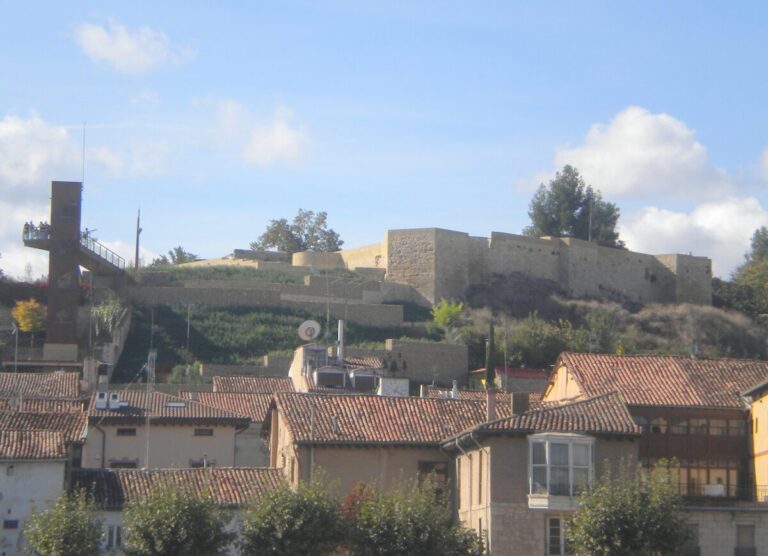
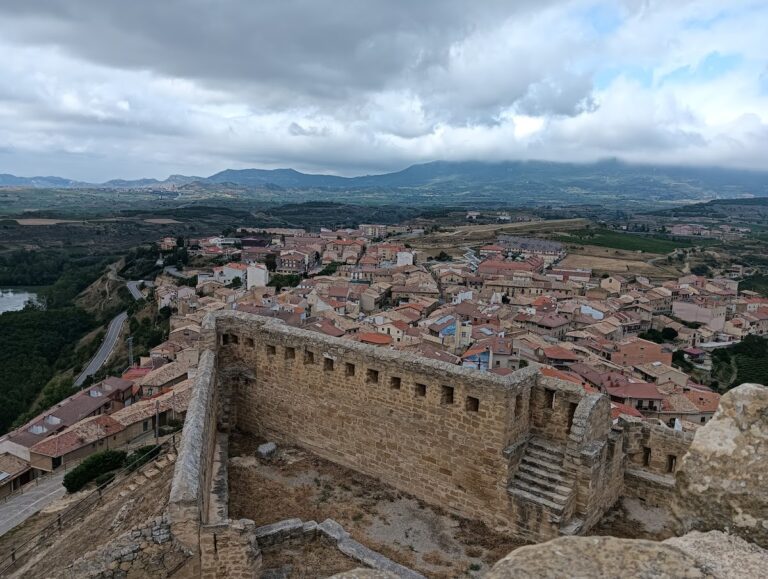
The surviving site forms a hilltop fortified town, or villa-fortress, in which the castle, former village, church, and defensive walls are understood together with the surrounding terrain. A villa-fortress was a settlement whose buildings and defenses functioned as one fortified center. Portilla stands at approximately 754 metres above sea level, on a rocky elevation overlooking the Sierra de Cantabria, the broad Ebro valley around Miranda de Ebro, and the western part of the Obarenes Mountains.
Castle and former settlement
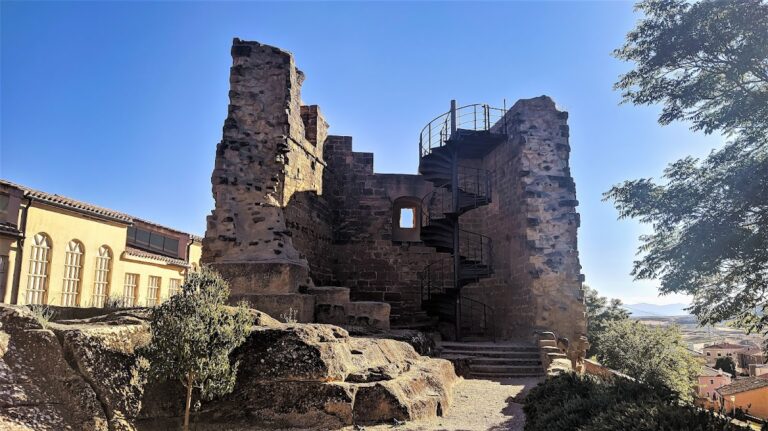
The rocky castle occupies the high point of the complex, while the former village developed around it on the hilltop. The church and defensive walls form part of the same monumental landscape, linking religious, residential, and military functions. The older settlement’s position contrasts with that of the later village of Portilla, which developed approximately 500 metres downslope. Their relationship preserves the physical record of habitation shifting from the fortified summit to a lower settlement.
Fortified cultural landscape
The castle, village remains, ecclesiastical building, and fortifications are integrated into a largely natural setting. The complex had reached a state of progressive ruin before the recovery project, but its surviving arrangement allows the site to be interpreted as a cultural landscape. That interpretation depends on considering the built remains, the hilltop location, the surrounding terrain, and the later displacement of habitation as parts of one historical setting.
Nearby sites