Tsetsyno Fortress: A Medieval Moldavian Fortification in Ukraine
Site at a Glance
- Rating
- 4.3
- Popularity
- Very Low
- Country
- Ukraine
- Primary era
- Medieval
- Eras represented
- Medieval
- Civilizations
- Principality of Moldavia
- Site type
- Military
- Remains
- Castle
On this page8 sections
History
Tsetsyno Fortress was a medieval Moldavian fortification in Ukraine, near Chernivtsi, built in the fourteenth century and traditionally attributed to Peter II Mushat, a ruler of the medieval Moldavian principality. It occupied the site of an earlier Rus fortified settlement dating from the eleventh to thirteenth centuries, identified with Chechun in the List of Rus Cities, Near and Far.
The Earlier Rus Settlement
Some researchers connect the foundation of the earlier settlement with Vladimir I, also known as Vladimir the Great, after his campaign against the Croats in 992–993. On this interpretation, the site may have served as a permanent garrison guarding the southwestern frontier of Rus and controlling conquered territory. Other proposed builders of the first fortress include Casimir III and Yuri Koriatovich. The attribution of the later fortress to Peter II Mushat derives from the research of Virgil Vatașianu.
A Contested Moldavian Frontier
The settlement and fortress belonged to the administrative district of Tsetsyno in the land of Shipenitsa. From the late fourteenth to the early fifteenth century, this territory was disputed by the Kingdom of Poland and the Moldavian principality. Tsetsyno served as the administrative center of the district, which was governed by a starosta, or district governor.
Records name Jotka Tsiatsinski as commander in 1404 and Shcheful Tsetsinski in 1440. Charters refer to the area as the Tsetsyno state or district. In 1436, Ilias, the son of Alexander the Good, declared that he was returning Shipenitsa, along with the fortresses of Tsetsyno, Khotyn, and Khmelev, to the Polish king. Written references to Tsetsyno begin in 1395 and continue into the late fifteenth century, with the latest known reference dating to 1481.
Destruction and Later Investigation
The fortress survived until the second half of the fifteenth century, when it was destroyed. An Austrian administrative document from 1784 states that stone from the ruined fortress was reused in barracks and public buildings. The remains of a watchtower were first investigated in 1908, followed by further research in the 1930s by the Institute of Military History in Bucharest. Tsetsyno is now protected as a locally significant archaeological monument of Chernivtsi.
Remains
The remains occupy the summit of Mount Tsetsyno near the western outskirts of Chernivtsi, in the Rosha district. The earlier fortified settlement formed a strongly elongated plateau covering up to 1 hectare. The later fortress was organized around a central stone tower, with wooden-and-earth defenses enclosing the central area on its eastern and western sides. Surviving elements are in ruins.
Central Tower and Enclosure
Stone Tower
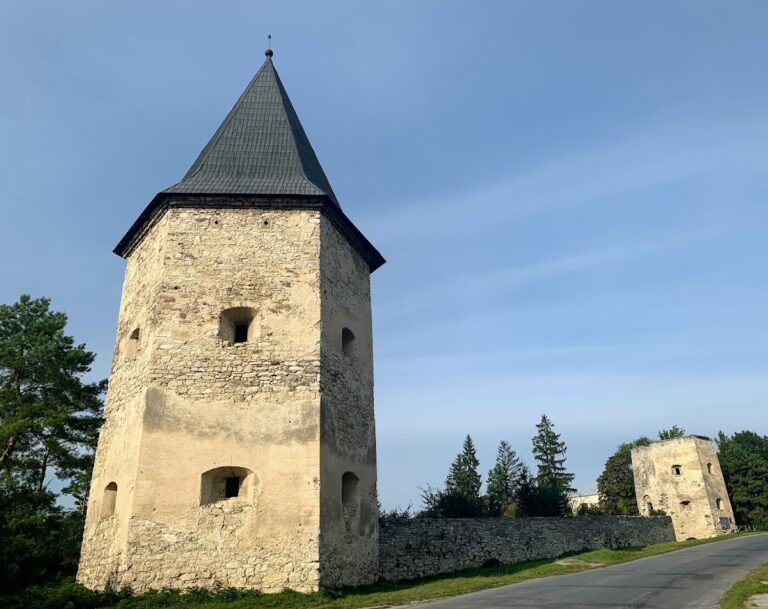
The central structure was a stone tower, described as both a donjon, the principal fortified tower of a castle or fortress, and a watchtower. It dates to the fourteenth century and has a diameter of 20 metres. Mountain stone was the principal building material. Archaeological study of the tower began in 1908, and the surviving structure remains ruined.
Wooden-and-Earth Defenses
Wooden-and-earth walls surrounded the central area and protected the fortress on its eastern and western sides. Remains of these fortifications survive around the central tower, preserving part of the enclosure that defined the stronghold’s layout.
Nearby sites