Olomouc Fortress: A Historic Bastioned Fortress in Czechia


Site at a Glance
- Rating
- 4.4
- Popularity
- Very Low
- Country
- Czechia
- Primary era
- Early Modern
- External website
- Open
- Eras represented
- Medieval, Early Modern, Modern
- Civilizations
- Great Moravia, Habsburg, Holy Roman Empire, Kingdom of Bohemia, Swedish
- Site type
- Military
- Remains
- Fortified Town
On this page20 sections
History
Olomouc Fortress is a fortified historic city in Czechia, in Olomouc, whose origins reach back to Slavic settlement in the late seventh century. Great Moravian defenses, associated with the early medieval Slavic state centered in Moravia and western Slovakia, were established in the late ninth or early tenth century. The fortress later developed through medieval, Swedish, Habsburg, and eighteenth-century French-influenced phases, becoming one of the strongest fortresses in the Bohemian Crown.
Early and medieval fortifications
After Great Moravia collapsed, Olomouc came under the influence of the Přemyslids, the medieval ruling dynasty associated with the Bohemian lands and Moravia. By the twelfth century, a two-part fortified settlement extended approximately from the castle on Wenceslaus Hill to the Jewish Gate. Between 1239 and 1243, settlements south of the castle joined into a single town under Magdeburg law, a medieval urban legal system governing municipal administration, courts, and commerce.
A permanent stone wall was begun soon afterward, with its earliest written mention dating from 1321. By about the turn of the thirteenth and fourteenth centuries, the historic center was enclosed by a complete early Gothic wall with gates. This enclosure broadly occupied the area of the present historic center and formed the foundation for later military rebuilding.
Sixteenth-century changes and Swedish occupation
During the sixteenth century, parts of the fortifications were expanded or rebuilt. The northern city wall was altered after 1526, and several gates were reconstructed. Olomouc had remained at peace for more than a century after the Peace of Olomouc in 1479, but the medieval defenses proved inadequate when the Thirty Years’ War brought large armies into Moravia.
Shortly before Swedish forces arrived, a substantial section of the wall collapsed into the city ditch. In 1642, the Swedish army commanded by Field Marshal Lennart Torstenson captured Olomouc after a four-day siege. Swedish attacks caused especially heavy damage to the northern defenses. The occupiers cleared forests around the city, demolished buildings outside the walls and several houses inside them, limited the usable gates to four, and built new defenses, particularly on the northern side.
Imperial forces maintained a blockade until 1645. From 1646 until the end of the Thirty Years’ War, the Swedish garrison repaired and enlarged the deteriorated fortifications. The resulting fortress became one of the strongest in the Bohemian Crown, although financial and time pressures meant that much of the work fell short of contemporary military standards.
Habsburg fortress planning
In 1655, Emperor Ferdinand III declared Olomouc a fortress city and appointed Locatello de Locatelli as its first commander. In 1658, Marshal Jean-Louis Raduit de Souches prepared a plan to strengthen the defenses with pentagonal bastions, projecting works designed to provide flanking fire along adjoining walls. A further proposal based on Vauban’s influential French system of bastioned fortification was submitted in 1699, followed by another bastioned plan from Louis de Rochetz in 1717.
Olomouc gained renewed strategic importance after Austria lost much of Silesia to Prussia and became an Austrian frontier fortress. By decision of Empress Maria Theresa, the defenses were transformed between 1742 and 1757 into a modern polygonal bastion fortress. The engineer Pierre Philippe Bechade de Rochepin directed plans for this Theresian rebuilding, which followed the French school of fortification and added redoubts, ravelins, contregards, advanced forts, and the Crownwork. The nearby monastery complex at Klášterní Hradisko was also fortified.
The Prussian siege of 1758
In 1758, Frederick II of Prussia besieged Olomouc for five weeks, hoping that its capture would force Maria Theresa to make peace. The siege began on 20 May with a Prussian corps of approximately 8,000 men. The Austrian commander Ernst Dietrich Marschall von Burgholzhausen prevented a complete encirclement, allowing Field Marshal Daun to restore communications with the garrison and bring in reinforcements.
Austrian attacks led by Ernst Gideon von Laudon destroyed a major Prussian supply convoy near Guntramovice on 28 June and another at Domašov nad Bystřicí on 30 June. Frederick II abandoned the siege on 1 July. During 32 days of bombardment, Prussian forces fired approximately 103,000 cannonballs from 143 guns and mortars, together with more than 25,000 bombs and grenades weighing between 10 and 103 kilograms.
Expansion, military use, and dismantling
After the failed siege, planners proposed or built 21 additional forts to complete the defensive ring around Olomouc. Seventeen had been constructed by 1866, and four more followed, including the last at Radíkov in 1874. Plans called for the defensive line to move farther from the city onto the hills of Baba, Chlum, and Svatý Kopeček. Only the fort at Svatý Kopeček in Radíkov was completed from that outer proposal.
During the Napoleonic Wars, the French general and political figure Marquis de Lafayette was imprisoned in the fortress, while Marshal Aleksandr Suvorov was accommodated there. In 1850, rising tensions between Austria and Prussia led to the dispatch of Marshal Josef Radetzky to Olomouc. Major military maneuvers took place in 1853, when Emperor Francis Joseph I and Tsar Nicholas I met in the city. Francis Joseph also visited the fortress and its western forts several times.
The fortress lost strategic importance after the Austro-Prussian War of 1866, as advances in artillery made its defenses obsolete. Demolition began in 1870, including the eastern city gate leading toward the railway station, and accelerated after an imperial decree of 1886 abolished Olomouc’s fortress status. Much of the fortress was dismantled under Habsburg rule, although demolition continued in some areas into the 1970s.
The eastern section of the former walls became Bezruč Park in 1898. Later conservation and reconstruction in the Czech Republic preserved selected remains, and several forts were placed on the Czech cultural-heritage register. Since 2008, the Baroque powder magazine and Crownwork have undergone restoration. The restored Crownwork buildings now house the Fortress Olomouc Museum, while Palacký University has operated the interactive Pevnost poznání science museum there since 2015.
Remains
Olomouc’s surviving defenses form a dispersed system rather than a single intact enclosure. Medieval wall fragments, towers, gates, sally ports, bastions, ravelins, redoubts, barracks, arsenals, casemates, and detached forts remain among later streets, parks, institutional buildings, and river landscapes. Their materials and forms reflect the transition from early Gothic city walls to the eighteenth-century polygonal fortress.
Medieval walls, gates, and castle structures
Walls and medieval gates
Sections of the early Gothic city wall and other medieval fortification remains survive in the historic center. The Jewish Gate retained a defensive function into the sixteenth or seventeenth century and still has openings for the chains of a drawbridge. The Castle Gate, also called the Opava Gate or Kopecká Gate, had inner and outer sections separated by several metres and linked by a drawbridge. Its inner section included a guardhouse and punishment bench, while the outer section formed a barbican. General Felix Scherovský ordered its reopening in 1678, but it was demolished in 1876.
Several other gates mark the former medieval and early-modern enclosure. The Blasius Gate connected Blasius Square with Bezruč Park. One of the oldest entrances, it was closed by the Swedes in 1645 and later used as a powder store after the Catherine Gate opened. It was demolished between 1826 and 1904. The Catherine Gate was inserted into an older wall section and entered service in 1699, replacing the Blasius Gate because of its more favorable position; it was demolished in 1878.
The Litovel Gate stood on the present Heroes’ Square. Completely destroyed between 1644 and 1645, it was rebuilt, demolished in 1882, and moved to the entrance of Čech Park. The Middle Gate stood at the start of Pavelčák Street and was renamed the Inner Theresian Gate in the eighteenth century before its demolition in 1883. The Lower Gate, also called the Butchers’ Gate in the fourteenth century because of nearby butcher shops, stood at the beginning of La Fayette Street and was demolished in 1884.
Castle towers and surviving passages
The round Romanesque tower incorporates the Chapel of Saint Barbara, while a Gothic rectangular defensive tower of Olomouc Castle survives as part of the Archdiocesan Museum. The All Saints’ Gate also remains as a tower within the castle, although it can no longer function as a gate.
The Jacob Sally Port is a rectangular tower with a stairway between Bezruč Park and Křížkovského Street. It is also documented beneath the Faculty of Philosophy. The Jewish Sally Port was a sealed passage through the early-modern city wall that formerly connected Bezruč Park with the Jewish Gate. The Michael Sally Port is another rectangular tower, with a stairway dating from 1756. V. Richter proposed that it might have originated in the thirteenth century. The roofless rectangular Executioner’s Gate has a stairway that entered use in 1943.
The Putzentürl postern, also called the Butzen-Thürl, served to clean the sewer outlet at the mouth of Swedish Lane before its demolition. The Rose Gate survives partially within a brick wall on Slovenská Street. The New Gate, which connected Olomouc with the suburb of Předhradí, was known by 1388 and demolished in 1787. The Rohel Gate, or French Gate, stood at the junction of Kačení and Vodární streets. It was rebuilt in 1834, renamed after Francis Joseph I, and demolished in 1884.
Bastions, ravelins, and early-modern defenses
Locatelli Bastion and associated works
The Gypsy Gate, preserved in the Locatelli Bastion, formed a connection toward Klášterní Hradisko. The Locatelli Bastion survives in the park below the open-air cinema. Construction began during the Swedish occupation and was completed in 1676. Ravelin No. 27 also survives as a preserved ravelin, an outwork placed in front of a fortified wall.
The Hospital Bastion stood between Dubrovského and Koželužská streets. Built from 1656, it was later demolished, although its pentagonal Military Bakery survives as the Podkova Gallery. The Blasius and Catherine defenses belonged to the same changing system of gates, walls, and projecting works that developed as the city adapted its medieval enclosure for artillery warfare.
Barborina and Theresian gates
The Barborina Gate was rebuilt in 1661 but had existed earlier. The gate itself was demolished, while fragments of the Late Gothic city wall remain. The Theresian Gate is preserved on Freedom Avenue as an eighteenth-century Baroque brick structure. Carved stone decoration gives it the form of an antique triumphal arch.
Detached redoubts and the Crownwork
The Olomouc Crownwork is an advanced fortification shaped around a central salient and situated across the Mlýnský potok. Its buildings house the Pevnost poznání and Fortress Olomouc museums, while part of the Botanical Garden and Rosarium lies within the Crownwork. The Baroque powder magazine is also undergoing restoration there.
Salzer Redoubt II, commonly called Salzerka, is the southernmost surviving redoubt. It stands on an island in the Morava River and was used in flooding the area around the fortress. The defensive system also included numerous pentagonal bastions, ravelins, contregards, redoubts, advanced forts, and the Crownwork, arranged according to eighteenth-century French fortification principles.
Military buildings and urban remains
Arsenals, barracks, and casemates
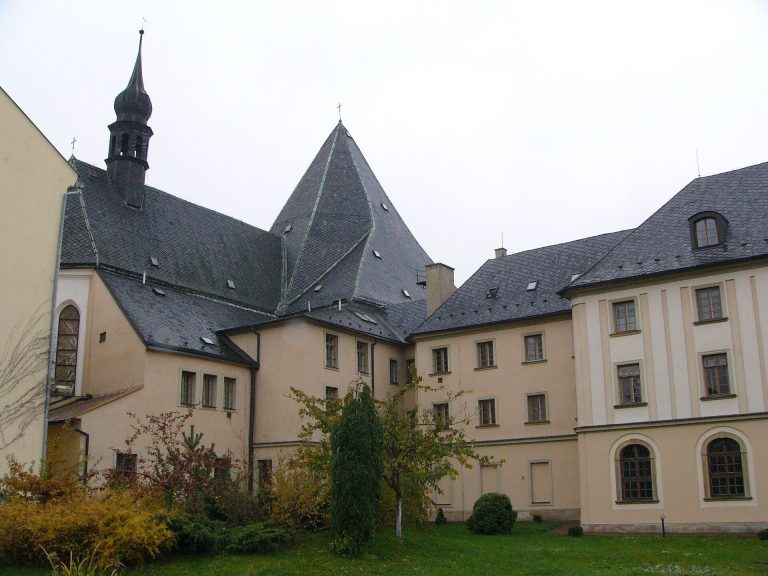
The Theresian Arsenal stands on Bishop’s Square and now houses the library of Palacký University. The Old Town Barracks on Studentská Street were built in 1810. The House of the Army occupies a former Augustinian monastery at the corner of 1 May Avenue and Pekární Street; a rectangular tower of originally Gothic city-wall construction is incorporated into its northwestern side.
The Haná Barracks stand on 1 May Avenue, while the Water Barracks and associated casemates occupy Freedom Avenue. A casemate is a fortified vaulted space used for shelter or artillery. The Maurice Barracks occupied the site of the present Komenium primary school, whose rear wing is partly preserved. The City Arsenal stood on the site of the present Na Hradě primary school and was demolished.
Powder stores and former gates
The Powder Tower stood in the block between 8 May Street and Sokolská Street before its demolition. The Military Bakery in the Hospital Bastion is a pentagonal structure that now houses the Podkova Gallery. These surviving and reused buildings preserve parts of the fortress’s logistical and military infrastructure alongside the larger defensive works.
Outer forts and military residences
Fort ring and post-siege forts
The later fortress ring included forts near Křelov, Neředín, Slavonín, Chválkovice, Tafelberg, and Nová Ulice, as well as Radíkov Fort. Tafelberg Fort was built after the 1758 siege rather than as part of the later Olomouc ring and now serves as the archive of Olomouc University Hospital. Fort Galgenberg was likewise constructed after the siege and belonged to the earlier expansion rather than the formal ring.
Radíkov Fort was the last fort built for the expanded system, in 1874. It belongs to the group of detached works that extended the fortress beyond the medieval city walls and reflected the continuing effort to place defensive positions farther from the urban center.
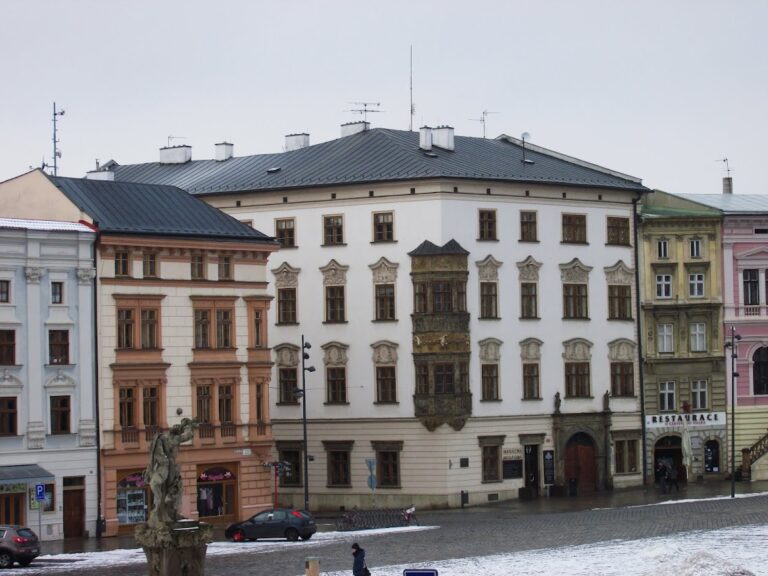
Edelmann Palace
Edelmann Palace on Upper Square served from 1816 as the residence of the fortress commander. Field Marshal Josef Radetzky von Radetz lived there between 1829 and 1831, linking the palace to the nineteenth-century military administration of Olomouc.