Olomouc Town Hall: A Municipal Building in Czechia
Site at a Glance
- Popularity
- Medium
- Country
- Czechia
- Primary era
- Medieval
- Eras represented
- Medieval, Early Modern, Modern
- Civilizations
- Austria-Hungary, Habsburg, Holy Roman Empire, Margraviate of Moravia
- Site type
- Civic
- Remains
- Town Hall
On this page13 sections
History
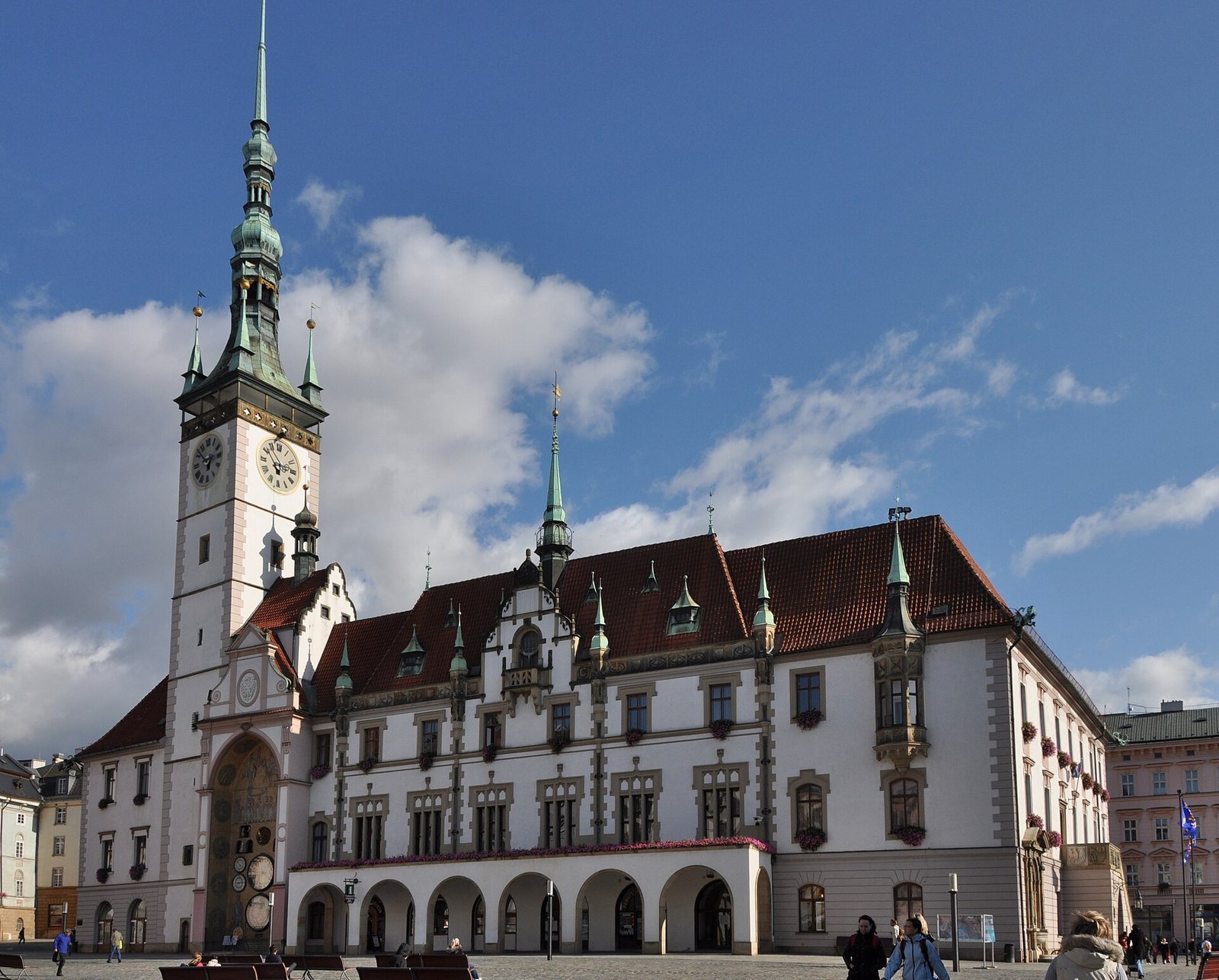
Olomouc Town Hall is a municipal building on Horní náměstí in Olomouc, Czechia, whose Gothic construction began with a foundation stone in 1378. Its origins lay in a 1261 privilege from King Přemysl Otakar II of Bohemia, which permitted the city to build a municipal building. The town hall became a centre of civic government and market activity in Olomouc’s historic centre, behind the Holy Trinity Column.
Foundation and medieval development
In 1378, Jobst of Moravia, a Moravian ruler, authorized the Gothic town hall. The town council was established as construction began. A market hall was attached to the building, and a marketplace was arranged around it, providing revenue for the city.
A temporary timber town hall served from 1410 to 1411. In 1415, work stopped as the city redirected funds to its defence against the Hussites, followers of a religious reform movement in Bohemia who fought in the Hussite Wars. The building burned around 1417, but its basic stone structure was complete by 1420. Tradition places the astronomical clock in this early structure, although its first written mention appears in a 1519 humanist work by Štěpán Taurin.
Construction resumed in the 1440s, and the tower was roofed before the building work was completed in 1443. A major rebuilding in 1474 added a second storey to the section containing merchants’ shops, a large ceremonial hall in the Gothic style, and a room for the astronomical clock. The Chapel of St Jerome was completed in 1488 and consecrated in 1491. Around 1500, a pillory was installed on the south side. In 1529, the council chamber was rebuilt and an eastern portal added.
Renaissance and later changes
In 1591, stonemason Hans Jost built a Mannerist loggia, an open-sided gallery, with a double-flight staircase. From 1601 to 1607, the tower was raised to 75 metres and given a Renaissance arcade gallery. Baroque changes, particularly to the façade, followed in the 1720s; further alterations affected the exterior and courtyard buildings during the first half of the nineteenth century.
In 1849, the town hall was required to house the newly established provincial court. The court and other state institutions remained there until 1901, while the council, mayor, and other municipal officials worked from nearby Edelmann Palace. A fountain showing a boy riding a dolphin was installed at the western façade in 1898. Between 1898 and 1904, a reconstruction in a historicist style, drawing on earlier architectural forms, removed the Baroque alterations. Municipal authorities then returned to the town hall.
Twentieth-century reconstruction and restoration
Events at the end of the Second World War damaged the astronomical clock. Karel Svolinský reconstructed it between 1947 and 1955, giving it a new artistic design. The western fountain was damaged in 1945 and replaced three years later by a statue of Hygieia, the Greek goddess associated with health.
Work on the roofs, façades, and projecting exterior features took place in the 1990s. Comprehensive repairs and restoration followed in 2017 and 2018, with the work officially completed on 27 October 2020. The project restored the heraldic galleries on both sides of the building, and the rulers’ and regional coats of arms regained colours removed during an early-twentieth-century reconstruction. The town hall also houses exhibitions about Olomouc, the building, and its astronomical clock.
Remains
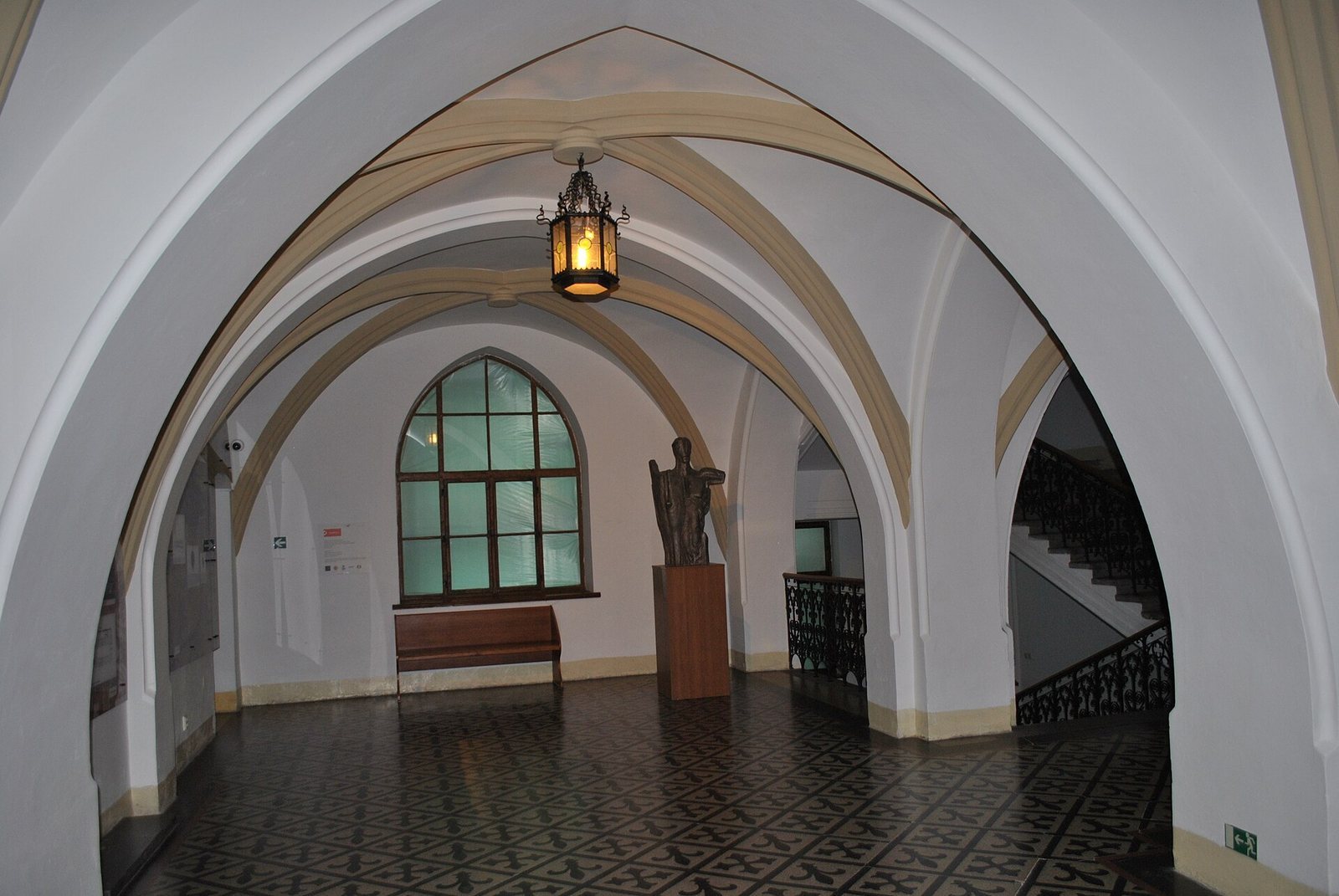
The town hall is a rectangular, four-wing building of two storeys arranged around an inner courtyard. Its fabric combines Gothic, Renaissance, Baroque, and Gothic Revival elements. A 75-metre tower rises above the complex; Gothic corridors and a large hall are among its interior features.
Courtyard and exterior features
Loggia and portals
On the eastern side, the Renaissance loggia opens onto a double-flight staircase. Its low parapet bears coats of arms representing lands of the Austro-Hungarian Monarchy, a dual monarchy in Central Europe from 1867 to 1918. Olomouc’s coat of arms appears beneath the projecting roofline. A richly ornamented portal to the first floor carries the coat of arms of Moravia above its opening.
Façade ornament and fountain
Stone shields bearing coats of arms decorate the western staircase, while the restored heraldic galleries extend along both sides of the building. At the southwest corner, a sundial was restored in 2020. The exterior also includes a window with S-shaped stone tracery, ornamental stonework that divides or decorates an opening, and coloured stained glass. A nearby door repeats the window pattern in its decoration. A sculpted animal-form gargoyle projects from the roof edge.
The fountain at the western façade first showed a boy riding a dolphin. After wartime damage, a statue of Hygieia replaced it in 1948. The earlier and replacement designs mark successive changes to this part of the exterior.
Courtyard arcade and bells
The courtyard arcade is formed by rows of pointed arches. Two unusually flat bells, once suspended in the tower’s large lantern and struck to indicate the time, are now displayed on a metal frame in the courtyard. The larger bell dates to 1501 and the smaller to 1603.
Council hall and chapel
Council hall
The council hall occupies the first floor of the north wing. Its original nine sections of vaulted ceiling were reduced to six during the 1902–1904 reconstruction. The hall has a cross vault, formed by intersecting vaulted sections, with ribs of pear-shaped profile. Each projecting support, or corbel, has different relief decoration. Many carry floral or animal designs, including a lizard, eagle, or lion; others display coats of arms.
Painter Karel Wild made the hall’s murals during the reconstruction, with historical subjects selected by archivist and historian Hans Kux. On the east wall, opposite the entrance, Olomouc is depicted. The south wall shows Přemysl Otakar II presenting the town-hall charter to city councillors. Near the entrance used by town-hall representatives, four coats of arms and a copy of a codex associated with Václav of Jihlava appear above the door.
Other scenes show Rudolf of Habsburg, a medieval ruler of the Habsburg dynasty, confirming Olomouc’s existing privileges near Ivančice; the 1469 union of Litovel, Uničov, and Olomouc; and Prussian troops besieging the Olomouc fortress. Prussia was a German kingdom.
Chapel of St Jerome
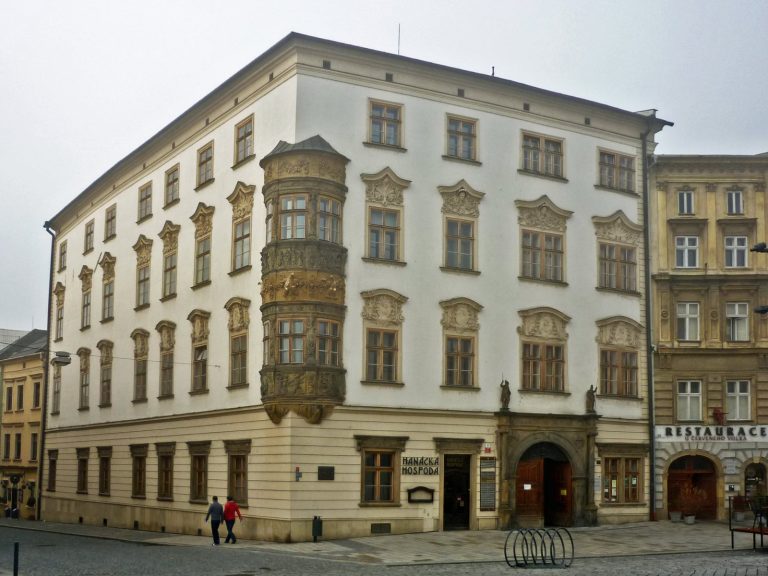
The first-floor Chapel of St Jerome projects from the south side of the eastern wing. Its five-sided sanctuary forms a closed stone bay two storeys high. The chapel’s Gothic oriel, a projecting upper-storey bay, rests on the shoulders of a bearded male figure thought to represent the building’s creator. The lower part also bears the coat of arms of the Lords of Švábenice, a Moravian noble family.
Intersecting mouldings shape the base, with four columns at the sides. Above them are animal-shaped gargoyles and decorated canopies. Three rectangular fields above the gargoyles contain tracery, diamond, and semicircular designs with S-shaped forms, while a band of foliage ornament runs along the top. A lamb-shaped keystone has also prompted a proposal that an earlier Chapel of St Lawrence stood beside the staircase; the idea remains uncertain.
Astronomical clock
The astronomical clock is set into the town hall’s north wall within a pointed-arch niche nearly 14 metres high. Its central dial shows the positions of planets against the zodiac. The display is heliocentric, representing the planets in relation to the Sun, a form used by only a few astronomical clocks around the world. The clock’s present design follows Socialist Realism, an officially promoted style in Communist states that often depicted workers and social life.
A mosaic behind the clock combines the Ride of the Kings, a traditional Moravian folk procession, with a Pentecost procession of little queens, a worker, and a chemist. Medallions around the niche represent the months. The calendar beneath the clock includes name days and dates associated with the Communist regime, among them the birthdays of Joseph Stalin, leader of the Soviet Union, and Czechoslovak Communist leader Klement Gottwald. It also marks the 1917 Bolshevik revolution in Russia and the 1942 destruction of Lidice by Nazi forces.
The clock’s carillon, a set of bells arranged to play melodies, consists of sixteen bells cast in 1898 by the Austrian foundry of Peter Ignatz Hilzer. At noon, moving blacksmith figures accompany the hour striking. An original pastoral piece for organ follows as figures of pipe players move. Figures representing occupations, including a laborer, baker, official, and female volleyball player, then pass through the clock’s windows for five minutes to the bells’ melody, ending with the crow of a brass rooster.
The clock’s music changed over time. Religious hymns linked to the church calendar once formed most of its programme. The Austrian anthem was added in 1898 and replaced by the Czechoslovak anthem in 1918. During the clock’s 1950s reconstruction, proposals to add The Song of Labor or The Internationale were rejected in favour of folk songs from Haná, a region of Moravia with a distinct folk culture.
Sundials at the town hall served to synchronize the astronomical clock with sidereal time, measured by reference to the apparent motion of the stars. A sundial was removed in 1918 because of its pro-Habsburg motifs and restored in 2020.