Ardamullivan Castle: A Sixteenth-Century Tower House in Ireland


Site at a Glance
- Rating
- 4.8
- Popularity
- Very Low
- Country
- Ireland
- Primary era
- Early Modern
- Eras represented
- Early Modern
- Civilizations
- Irish
- Site type
- Military
- Remains
- Castle
On this page6 sections
History
Ardamullivan Castle is a sixteenth-century Irish tower house, a fortified residential tower, in County Galway, Ireland. Associated with the O’Shaughnessy clan, it stood within the territory of Cenél Áeda na hEchtge, which the clan ruled. The castle was first documented after the death of Ruaidhrí Gilla Dubh Ó Seachnasaigh in 1567, while its construction is also attributed, with some uncertainty, to the clan chief Robert O’Shaughnessy.
Conflict within the O’Shaughnessy clan
Ardamullivan became the focus of a struggle in 1579, when Diarmaid Riabach Ó Seachnasaigh and his nephew John, both members of the O’Shaughnessy clan, fought over the castle and its associated lands. Both men died in the conflict. Diarmaid had earlier become known for betraying Richard Creagh, the Roman Catholic Archbishop of Armagh, to the authorities while Creagh was a fugitive.
Decline and restoration
The O’Shaughnessy clan lost its lands during the Cromwellian reconquest of Ireland in the 1650s, the English Parliamentarian campaign associated with Oliver Cromwell. After the dispossession, Ardamullivan Castle declined and gradually became ruinous.
Restoration work in the 1990s included fitting a new roof and replastering the building with lime mortar. Late-medieval wall paintings were discovered in the course of the work. The castle is state-owned and protected as a National Monument of Ireland, a legally protected monument recognized as nationally important, under official reference number 252.
Remains
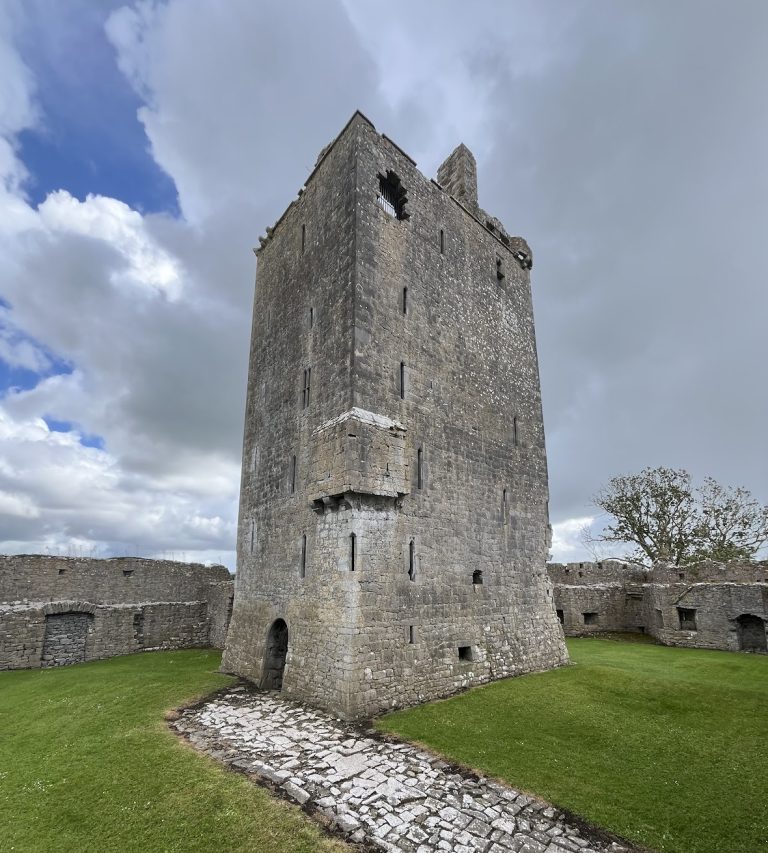
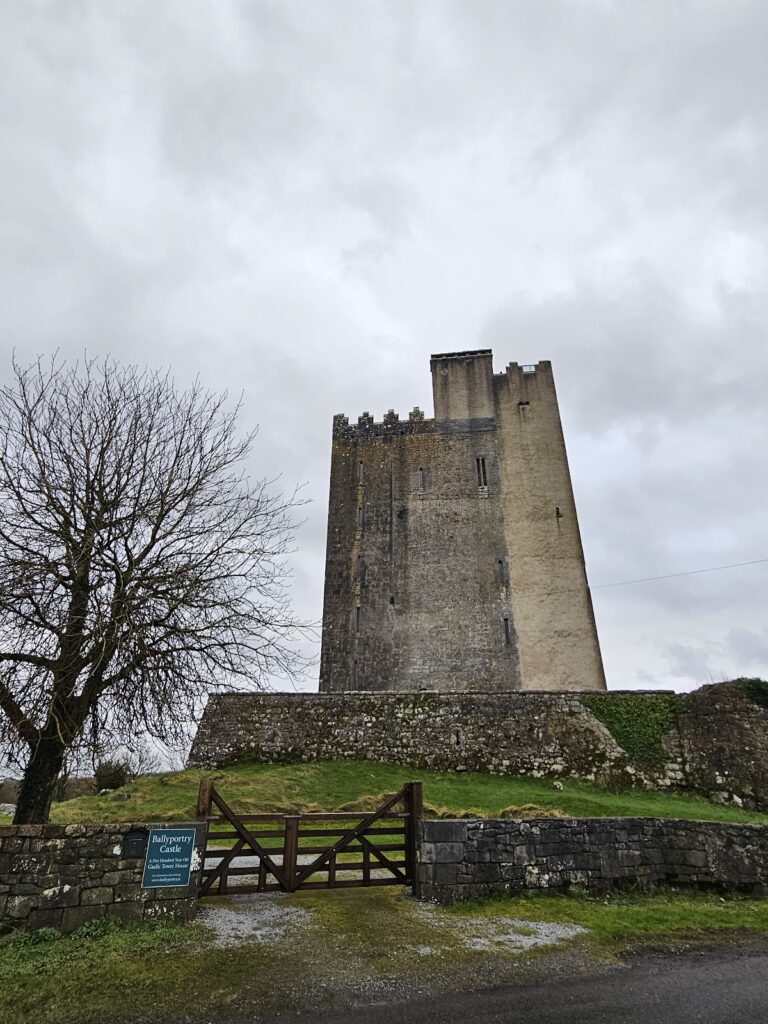
Ardamullivan Castle stands at Ardamullivan in Shanaglish, about 8 kilometres south of Gort and 2 kilometres southwest of Lough Cutra. It occupies a narrow rocky outcrop near rocky upland terrain and woodland. The six-storey tower is built of dressed stone and has been plastered. Part of the original defensive wall survives, while traces of further walls around the building may represent the remains of its bawn, an enclosed defensive yard.
Defensive features
The tower retains traces of bartizans, projecting corner turrets that allowed defenders to observe and fire along the walls, at the northeast and southwest corners and along the southern wall. A machicolation, a projecting opening used to attack people below, and numerous narrow slit windows also formed part of its defences. Together with the surviving wall fragments, these features show how the residential tower was combined with measures for protection.
Interior features and wall paintings
Inside the tower are open fireplaces and a slopstone. The restoration revealed paintings in both the lower and upper parts of the building. Their subjects include a bishop, a stag hunt, Saint Christopher, scenes from the Passion, and the archangel Michael weighing souls on Judgement Day. The paintings have been compared with those at Abbeyknockmoy and Clare Island Abbey, linking Ardamullivan’s surviving decoration with other late-medieval Irish religious imagery.
Nearby sites