Château de Mesmont: A Fortified Estate in France


Site at a Glance
- Rating
- 4
- Popularity
- Very Low
- Country
- France
- Primary era
- Early Modern
- External website
- Open
- Eras represented
- Early Modern
- Civilizations
- French
- Site type
- Domestic
- Remains
- Castle
On this page10 sections
History
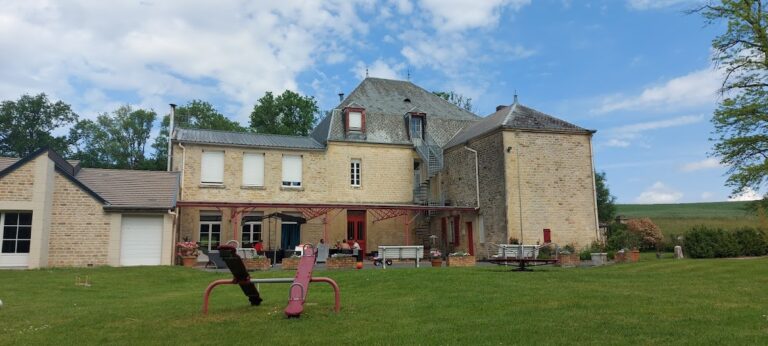
Château de Mesmont, also known as Château de Romance or Château de Mesmont-Romance, is a fortified château in France, slightly outside the village of Mesmont in the Ardennes. Its present style suggests a seventeenth-century building, although the dates of its construction and of the destruction of an earlier château are unknown.
An earlier château and the Villelongue family
An earlier construction at Mesmont appears in a 1607 gouache by Charles III de Croÿ, a nobleman and patron known for commissioning detailed illustrated views and maps. The earlier château may have been destroyed in 1617 by royal troops moving toward Rethel under the Duke of Guise and the Marquis of Thémines. This action took place during Louis XIII’s effort to end his mother’s regency, the period when a ruler governed for a monarch who had not yet assumed personal authority. The connection between the military advance and the château’s destruction remains uncertain.
At the beginning of the seventeenth century, the lands of Wasigny and Mesmont belonged to the Villelongue family. In 1639, the family sold its possessions at Mesmont to the Romance family, with which it had formed family ties. Germain-Hyacinthe de Romance, Marquis of Mesmont and son of Hugues-Étienne de Romance, Marquis of Acy-Romance, later inherited the property.
Revolutionary confiscation and twentieth-century rebuilding
Germain-Hyacinthe de Romance emigrated during the French Revolution, and his possessions were confiscated. The château later passed to the Ternaux-Compans family, which included the diplomat Maurice Ternaux-Compans, an official engaged in political relations on behalf of a state.
During the First World War, a fire on 26 February 1916 destroyed much of the château. Maurice Ternaux-Compans rebuilt and restored the estate during the interwar period. Château de Mesmont has remained privately owned and has been registered as a French historic monument since 1994.
Remains
The château is organized around a rectangular central platform surrounded by moats. Buildings occupy the northern and eastern sides without fully enclosing the platform. Brick and stone form the principal visible materials, while the surviving structures combine fortified access arrangements with residential and service buildings.
Platform and access
Moats and bridges
A permanent bridge leads to the entrance pavilion, followed by a drawbridge that could be raised or lowered to control access. The lowered arch of the carriage entrance fits into a rebate in the drawbridge deck, linking the bridge mechanism directly with the fortified gateway.
Entrance pavilion
The entrance pavilion opens onto the central platform. Its facade is built of brick, with stone surrounds framing the openings and corner stones arranged in alternating projections, known as harped quoins, to bind the walls together. A steeply pitched roof covers the pavilion. After the 1916 fire, its base remained among the surviving elements.
Service buildings
A service building stands opposite the entrance pavilion. Its dormer windows project from the sloping roof and are crowned by triangular pediments. A separate pavilion stands somewhat apart from this building and is finished with a cornice supported by small projecting blocks called modillions.
Residential buildings
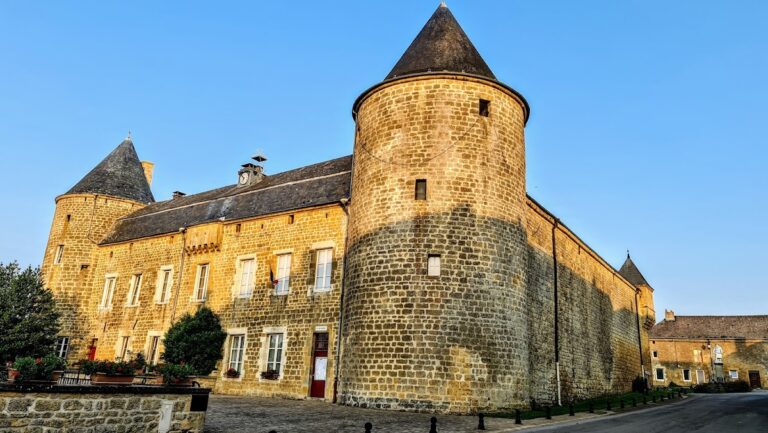
Residential block and round tower
On the northern side of the platform is the principal residential block, or corps de logis, connected to a large round tower. The tower has a stone exterior at its base and ground-floor level, while its upper storey is faced in brick. The adjoining residential building retains its stone masonry. This masonry, together with the tower’s stone lower work, formed part of the fabric that survived the wartime fire, alongside the fixed bridge and service buildings.