Palais de Charlemagne: A Renaissance Remnant of Attigny’s Carolingian Palace


Site at a Glance
- Rating
- 4
- Popularity
- Very Low
- Country
- France
- Primary era
- Early Modern
- Eras represented
- Early Modern
- Civilizations
- French
- Site type
- Domestic
- Remains
- Elite Residence
On this page6 sections
History
The Palais de Charlemagne is a sixteenth-century French Renaissance residential building in Attigny, France, constructed on the ruins of an earlier Carolingian royal palace. The site became part of the Frankish royal estate when Clovis II, a seventh-century Merovingian king, acquired it in 651. Its historical importance grew from its position near the Roman road linking Reims and Trier, which made Attigny a useful stopping place between the eastern and western parts of the Frankish kingdom.
From Royal Estate to Carolingian Residence
In 749, Attigny became a residence of Pepin the Short, the Frankish ruler who became king in 751 and founded the Carolingian royal line. The palace formed one of his occasional residences within a rural estate. Under the Carolingian dynasty, which ruled the Frankish kingdoms from the eighth to the tenth centuries, Attigny continued to serve royal itineraries and political purposes.
Several Carolingian rulers stayed at Attigny, including Carloman I, Charlemagne, Louis the Pious, Charles the Bald, Louis III, Carloman II, Charles the Fat, and Charles the Simple. Charles the Bald visited most often, with 23 recorded stays. Charlemagne stayed four times, including two Christmas celebrations. The palace therefore served not only as a residence but also as a place where royal authority was exercised through travel, ceremony, and political gatherings.
Assemblies and the End of Royal Visits
Attigny’s location also helped make it a meeting place for rulers from different parts of the Frankish world. General assemblies, royal colloquies, meaning formal meetings between rulers or political representatives, and councils were held there. These gatherings connected the western kingdom that developed into France with Lotharingia, the middle kingdom formed from the former Carolingian empire.
The palace’s role declined after the political geography of the Frankish kingdoms changed. Kings of France ceased visiting Attigny after 931. The Carolingian palace was later replaced by the present Renaissance building, which was erected on its ruins during the sixteenth century. It was also historically known as the Palace or Dome of Charlemagne and was once presented as a surviving part of the Carolingian palace. Henry IV probably stayed at Attigny during his two passages through the town, in October 1591 and October 1592. The building was classified as a French historic monument in 1922.
Remains
Renaissance Building
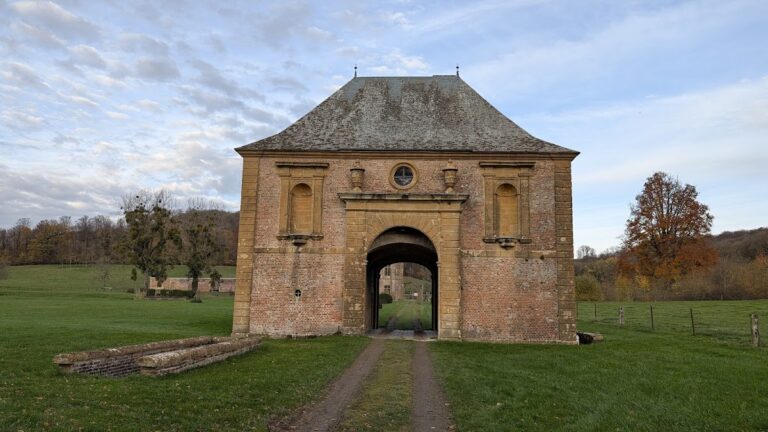
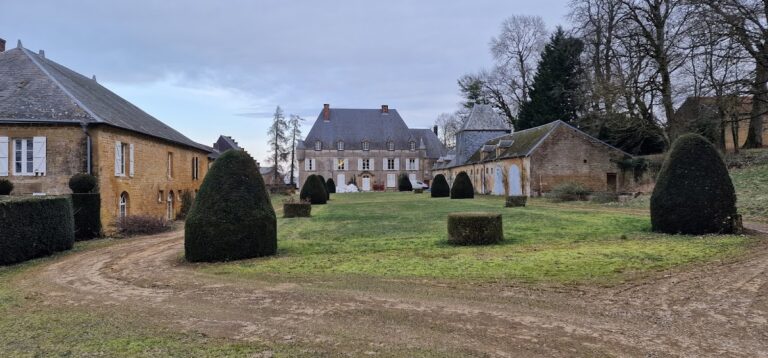
The surviving structure is a reduced residential building opening onto Place Charlemagne. Its present form consists of a passage, an upper floor, and an attic. The passage has a round arch and Renaissance decoration, including small columns with capitals, the upper parts of the columns, together with a vault, a curved structure spanning the space, and sculptures. The building’s fabric belongs to the sixteenth-century reconstruction carried out on the site of the earlier royal palace.
Commemorative Plaques
Two plaques on the side facing Place Charlemagne preserve the historical associations of the former palace. One is positioned to the right of the passage and the other to the left. Together, they commemorate the acquisition of the estate, assemblies of the Franks, councils held at Attigny, and meetings between kings. Their inscriptions connect the modest surviving Renaissance structure with the wider political and religious history of the royal site.