Castle of Enguera: A Muslim-Origin Fortress and Santiago Commandery in Spain


Site at a Glance
- Rating
- 4.3
- Popularity
- Very Low
- Country
- Spain
- Primary era
- Medieval
- External website
- Open
- Eras represented
- Medieval
- Civilizations
- Almohad, Crown of Castile
- Site type
- Military
- Remains
- Castle
On this page9 sections
History
The Castle of Enguera is a medieval fortress in Spain, standing near the urban centre of Enguera in La Canal de Navarrés, Valencia Province. Probably built under Muslim rule during the eleventh or twelfth century, it occupied a strategic mountain summit and controlled the surrounding territory. The settlement of Enguera, together with its dependent villages and farmsteads, developed during the Muslim period, although the place-name may be older.
Muslim Enguera and the taifa period
Enguera briefly gained regional importance in the twelfth century, when it became the capital of a taifa, an independent Muslim kingdom formed after the fragmentation of the Caliphate of Córdoba. This kingdom extended as far as Denia and included dependent settlements. The castle belonged to a wider defensive landscape influenced by Xàtiva, whose authority extended across a broad region and included control of the ancient Via Augusta, the major Roman road connecting northeastern Iberia with central Iberia and present-day Andalusia.
The fortress also helped control routes approaching from the west. Roads ran at the foot of the mountain, including the route linking the Almansa and Ayora area with the Cáñoles River valley. Travellers could pass through the old La Alcudia pass or follow an alternative route towards Montesa across the La Plana range near El Piquet. Secondary roads connected other parts of the surrounding territory. These routes were already in use by at least the Iberian period, the era of the pre-Roman peoples and cultures of eastern and southern Iberia.
Christian conquest and the Order of Santiago
After the Christian conquest, Castilian troops under Pedro Núñez de Guzmán captured Enguera Castle and adapted it for continued military use. James I of Aragon, known as James the Conqueror, later incorporated Enguera into the Kingdom of Aragon. He granted Enguera and its territory, including the castles of Garamoixent and La Mola, to the Order of Santiago. This Christian military-religious order was established to fight Muslim forces and protect territory. The holdings together formed the Commandery of Enguera, an administrative territory governed for the order.
The castle served as a barracks, a defensive post, and a means of protecting royal interests through the knights of Santiago. It also helped defend the dependent settlements and their economic resources. Its frontier position gave it continuing strategic value within a network that included the fortresses of Millares, Quesa, Navarrés, Montesa, Garamoixent, Moixent, and La Mola. Until 1477, it additionally functioned as a northwestern control point for the Muslim vassal lordship of Montesa.
A donation made in 1244 transferred Enguera and its castle to Pelayo Pérez de Correa, Master of the Order of Santiago. In 1276, the order received permission to obtain wheat for the fortress during the Mudéjar revolt led by Al-Azraq. Mudéjars were Muslims who remained under Christian rule. The revolt continued in the surrounding territories until 1304, making the supply and defence of the castle an immediate concern.
Conflict, repair, and royal administration
Enguera was attacked by Pedro de Jérica in 1336 during a dispute between Pedro IV of Aragon and his stepmother, Eleanor of Castile, the widow of Alfonso IV, over inheritance claims. A 1350 inventory of fortifications protecting the territory south of the Júcar also listed Enguera, confirming its place within the region’s defensive system.
On 16 May 1365, during the War of the Two Peters, a conflict involving the Castilian and Aragonese crowns, Pedro IV ordered García de Lóriz and the jurats of Xàtiva to demolish the castle. He feared that Castilian troops might occupy it and use it to threaten the security of Xàtiva. The demolition was probably incomplete. In 1367, the castle was scheduled to receive weapons, and in 1369 it was ordered to receive provisions and repairs.
The fortress remained under close royal supervision. In 1370, the Bailiff General of the Kingdom, a senior royal official in the Kingdom of Valencia, ordered an inspection after learning of its condition. The inspection found that maintenance was poor, and a visit by the Lieutenant Governor in 1371 indicates that the problems had not been resolved. In 1372, at the request of the senior commander of Montalbán, Pedro IV revoked Eximen d’Esparça’s appointment as castle warden, the officer responsible for the custody and defence of the fortress.
The castle was still functioning under the Order of Santiago in 1475. That year, King John II ordered the release of three Muslim prisoners held there. They had been captured during a punitive expedition against the interests of the Marquis of Villena, commanded by Ferrando Dixar, and were brought to Enguera, where Ferrando’s brother, Johan d’Ixar, served as the order’s commander.
Decline and protection
By 1575, the castle had fallen into ruin. When Philip II sold Enguera to the Borja family, it was described as a ruined fortress on a high mountain within the town’s territory. The sale formed part of the Crown’s effort to raise money for costly European wars undertaken to maintain its political and military position.
The remaining structures suffered further damage in the earthquake of 1748. Exposure and the passage of time increased the deterioration. The Castle of Enguera was declared a Spanish Asset of Cultural Interest in 2001 and entered in the ministerial register under number RI-51-0010676.
Remains
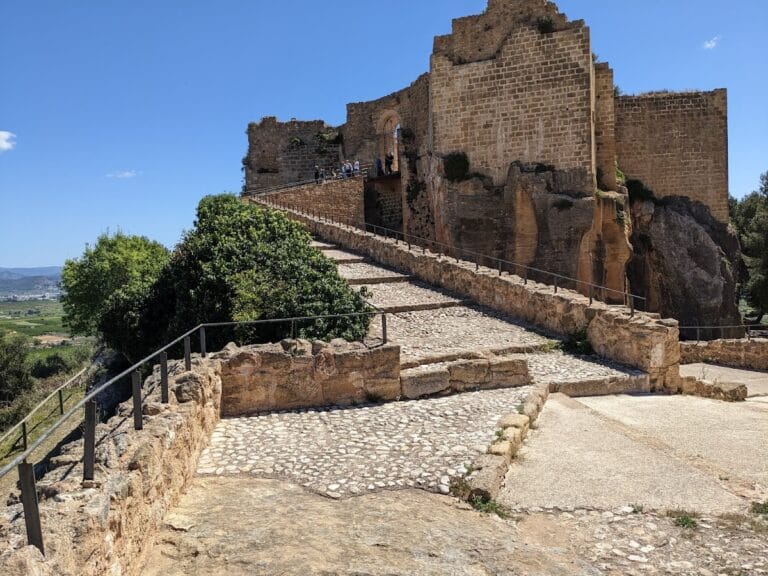
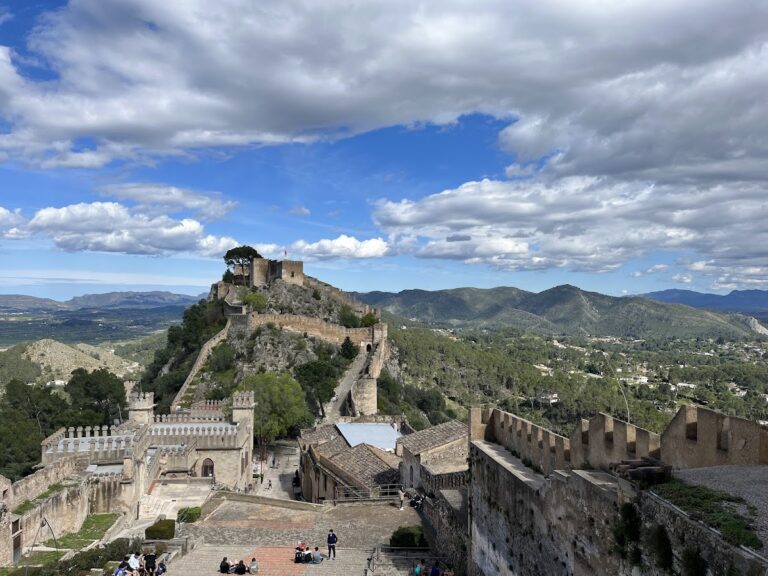
The remains occupy the summit of a mountain and consist of two walled enclosures. The lower enclosure follows the shape of the terrain and forms an outer defensive line around the foot of the principal castle. Above it, the upper enclosure has an almost rectangular plan and contains walls, towers, and the remains of a large central structure. Rammed earth is the dominant construction method, although the upper enclosure also includes rubble masonry and limited ashlar, which uses regularly cut stone blocks.
Lower enclosure
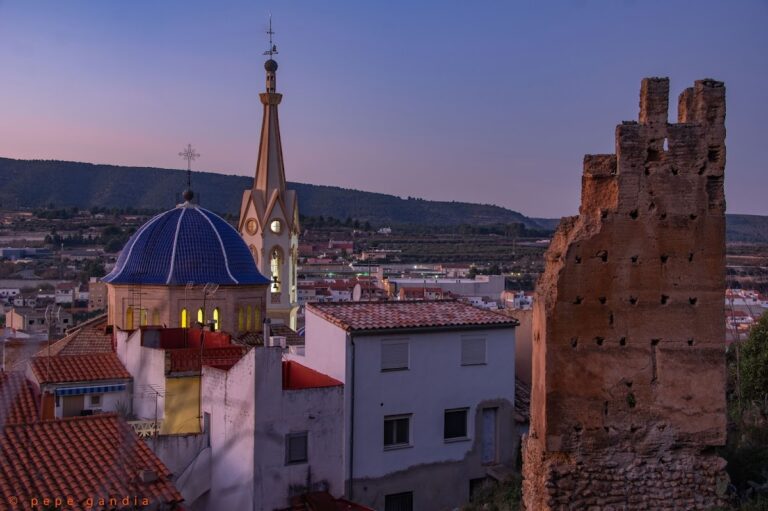
The lower enclosure has an irregular polygonal layout adapted to the mountain. It preserves numerous remains associated with the Islamic phase of the fortress. Several rectangular towers survive in badly damaged condition, together with an earlier lower defensive work. Their position within the outer enclosure shows how the castle’s defences extended beyond the principal stronghold and followed the natural contours of the summit.
Upper enclosure
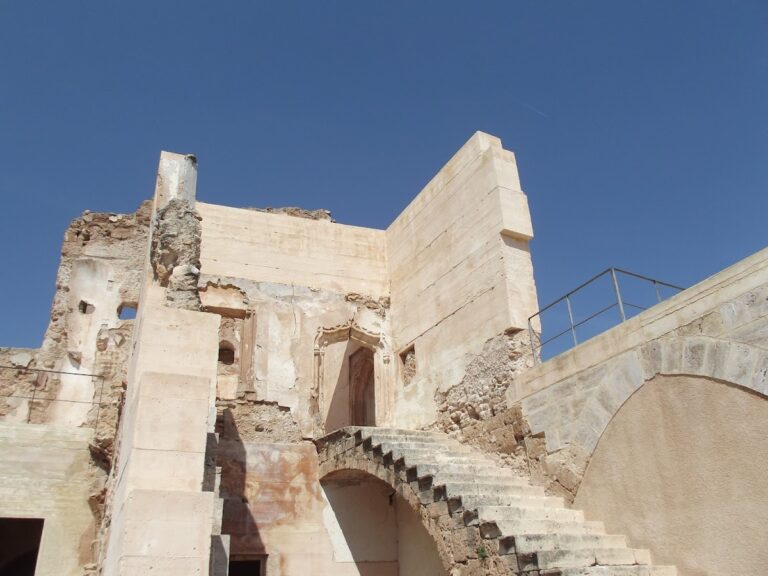
The upper enclosure is nearly rectangular and preserves walls and corner towers that appear to belong to the Christian period. These parts were built mainly with lime and rubble masonry. On the southern side, an advanced tower retains narrow arrow slits, openings through which defenders could use bows or other projectile weapons. The same area contains a bastion, a projecting defensive work, with two towers.
At the centre of the upper enclosure are the remains of a large tower built with ashlar blocks. It may have served as the Christian keep, the principal or strongest tower of the castle. The surviving structure forms the central element of the upper fortification, while the surrounding walls and corner towers provided its defensive framework.
Rammed-earth walls and false ashlar
Most of the castle was constructed with rammed earth. Builders poured earth-and-lime mortar mixed with rubble into temporary moulds and compacted it to form the walls. Some sections of the upper enclosure instead use rubble masonry, while regularly cut stone appears only in relatively limited areas.
The northeast corner of the second enclosure preserves a false-ashlar pattern. Rectangular mouldings outline shapes resembling large stone blocks, creating the appearance of ashlar construction. This treatment was not simply ornamental. It projected an impression of structural strength intended to discourage attackers.
Comparable treatment in regional fortifications is associated with Almohad construction, a building tradition linked to the Muslim dynasty and political movement that ruled much of the Maghreb and parts of Iberia during the twelfth and early thirteenth centuries. Because this form of construction ceased to be used after the Christian conquest, the false-ashlar work at Enguera dates no later than the final two decades of the twelfth century, approximately 1184 to 1199, the period when Abu Yusuf Ya’qub ibn Yusuf al-Mansur ruled as Almohad caliph.