Château de Tramezaygues: A Fortified Frontier Castle in France


Site at a Glance
- Rating
- 4.1
- Popularity
- Very Low
- Country
- France
- Primary era
- Medieval
- Eras represented
- Medieval, Early Modern
- Civilizations
- French
- Site type
- Military
- Remains
- Castle
On this page11 sections
History
Château de Tramezaygues is a fortified castle in Tramezaïgues, France, built as a military and defensive stronghold on a strategic spur above the confluence of the Neste d’Aure and the Rioumajou torrent. The castle is first recorded in the twelfth century, although its construction may reach back to the eleventh century and its origins remain uncertain. Parts of its keep date from the twelfth century.
A Frontier Watch Post
The castle monitored the approach to the Aure Valley and the nearby frontier with Spain. Its keep served as a watch post and probably as a signal tower, a defensive structure used to observe movement and relay warnings. Fires communicated alerts between watchtowers in the valley, linking Château de Tramezaygues with other defensive positions, including the tower of Cadéac. It is one of the valley’s last surviving remains associated with this system of watch and signal towers.
Château de Tramezaygues continued to function as a frontier-surveillance post until the French Revolution. It also served as a prison and became a customs post during the seventeenth century, reflecting the castle’s continuing administrative and military use.
Seventeenth- and Eighteenth-Century Defences
In 1706, wooden palisades protecting the lower bailey, an enclosed courtyard within the castle’s defences, were replaced by masonry walls fitted with gunports. In 1712, Louis XIV, the Bourbon king of France from 1643 to 1715, sent 100 men to guard the frontier with Spain. Fifty of them were stationed at Château de Tramezaygues, while the local population was required to feed and supply the troops.
Decline and Preservation
After the French Revolution, the castle lost its military importance. It remained in use and was maintained until 1808, after which it fell into decline. The ruins were listed as historic monuments in 1980. Around the same period, the commune attempted to transfer them to Isabelle Mir, a former ski champion, but the courts annulled the transaction because the municipal authorities had acted irregularly. Ownership consequently returned to the public, and the castle remains the property of the commune. The surviving remains were restored in 1990.
Remains
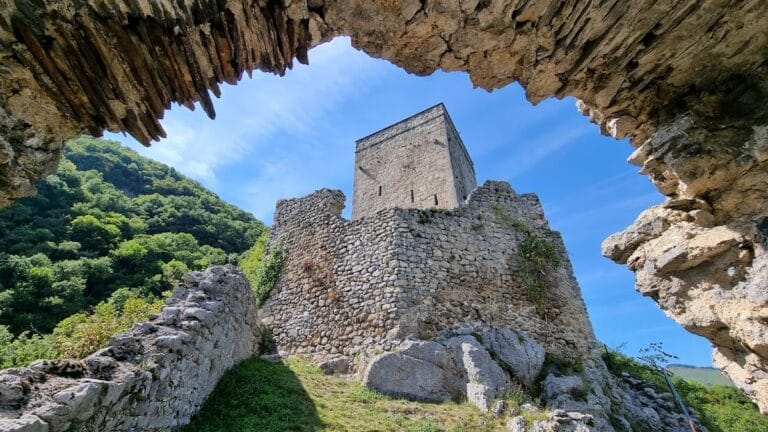
The castle occupies a spur at the meeting point of the Neste d’Aure and the Rioumajou torrent, at the foot of Pic de Tramezaïgues, which rises to 2,548 metres. The surviving ruins consist of the keep and part of the enclosing defensive walls, or enceinte. The south side was protected by a ravine, while three enceinte walls defended the other sides. The present enceinte dates from the seventeenth and eighteenth centuries, and the castle is now in a ruined condition.
The Keep
Three-Level Tower
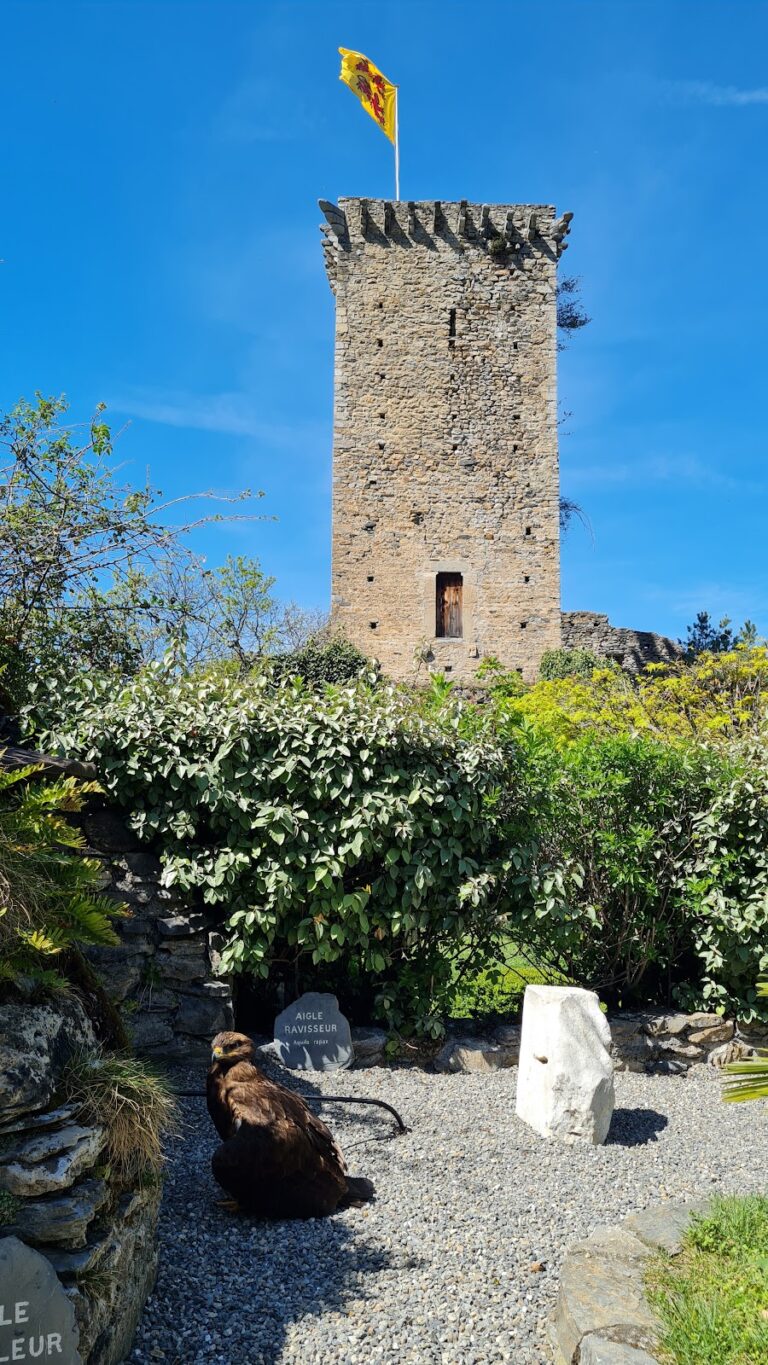
The original castle included a quadrangular keep, the principal fortified tower of a castle, with three levels. Its ground floor was windowless. A doorway on the north side gave access to the first floor at approximately 6 metres above ground level, reached by a ladder placed in the courtyard. The upper level probably ended in a crenellated terrace used for observation and defence. From this elevated position, the keep could perform its watch and signalling role.
Courtyards and Defensive Walls
Upper Bailey
The upper bailey contains remains identified as an officers’ chamber and a guardhouse. These features formed part of the castle’s internal military organization and survive within the broader defensive enclosure.
Lower Bailey
The lower bailey was initially enclosed by two wooden palisades. In 1706, these were replaced with masonry walls equipped with gunports, adapting the outer defence to the military requirements of the period.
Eastern Wall and Gate
The eastern wall faced the village and contained the entrance gate. It collapsed in 1966, leaving the keep and the surviving portions of the enceinte as the principal visible remains of the fortified complex.
Nearby sites