Château de Beaucens: A Ruined Viscountial Castle in France


Site at a Glance
- Rating
- 4.6
- Popularity
- Medium
- Country
- France
- Primary era
- Medieval
- External website
- Open
- Eras represented
- Medieval
- Civilizations
- Unclassified
- Site type
- Military
- Remains
- Castle
On this page8 sections
History
Château de Beaucens is a ruined castle in Beaucens, France, associated with the Viscounts of Castet-Loubon, usually called the Viscounts of Lavedan. Its construction history remains uncertain: the castle is described as dating from the fourteenth century, while another date places construction in 1037. The complex was altered and enlarged repeatedly during its history.
Residence of the Viscounts of Lavedan
The castle served as the ordinary residence of the viscounts and the administrative centre of their vicomté. A viscount was both a noble title and an administrative office. The Lavedan vicomté was described as the most powerful in Bigorre, and its possessions included seventeen towns in the Barèges valley.
From the fifteenth century, the viscounts seldom lived at Beaucens. They continued to use the castle when conducting business in the surrounding area. In 1560, during the conflicts that preceded the French Wars of Religion, Catholic forces pillaged it after the viscount had adopted the Huguenot cause. The Huguenots were French Protestants whose conflict with Catholic forces helped produce the religious wars of the sixteenth century.
Later Occupants and Revolutionary Upheaval
The castle remained inhabited in 1643, when it belonged to the House of Montaut-Bénac. Madame de Motteville stayed there while travelling to the marriage of Louis XIV and Maria Theresa of Spain, celebrated on 9 June 1660 at the Church of Saint John the Baptist in Saint-Jean-de-Luz. She compared Beaucens with the palace of the fairy Urgande.
Prince Charles Louis Gaspard de Rohan-Rochefort, described as the thirty-first and last viscount, later lived at Beaucens with his wife and cousin, Marie Louise Joséphine de Rohan. In 1792, during the French Revolution, he fled to Austria, leaving his wife and papers behind. His wife secured a divorce, while the papers were lost when the castle was set on fire. She retained part of the property and sold all her possessions in Bigorre in 1802. The castle then passed through a succession of owners.
Earthquake, Protection, and Reuse
An earthquake in July 1854 caused part of the western wall to collapse and severely destabilized the base of the square tower at the southwestern corner. In 1856, the castle became the property of Achille Marcus Fould, a prominent French banker and politician who restored it. Despite this intervention, the site remained a ruin overgrown with vegetation.
The surviving remains were listed as historic monuments in 1927. This designation provides legal heritage protection for a site considered historically or architecturally important. Since 1973, the castle has housed the Donjon des Aigles zoological park, changing the use of the ruined site while retaining its castle remains.
Legends and Local Resources
A Bigorre legend connects the castle with the lifting of a long siege. In one version, Charlemagne besieged a castle held by a Saracen leader named Mirât. An eagle carrying a trout in its beak supposedly persuaded Charlemagne that the defenders still had plentiful fresh food, leading him to abandon the siege.
The castle site is also associated with a cold sulphurous spring whose water was drunk by the inhabitants of Beaucens. A lead mine lies in the rock forming the castle’s base, and a copper mine was reported on Aiguesalat hill.
Remains
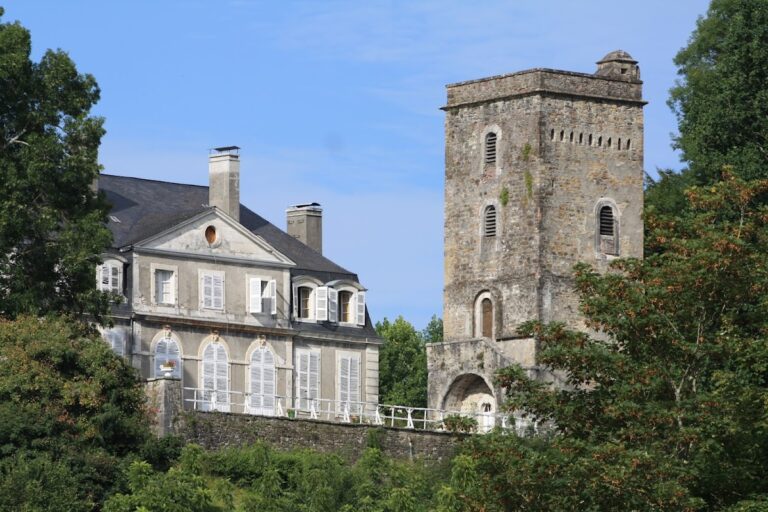
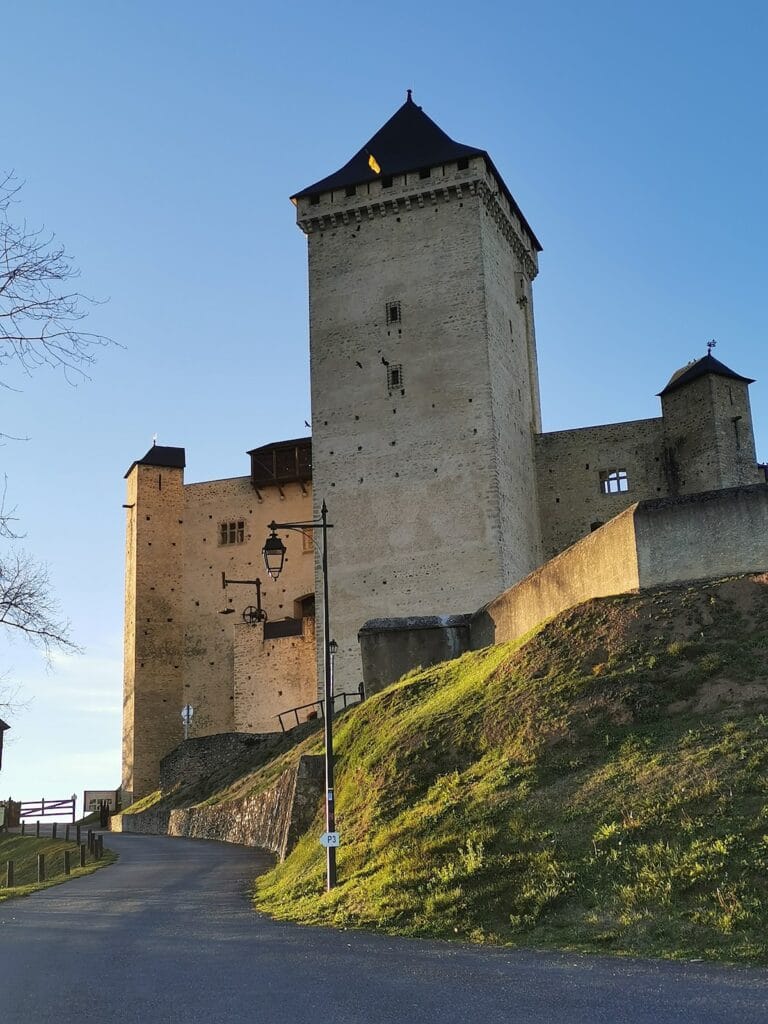
Château de Beaucens survives as a group of castle ruins incorporated into the Donjon des Aigles zoological park. The remains occupy rock overlooking the Gaves valley. The principal surviving fortified element is the keep, the castle’s main defensive tower, built with well-laid medium-sized masonry set in cement. The castle rock forms the foundation of the former complex, with the cold sulphurous spring at its foot and a lead mine within the rock.
Damaged Walls and Tower
The western defensive circuit was damaged by the earthquake of 1854. A fragment of the western wall fell, while the base of the square tower at the southwestern corner became so unstable that its collapse was considered imminent. These damaged elements remain part of the physical evidence for the earthquake’s effect on the castle.
Donjon des Aigles
Since 1973, the ruins have been used by the Donjon des Aigles zoological park, which holds a collection of birds of prey. Kites, vultures, eagles, sea eagles, falcons, and buzzards are flown around the castle remains. Demonstrations also feature an Egyptian vulture breaking an imitation ostrich egg with a stone, together with a condor, a secretary bird, owls, parakeets, and parrots.