Castillo de María de Huerva: A Muslim-Origin Fortress in Aragón


Site at a Glance
- Rating
- 4.1
- Popularity
- Very Low
- Country
- Spain
- Primary era
- Medieval
- External website
- Open
- Eras represented
- Medieval
- Civilizations
- Umayyad
- Site type
- Military
- Remains
- Castle
On this page6 sections
History
Castillo de María de Huerva is a Muslim-origin fortress in María de Huerva, Spain, built in the tenth century as part of the defensive system around Saracusta, the Arabic-era name associated with Zaragoza. During that century, Abd al-Rahman III, ruler of the Umayyad Caliphate of Córdoba, quartered part of his troops there while preparing an attack on Zaragoza.
A Fortress in the Defensive Perimeter
The castle formed part of a chain of fortresses protecting Saracusta. This defensive perimeter included Juslibol, Miranda, Alfocea, Torre de Candespina, El Castellar, Cadrete, María, Santa Bárbara, Santa Inés, and Pola. Its position within this network connected the fortress to the military organization of the surrounding territory.
Alfonso I of Aragón conquered the castle in 1118, during the same reign in which the Aragonese king led the Christian conquest of Zaragoza. Afterward, several royal governors commanded the fortress. In 1232, James II of Aragón granted it to Blasco of Aragón in exchange for Morella, a transaction that reflects the castle’s continuing importance in the medieval kingdom.
Lords, Conflict, and Decline
Castillo de María de Huerva later passed among various lords and gradually declined in importance. In the fourteenth century, it became involved in conflicts between the Unionists, supporters of the Aragonese Union who opposed royal authority, and royal troops. Roger de Lauria, a medieval admiral and nobleman, held the lordship in 1351. By 1428, the castle belonged to the Fernández de Heredia family, an Aragonese noble house later associated with the countship of Fuentes.
The castle is protected as an Asset of Cultural Interest under the second additional provision of Aragón’s Cultural Heritage Law 3/1999. Its designation was formalized by a resolution dated 17 April 2006 and published on 22 May 2006.
Remains
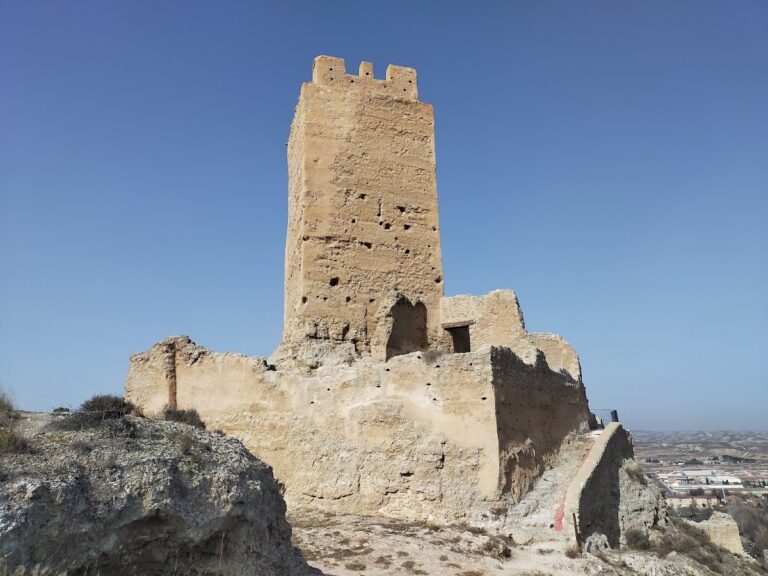
The fortress occupies a promontory set somewhat apart from the settlement, on the opposite side of the Huerva River. Its surviving enclosure follows an oval plan, with a major axis of approximately 50 metres. A higher rocky elevation rises above this enclosure and carries the remains of a square tower.
Enclosure and Upper Tower
The tower has lost its upper section and one of its sides. It was built using rammed earth, a technique in which earth-based material is compacted within forms, together with rubble masonry made from irregular stones set in mortar. Its damaged condition exposes the fragmentary character of the upper defensive structure while preserving its relationship to the enclosure below.
Rock-Cut Structures and Access
Below the rocky outcrop and beside the enclosure are remains of numerous other constructions. Stairways cut into the rock survive among zigzag access routes characteristic of Muslim fortresses, providing physical evidence of the complex arrangement around the main enclosure and elevated tower.