Zaragoza Museum: A Historic Museum of Aragonese Archaeology and Art

Site at a Glance
- Rating
- 4.6
- Popularity
- Medium
- Country
- Spain
- Primary era
- Early Modern
- External website
- Open
- Eras represented
- Stone Age, Classical, Medieval, Early Modern, Modern
- Civilizations
- Chinese, Gandharan, Japanese, Roman
- Site type
- Museum
On this page22 sections
History
Zaragoza Museum is a state-owned museum in Zaragoza, Spain, established in 1836 during the ecclesiastical confiscation associated with Mendizábal, a policy that dissolved many religious institutions and transferred their property to the state. Founded under the regency of María Cristina through the Royal Academy of Nobles and Fine Arts of San Luis of Zaragoza, the institution later moved into its Neo-Renaissance building, completed for the Spanish-French Exhibition of 1908.
Foundation and Early Collections
The museum’s first holdings came from confiscated ecclesiastical property. An artistic commission of the Royal Academy inventoried these possessions between 1835 and 1844. From 1844 to 1850, the Scientific and Artistic Commission of Zaragoza Province continued the work. The collection subsequently grew through purchases, donations, deposits, archaeological excavations, and surveys.
The museum opened to the public in January 1848. It initially occupied the church of San Pedro Nolasco, then moved to the former Santa Fe convent, where it remained from 1845 to 1894. Between 1894 and 1910 it was housed in the Preparatory Military College. The institution was installed in its present building at Plaza de los Sitios in 1910, with its inauguration there also dated to 1911.
Institutional Development
Over time, the museum operated under names including Provincial Museum and Museum of Fine Arts and Archaeology. It is now known as Zaragoza Museum and is the oldest museum in Zaragoza. The Royal Academy of Nobles and Fine Arts of San Luis, closely associated with the museum’s foundation and early administration, remains based at the institution.
The museum came under the Ministry of Education and Science in 1971 and the Ministry of Culture in 1977. Management of the state-owned institution was transferred to the autonomous community of Aragon in 1987. Its archaeological section was first reorganized in 1954, followed by a broader museographic reform of the main building and its Archaeology and Fine Arts sections in 1974 and 1975.
Expansion of the Sections
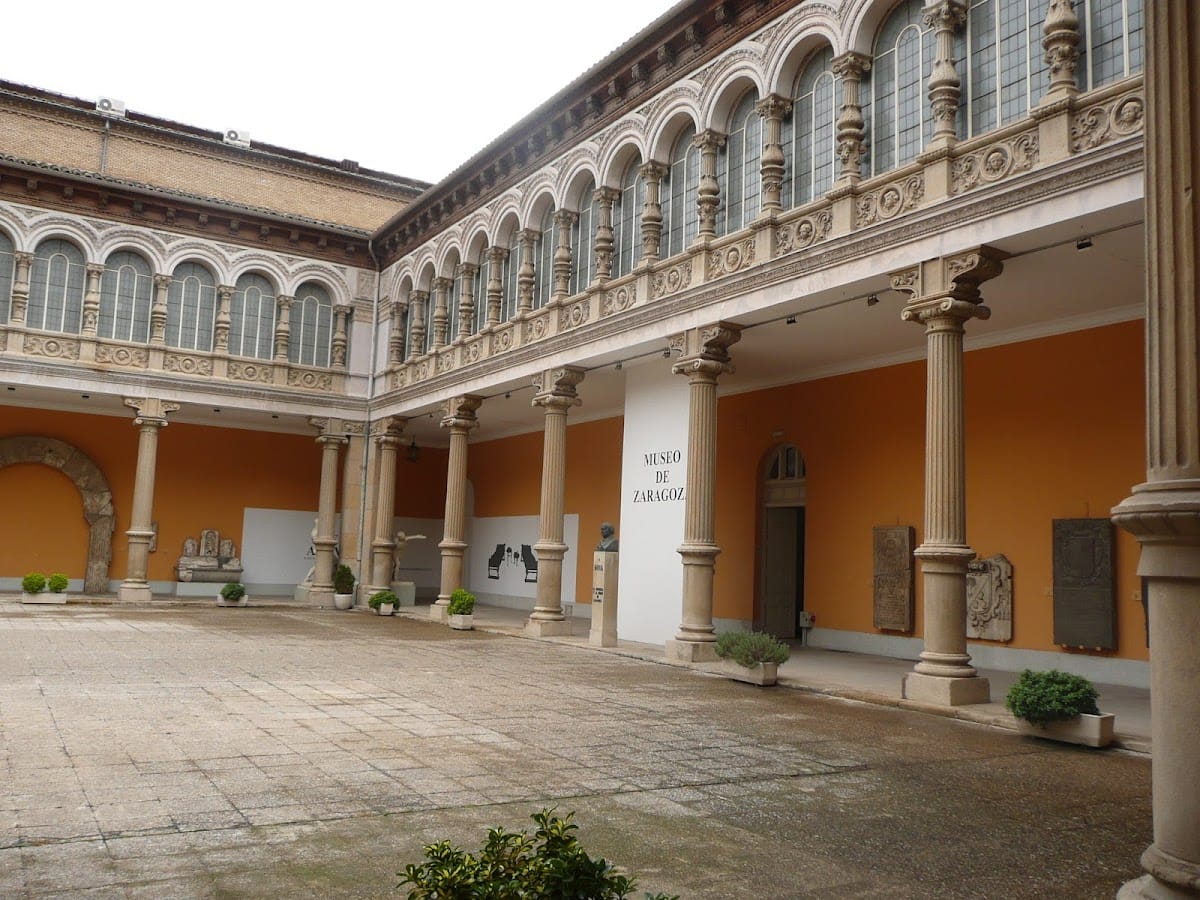
The Ethnology Museum and the Museum of Natural Sciences of Aragon were incorporated in 1976. The former natural-sciences museum was reorganized as the Ceramics Section in 1991. The Ethnology Section received further museographic reforms in 1984 and 2010. The Colonia Celsa section was added in 1997 after the construction of its facility at Velilla de Ebro in 1983. The museum’s courtyard and railings were refurbished in 2019.
The collections now cover the history of the region from the Lower Palaeolithic and Prehistory through Antiquity, the early and Muslim medieval periods, the Gothic and Renaissance eras, the Baroque, the age of Francisco de Goya, and the nineteenth and twentieth centuries. The principal sections are Archaeology, Fine Arts, Ethnology, Ceramics, Oriental Art, and Colonia Celsa. The institution also provides conservation and restoration, library, publication, educational, communications, and cultural-activity services.
Archaeology and Fine Arts
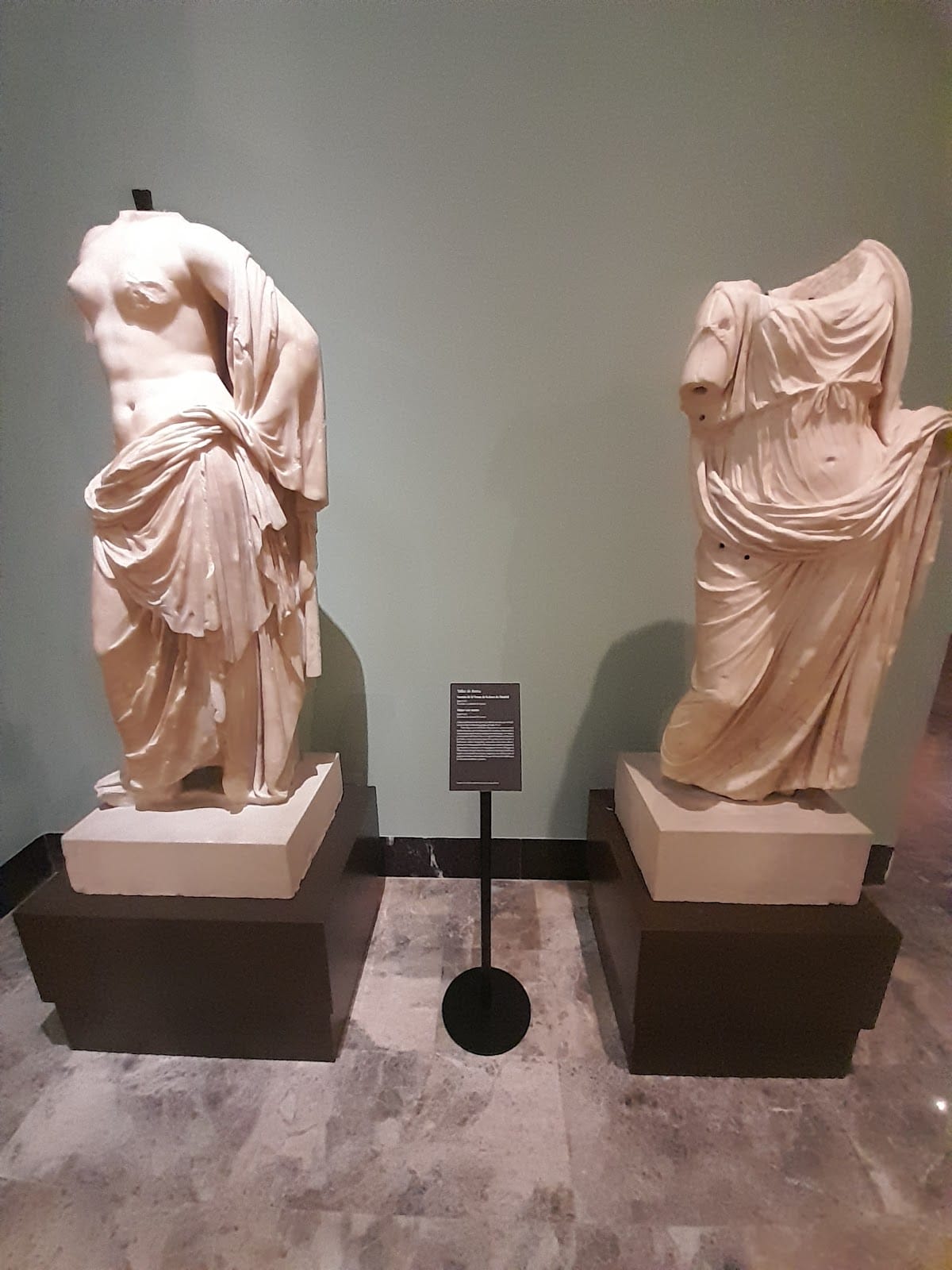
The Archaeology Section contains material from Prehistory to the Middle Ages. Its holdings include the Botorrita bronze plaques, finds from the Roman settlement of Turiaso at Tarazona, the Tremissis of Sisebutus from Cesaraugusta, remains from the Aljafería palace, and a Roman head of Augustus recovered during the excavation of a spa pool at Turiaso.
The Fine Arts collections occupy the second and third floors of the main building and extend from the twelfth century to contemporary art. They include substantial groups of Aragonese Gothic, Renaissance, and Baroque works, as well as graphic art and the Federico Torralba-Fortún Oriental Art collection. The Renaissance holdings were presented in the travelling exhibition The Splendour of the Renaissance in Aragon, shown in Zaragoza, Bilbao, and Valencia between autumn 2009 and spring 2010.
The museum holds seven works by Damián Forment, many of them originating in Zaragoza convents that later disappeared. Some suffered damage during the Sieges of Zaragoza in 1808, military assaults during the Peninsular War. The Baroque collection contains approximately 3,000 works, with particularly strong representation of the Aragonese school, including paintings by Jusepe Martínez and Vicente Berdusán.
Goya and Later Collections
The eighteenth-century collection centers on Francisco de Goya, whose early artistic development in Zaragoza was connected with his teacher José Luzán. The museum’s Goya holdings contain more than sixty paintings, drawings, prints, and related items. They were assembled through purchases, donations, bequests, and deposits, including a 1926 purchase from Manuela Lucientes, a descendant of Goya. The collection is complemented by works by the Bayeu family, painters closely connected with him.
In June 2017, a painting formerly attributed to Francisco Bayeu or Antonio González Velázquez, showing the death of Saint Anthony Abbot, was identified as an original work by Goya after restoration research. The museum also preserves three of the seven paintings from Goya’s fresco cycle for the Oratory of the Counts of Sobradiel. Its graphic-art collection includes drawings, etchings, lithographs, all four major print series, and prints after works by Diego Velázquez. It also contains a preparatory drawing for Goya’s fresco The Adoration of the Name of God and a letter written by the artist to Martín Zapater in 1780.
The later collections include works by Francisco Pradilla, Joaquín Sorolla, Francisco Marín Bagüés, Natalio Bayo, Félix Burriel, and Honorio García Condoy. A temporary deposit of Federico de Madrazo’s Portrait of the Most Illustrious Baron de la Linde entered the museum in 2019. The Oriental Art holdings grew from collections donated or deposited by Federico Torralba Soriano, Tanzan and Kentaro Kotoge, Víctor Pasamar, and M. A. Gutiérrez. In 2023, the Oriental collections received recognition through a five-year Japan Foundation research fellowship.
Remains
Plaza de los Sitios Building
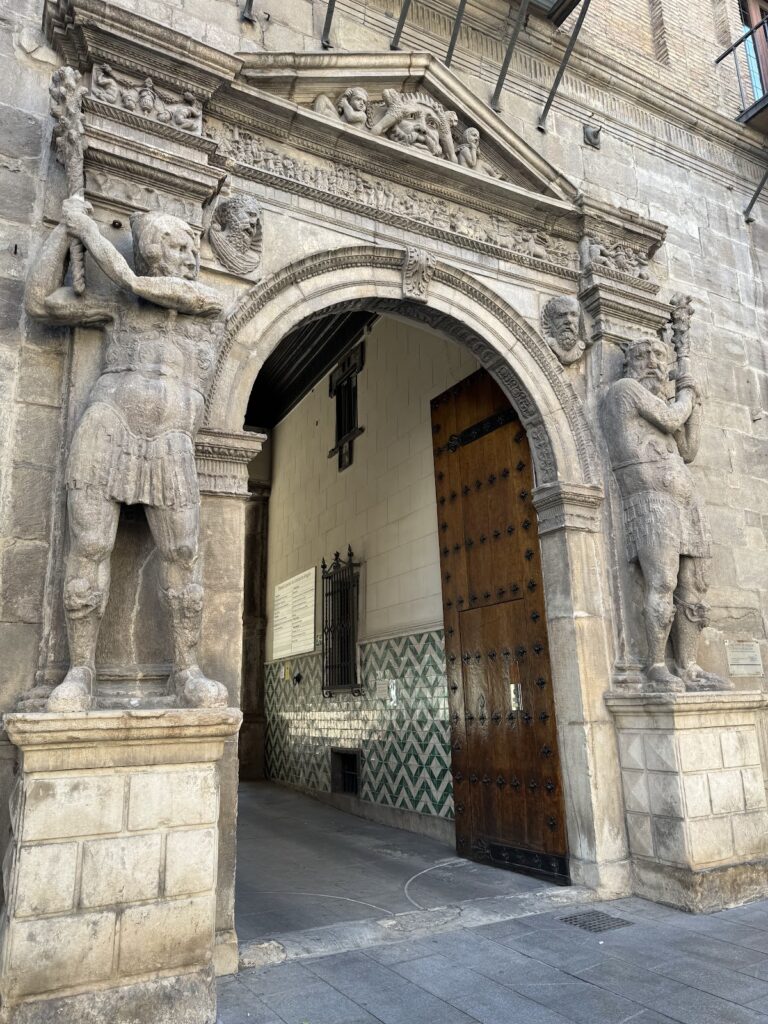
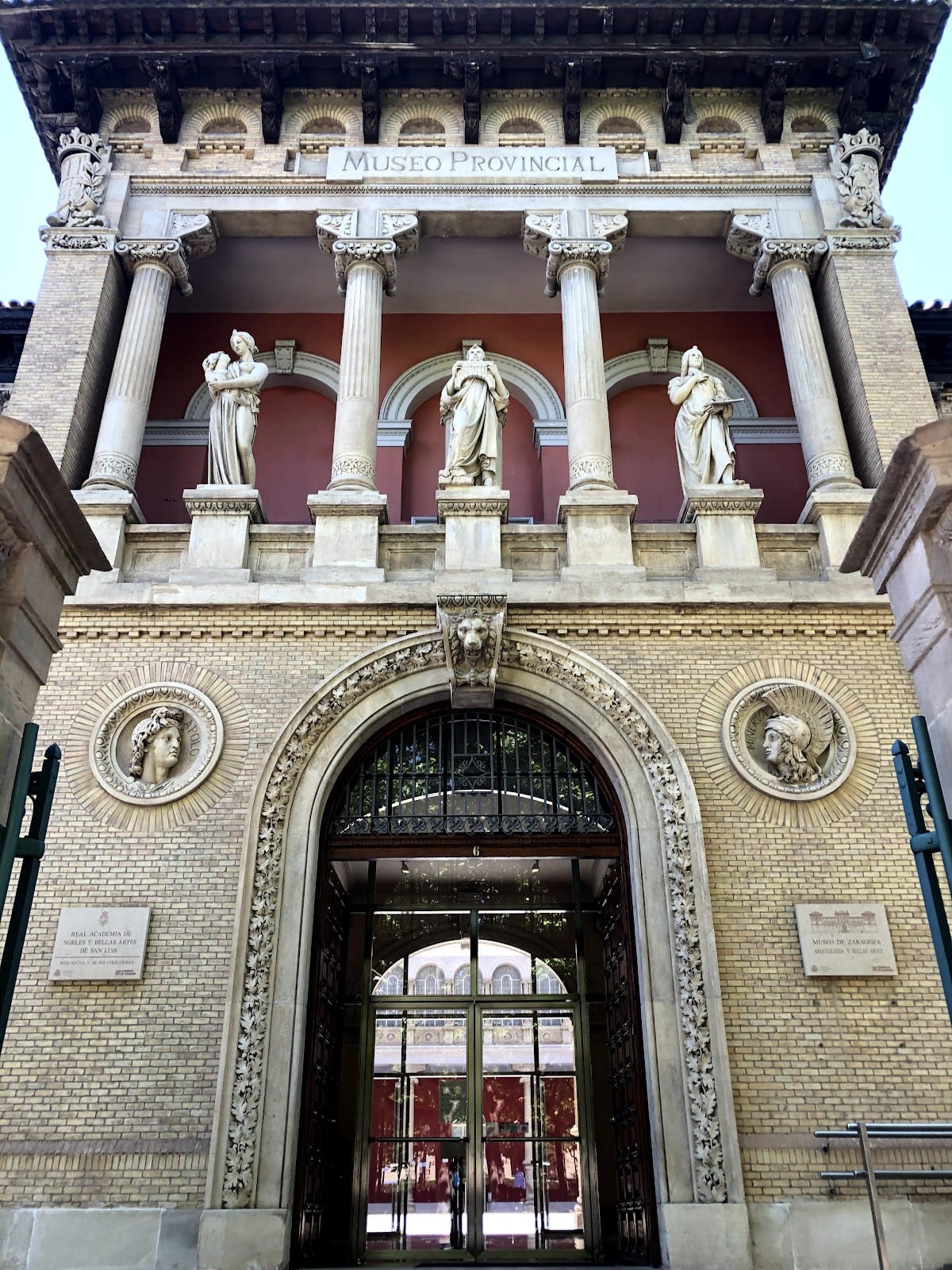
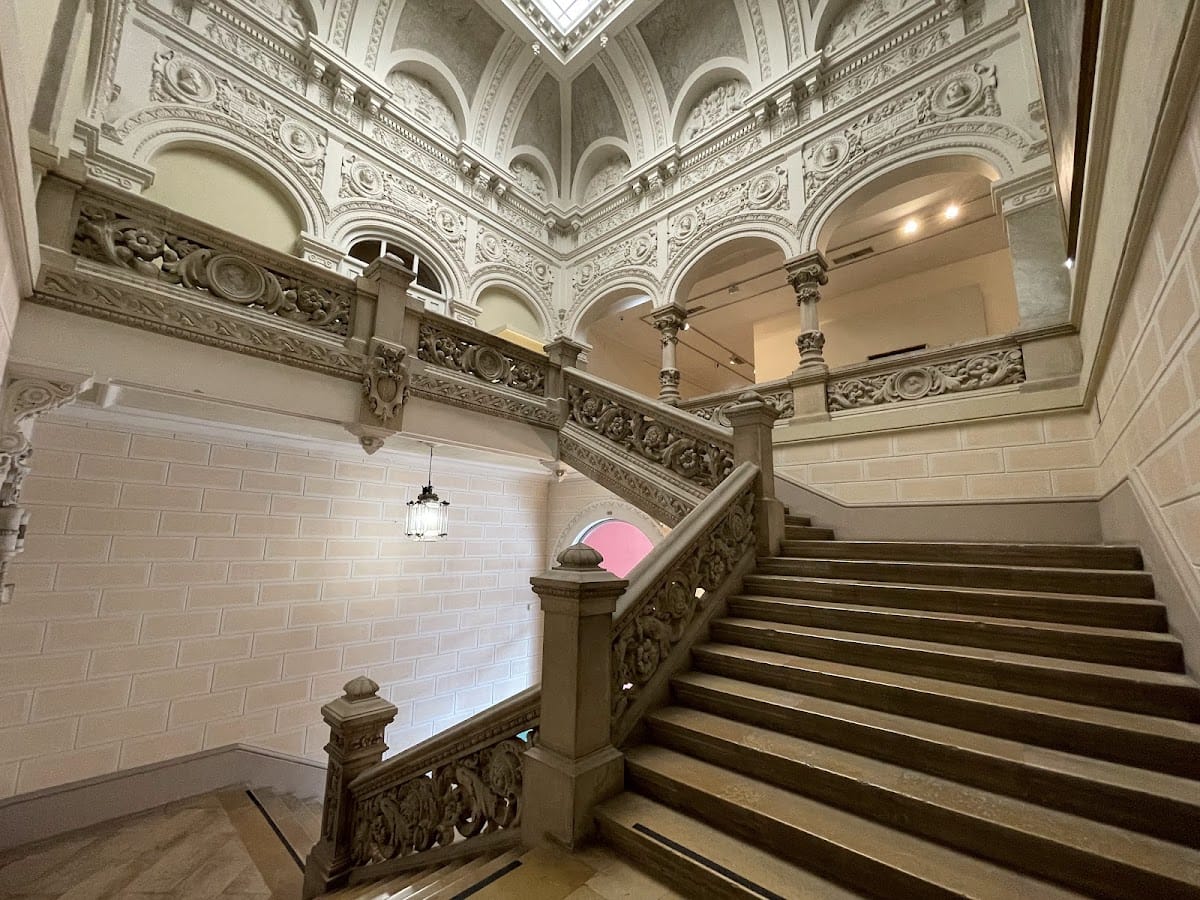
The principal museum building at Plaza de los Sitios houses the Archaeology and Fine Arts sections. Designed by Ricardo Magdalena and Julio Bravo for the Spanish-French Exhibition of 1908, it is a Neo-Renaissance structure inspired by the Patio de la Infanta, the Renaissance residence of Zaragoza merchant and patron Gabriel Zaporta. Its principal façade contains sculptures, while the interior includes a museum courtyard and a principal staircase.
Archaeological and Roman Objects
Head of Augustus
The Roman head of Augustus is carved from a single piece of sardonyx, also described as Indian carnelian, and measures approximately 15 to 16 centimetres. It was probably made in Rome during the reign of Trajan and may originally have been intended for insertion into a composite bust assembled from different materials. The work has been interpreted as a Trajanic-era reworking of a head of Domitian, whose memory was officially condemned and erased after his fall. In this interpretation, the altered image presented Trajan as the heir of Augustus.
Other Archaeological Holdings
The Archaeology Section also preserves the Botorrita bronze plaques, the Tremissis of Sisebutus from Cesaraugusta, and archaeological remains from the Aljafería palace. Together with the Turiaso material, these objects represent the museum’s coverage of the region from Prehistory through the Roman and medieval periods.
Renaissance Works
Damián Forment and Renaissance Sculpture
Seven sculptures by Damián Forment are preserved in the museum. They include Adoration of the Magi, dated about 1517 to 1519, and Saint Onuphrius, dated about 1520. Their condition varies: some are substantially mutilated, while Saint Onuphrius and Saint Anne, the Virgin, and the Child are described as almost intact. The latter work remained unpublished until 2019 and is deposited from a private Zaragoza collection.
The Renaissance sculpture collection also includes works by Gil Morlanes the Elder and Younger, Gabriel Yoly’s alabaster Presentation of the Virgin in the Temple from the former Saint Anne altarpiece in the cloister of Sijena, and a carving of the Immaculate Conception associated with the circle of Juan Miguel Orliens.
Paintings and Ecclesiastical Furnishings
The collection includes two panels from the lower section of the former high altarpiece of the royal pantheon at the monastery of Sijena, acquired in 1921. Other works include Jerónimo Cósida’s Altarpiece of the Virgin and Child, panels from the former high altarpiece and sacred-object cabinet of the Aula Dei Charterhouse, and Roland de Mois’s Adoration of the Shepherds, formerly displayed in a chapel of the Dominican convent church in Zaragoza.
Additional Renaissance paintings include Juan de Juanes’s Portrait of Alfonso V of Aragon, Lavinia Fontana’s Double Portrait of a Married Couple, painted about 1577 to 1585, a deposited Nativity by Jorge Inglés, and works associated with the Monogrammist GB, the Master of the Mansi Magdalene, and Colyn de Coter. The museum also preserves glazed ceramics from the Muel potteries, the abbatial choir stall from Rueda Monastery, and choir stalls from Veruela Monastery. A surviving putto bearing the arms of Charles I of Spain comes from the destroyed tomb of the Flemish chancellor Jean Sauvage, also called Juan Selvagio, at the monastery of Santa Engracia. The tomb was made by Alonso Berruguete in collaboration with Felipe Bigarny.
Baroque and Eighteenth-Century Art
Baroque works include Jusepe Martínez’s Self-Portrait Painting His Father Daniel Martínez, Saint Peter Nolasco, and Saint Catherine. The collection also contains Vicente Berdusán’s paintings of the lives of Saint Benedict of Nursia and Saint Bernard of Clairvaux, formerly at Veruela Monastery, together with Antonio de Pereda’s Vanitas, Juan de Arellano’s Basket of Flowers, and four works by Luca Giordano, including Cephalus and Procris before Diana.
Eighteenth-century works include Antonio González Velázquez’s The Virgin and Child with Saints, a workshop copy of Charles-André van Loo’s Portrait of Louis XV, Francisco Bayeu’s The Holy Family and Saints in Glory and Portrait of Feliciana Bayeu and Merklein, Mariano Salvador Maella’s Group of Musical and Singing Angels, and Joaquín Inza’s Portrait of a Lady. The González Velázquez and Maella works were discovered in 2017 and then exhibited publicly for the first time.
Goya and Modern Art
The Goya collection includes Hannibal Victorious Contemplating Italy for the First Time from the Alps, a sketch submitted to the Parma Academy competition in 1771, as well as Venus and Adonis, The Death of Saint Francis Xavier, The Dream of Saint Joseph, and School Scene: The Letter with Blood Enters. Portraits include the Duke of San Carlos, Luis María de Borbón y Vallabriga as a child, Charles IV, Ferdinand VII, María Luisa of Parma, Francisco Javier Goya, and members of the artist’s circle and family.
Other paintings include Jaume Serra’s Altarpiece of the Resurrection, with scenes of the Dormition, Last Judgment, Coronation of the Virgin, Annunciation, Nativity, Descent into Hell, and Resurrection. The museum also holds works by Juan de la Abadía the Elder, Martín Bernat, Blasco de Grañén, Miguel Ximénez, Jerónimo Cósida, and Pablo Scheppers. Later works include Marcelino de Unceta’s paintings of Rodrigo at the Battle of Guadalete, the Moor’s Sigh, and an Aragonese peasant guard during the Sieges of Zaragoza, along with works by Mariano Barbasán, Francisco Pradilla, Carlos de Haes, Vicente Cutanda, Dionisio Fierros, and Joaquín Sorolla’s portrait of Santiago Ramón y Cajal.
Ethnology and Ceramics Buildings
Casa Pirenaica
The Casa Pirenaica in José Antonio Labordeta Park houses the Ethnology Section. Built by Alejandro Allanegui in 1956, it reproduces characteristic forms of popular architecture from the Pyrenean region. The section’s displays have been reshaped through reforms carried out in 1984 and 2010.
Casa de Albarracín
The Casa de Albarracín, also in José Antonio Labordeta Park, houses the Ceramics Section. Alejandro Allanegui built it in 1956 using forms associated with popular architecture in Albarracín and its surrounding region. The section traces Aragonese pottery from the Stone Age to the present, with particular attention to ceramics from Muel, Teruel, and Villafeliche.
Colonia Celsa and Oriental Art
Colonia Celsa Facility
The Colonia Celsa facility at Velilla de Ebro is a functionally designed building for finds from the Roman settlement of Colonia Celsa. It was constructed in 1983, and the museum installation opened there in 1997.
Oriental Art Collection
The Oriental Art collection contains several hundred sculptures, paintings, ceramics, prints, and everyday objects, including trunks, fans, and furniture. Japanese prints by Hokusai, Utamaro, and Hiroshige are displayed alongside Chinese and Japanese ceramics from the Song, Ming, and Qing periods. The collection also includes deep-red glazed ceramics known as “oxblood,” Buddhist works from varied origins, and a Greco-Buddhist head from Gandhara in present-day Pakistan, identified as its oldest piece.
Other notable works include the medieval Guardian Angel of the City of Zaragoza by Pere Johan and contemporary sculpture by Félix Burriel and Honorio García Condoy.