Castle Rheineck: A Medieval Burgraviate and Hilltop Castle in Germany
Site at a Glance
- Rating
- 3.7
- Popularity
- Very Low
- Country
- Germany
- Primary era
- Modern
- External website
- Open
- Eras represented
- Medieval, Modern
- Civilizations
- Electoral Palatinate, German, Holy Roman Empire
- Site type
- Domestic
- Remains
- Castle
On this page13 sections
History
Castle Rheineck is a hilltop castle in Germany near Bad Breisig, in the Ahrweiler district of Rhineland-Palatinate. Built by the Counts Palatine of the Rhine, it developed from a medieval fortification broadly dated to the eleventh century and became the center of the Burgraviate of Rheineck, the territory administered by its castle governor.
Origins and the twelfth-century stronghold
The castle’s precise founder and starting date remain uncertain. Its construction has been associated either with Siegfried I of Ballenstedt, after he relinquished Laach Castle in 1112, or with Otto I of Salm, after he lost Treis Castle in 1121. Siegfried died in battle in 1113, while Otto was using the title “Count of Rheineck” by 1126.
A struggle over the palatine fiefs along the Rhine followed the death of Count Palatine Wilhelm in 1140. King Conrad III confiscated the former fiefs, and Otto I of Salm-Rheineck and his son Otto II resisted. Their conflict with Hermann of Stahleck, whom Conrad had appointed to the palatine office, ended with Otto II’s capture and violent death at Schönburg.
Otto I died in 1150 after transferring his rights in Treis Castle to Archbishop Albero of Trier, with the consent of his wife Gertrud. After Albero seized Treis by force, Conrad III ordered the abandoned Castle Rheineck destroyed in 1151. He also captured Cochem Castle and made it an imperial castle, a fortress regarded as belonging to the Holy Roman Emperor rather than exclusively to a local lord.
In 1164, Rainald von Dassel, Archbishop of Cologne and imperial chancellor, ordered the castle hill occupied and Rheineck rapidly rebuilt as a Cologne stronghold. The action was intended to block territorial claims by Conrad of Hohenstaufen, the contemporary Count Palatine and a half-brother of Emperor Frederick I Barbarossa. Rainald’s deputy and later successor, Philip I of Heinsberg, assembled a force said to include about 125,000 cavalrymen, infantrymen, and sailors. A battle with Conrad’s forces was planned near Andernach on 18 May 1164, but no battle took place. Frederick later rewarded Rainald with Dairago near Milan, further estates and castles, and the relics of the Three Kings.
The Rheineck burgraves
The Archbishops of Cologne first appointed ministeriales, dependent service nobles who performed military and administrative duties, to maintain and guard the castle. The office was not initially hereditary. Around 1180, the knightly family of Ulmen probably received the fief and soon adopted the name Rheineck. Johann I of Rheineck became the first member of the family to receive the hereditary burgraviate, probably in the late thirteenth century.
The recorded succession includes Gottfried and Johann I in 1190, Heinrich I in 1200, Johann II from 1213 to 1229, Heinrich II and his wife Berta before 1237, Johann III from 1237 to 1245, Heinrich III in 1245, and Theodorich from 1263 to 1278. Heinrich II and Berta donated substantial property from the burgraviate to Maria Laach Abbey.
Johann IV of Rheineck, recorded from 1285 to 1304, fought beside Archbishop Siegfried of Cologne at the Battle of Worringen in 1288 and was captured. He was captured again during a dispute over Kaiserswerth Castle in 1298. Ransom payments impoverished him and intensified his hostility toward Archbishop Wigbold. Johann became a robber knight, attacking ships on the Rhine and vehicles passing the castle, while also joining the archbishop’s enemies. Count Gerhard of Jülich appointed him a castle retainer at Nideggen Castle.
Because of Johann’s activities, the Archbishops of Cologne, Mainz, and Trier besieged Castle Rheineck in 1301. They withdrew when King Albert I advanced to relieve it. Albert regarded Rheineck as an imperial castle and Johann as loyal to him. After Johann swore not to seek vengeance against Archbishop Wigbold, he and his descendants were reinstated as burgraves.
Later burgraves included Johann V, recorded from 1315 to 1351, Johann VI from 1368 to 1381, Johann VII from 1417 to 1460, Diedrich, who died in 1470, Jacob I, who died around 1500, and Jacob II. Johann V took part in the Kempenich Feud and pledged 60 armed men to the Elector of Trier until the conflict was settled at Lahnstein in 1331. Johann VI was publicly beheaded after stabbing the knight Rollman of Sinzig during a quarrel at Godesberg on Christmas Day 1381, in the presence of Archbishop Friedrich.
Warsberg and Sinzendorf ownership
When Jacob II died without a son in 1539, the Electorate of Cologne, under Archbishop Salentin of Isenburg, reclaimed Rheineck as an escheated fief. The Warsberg family contested the decision before the Imperial Chamber Court, relying on the hereditary claim created by the marriage of Heinrich of Warsberg to Metza of Rheineck, Jacob II’s daughter. In 1567 the claim succeeded, and in 1571 Metza’s sons Samson and Johann of Warsberg received Castle Rheineck as a fief.
The Warsberg holders included Johann, also known as Jean, who lived from 1534 to 1604, and his son Samson, who lived from 1569 to 1643 and served as a colonel for the French king. Johann Philipp of Warsberg sold the Burgraviate of Rheineck in 1654 to Count Rudolf von Sinzendorf for 7,000 ducats. The Warsbergs preferred to expand their principal seat at Saarburg.
The Sinzendorfs acquired Rheineck partly to obtain the title of burgrave and add its arms to their family coat of arms. They also valued its seat and vote in the Westphalian College of Counts at imperial diets and in the Kurrhenish Circle, an administrative and political district of the Holy Roman Empire centered on the ecclesiastical electorates along the Rhine. The family retained representation at the Cologne territorial diets. Rudolf von Sinzendorf died in 1677. His successors included Weickard Michael Wencelaus, who died in 1715, Prosper Anton, who died in 1756, and Wenzel Johann Eustach, who died in 1773. Prosper von Sinzendorf, born in 1751, was the last burgrave and later became a prince and Burgrave of Winterrieden.
War, destruction, and nineteenth-century rebuilding
Swedish troops under General Baudissin occupied and plundered the castle without resistance at the end of 1632, but they did not destroy it. During the War of the Palatine Succession, the major European conflict of 1688 to 1697, French troops occupied Rheineck, plundered it, and set it on fire when they withdrew. Cologne troops destroyed the remaining buildings in 1692, leaving the keep and chapel substantially intact.
A smaller rebuilding took place in 1718. In 1785, however, a fire that began in a thatched ancillary building destroyed the entire castle in about two and a half hours. A makeshift reconstruction costing 2,000 thalers provided only a residence for the administrator Johann Adam Schurp.
The Sinzendorfs retained the burgraviate until French forces occupied the left bank of the Rhine. Under the Treaty of Lunéville in 1801, their compensation consisted of Winterrieden in Württemberg and an annual pension of 1,500 florins. In 1805, the French authorities confiscated and auctioned Castle Rheineck as feudal property for 2,870 francs. The purchaser was the forester Wencelaus Schurp, whose father had administered the castle for the Sinzendorfs since 1749.
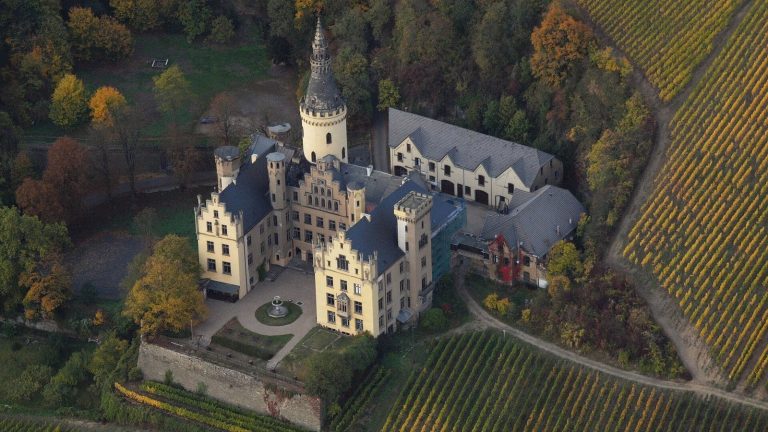
Moritz August von Bethmann-Hollweg, a professor at the University of Bonn and later Prussian minister of culture, bought the castle from Schurp’s widow and heirs in 1832 for 20,000 thalers. Between 1832 and 1836, it was rebuilt on its historic ground plan. The decayed fabric had to be removed down to the foundations, and the new owner intended a comfortable Romanesque-style residence rather than a medieval fortress. Johann Claudius von Lassaulx directed the work. Bethmann-Hollweg spent his final years at Rheineck and died there in 1877. The family mausoleum was established on the castle hill.
Recent history
During the 1950s, after the Second World War, Castle Rheineck was operated as a recreational destination with a cable railway, castle visits, and access to the keep. Herbert Hillebrand bought it in 1975 for his daughter Nathalie. Financial losses left the castle unoccupied from 1993 until 1999, when it was sold to the current owner, Kai Krause, who began extensive restoration.
Castle Rheineck is the only hilltop castle substantially preserved in the Lower Middle Rhine Valley. The castle itself is currently not open to the public.
Remains
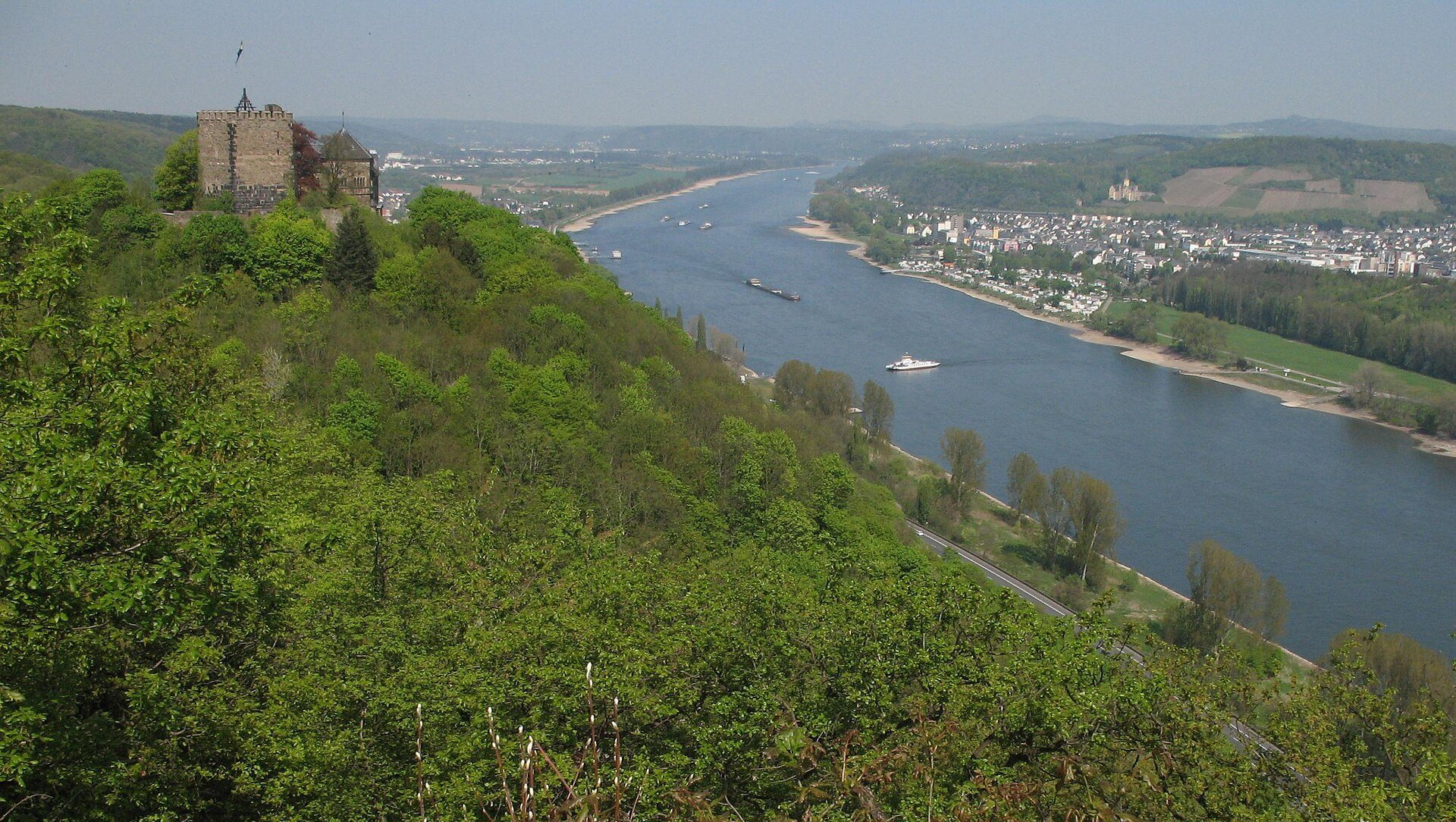
Castle Rheineck occupies an isolated hill on the left bank of the Rhine near the Vinxtbach, at approximately 186.9 metres above sea level. The ground falls away on all sides. Roman finds and antiquities from the hill suggest that Roman structures, possibly a watchtower, preceded the medieval complex. Rheinbrohl, on the opposite bank of the Rhine, was the starting point of the Upper Germanic Limes, a Roman frontier system of forts, walls, watchtowers, and related installations in parts of present-day Germany.
Medieval structures
Enclosure walls and keep
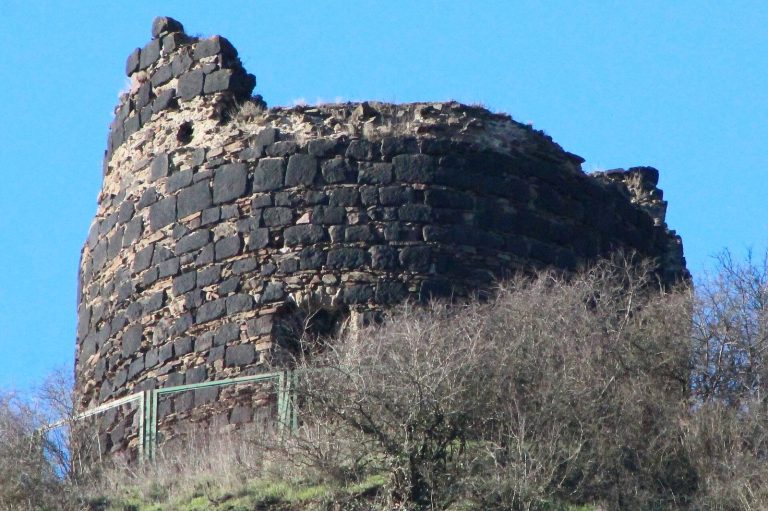
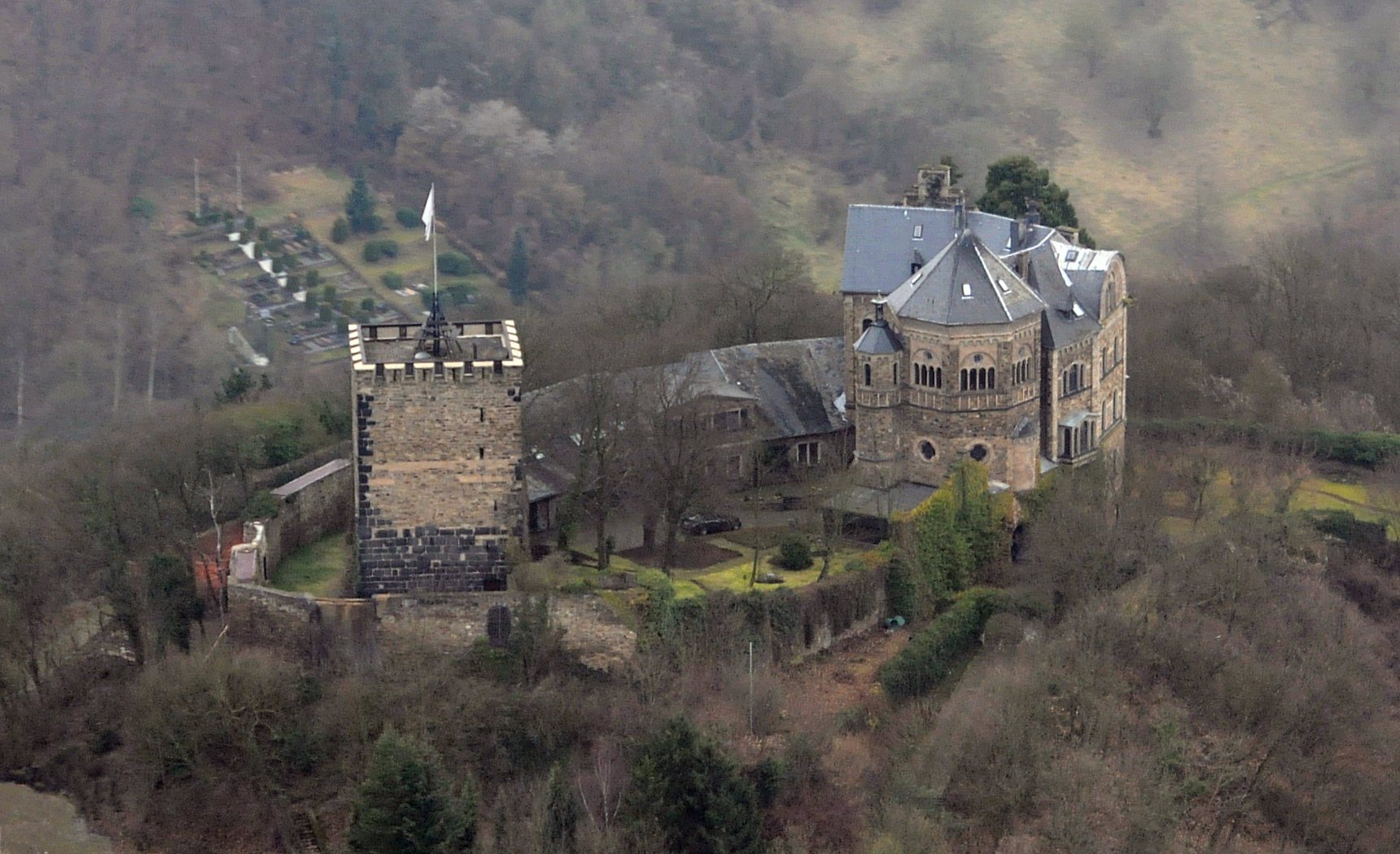
The surviving medieval fabric includes sections of the enclosure walls, the gate above the entrance road, and a massive square-plan keep. A keep was the principal fortified tower of a castle and could serve defensive and residential purposes. These elements represent the principal remains of the medieval complex after repeated destruction and rebuilding.
Gate chapel
The original entrance area contained an octagonal gate chapel dating from the twelfth century. Its form was associated with the Carolingian octagon of Aachen Cathedral. During the nineteenth-century rebuilding, demolition of the old administrator’s building, which had been attached to and helped support the chapel, caused large cracks in the structure. The chapel was consequently dismantled and rebuilt under Johann Claudius von Lassaulx, retaining the ground plan and exterior design of the earlier chapel. Eduard von Steinle painted the rebuilt interior between 1838 and 1840.
Nineteenth-century buildings and castle hill
Romanesque residence
The nineteenth-century castle was erected on the old foundations and historic ground plan in the Romanesque style, a medieval European form characterized by massive masonry, rounded arches, and relatively small openings. It was conceived as a habitable palace rather than as a reconstruction of a medieval fortress.
Mausoleum and surrounding features
The Bethmann-Hollweg family mausoleum stands within the enclosed castle area on the castle hill. Several gravestones formerly located in the immediate castle area were moved during the family’s rebuilding work to the Kesselberg north of Bad Breisig. A historical Jewish cemetery occupies a lower plateau beneath the summit.
Immediately above the castle, along the route of the Rheinhöhenweg, lies a Celtic refuge fortress with two lines of ramparts. The route continues toward Brohl-Lützing and the Reuterslei.