Malsburg Castle Ruins: A Medieval Hilltop Castle in Germany


Site at a Glance
- Rating
- 4.1
- Popularity
- Very Low
- Country
- Germany
- Primary era
- Medieval
- Eras represented
- Medieval
- Civilizations
- Holy Roman Empire
- Site type
- Military
- Remains
- Castle
On this page6 sections
History
Malsburg Castle Ruins are the remains of a medieval hilltop castle in Germany, near Zierenberg in northern Hesse. The castle stood on the Malsberg and served originally as the ancestral seat of the von der Malsburg family. It already existed when it was first mentioned in 1123.
Origins and Mainz lordship
In 1124, Volkold and Udalrich von Warthbeche, sons of Volkold I, inherited Malsburg and neighboring Schartenberg Castle from their father. They granted both holdings as fiefs to Adalbert I, Archbishop of Mainz. A fief was a holding granted by a superior lord to a subordinate in return for service and allegiance. Volkold had moved to Nidda, where his family possessed property, and founded the short-lived line of the Counts of Nidda from the House of Malsburg.
Mainz later granted Schartenberg to the Counts of Dassel, while its own castle men occupied Malsburg after Udalrich’s death. In 1143, the ministerials Stephan and Dietrich of Malsburg appeared in connection with the castle. Medieval ministerials were members of a service nobility who carried out administrative, military, and court duties for powerful lords. The two men probably belonged to a branch of the Schartenberg family and adopted the name von der Malsburg from their castle seat.
In 1213, Malsburg was a Mainz fief held by a branch of the Groppe von Gudenberg family. Landgrave Henry I of Hesse captured the castle in 1260, although the precise date is uncertain, during the Thuringian-Hessian War of Succession. He was forced to return it to Mainz, and Malsburg subsequently became part of the Mainz administrative district of Hofgeismar.
Pledges, military obligations, and transfer to Hesse
The castle remained connected to several noble families and territorial powers. In 1329, the squires Stephan and Hermann von der Malsburg, acting for their sons and other brothers, pledged a castle seat at Malsburg to the knight Rabe of Pappenheim and his brothers. The Pappenheims were forbidden to use the castle against the Malsburg family’s overlords, the Archbishop of Mainz and Duke Otto of Brunswick-Gottingen.
In 1337, the Malsburg family opened the castle to the Archbishop of Mainz, his officials, and the town of Hofgeismar. They also granted their village of Esebecke to the archbishop as a fief and received it back as an hereditary castle fief. In 1353, Malsburg and Sababurg were assigned to Baldwin, Bishop of Paderborn, for castle guardianship during a pledge. He had to protect both fortifications and preserve them as open castles for the Mainz archbishopric. An open castle was one that its feudal lord could enter and use for military or administrative purposes.
Malsburg eventually passed from Mainz to the Hessian landgraves. In 1427, Archbishop Conrad III of Dhaun suffered decisive military defeats against Landgrave Ludwig I of Hesse at Fritzlar and Fulda. These victories secured Hessian territorial supremacy in Lower and Upper Hesse, and Malsburg also came under the control of the Hessian landgraves.
Remains
Hilltop setting
The ruins occupy the summit of the Malsberg, a wooded basalt cone in the Malsburg Forest. This steep, roughly conical volcanic landform rises to 405.6 metres above sea level in the northern part of Habichtswald Nature Park. The terrain descends eastward from the summit toward the Warme valley. The castle was therefore positioned on elevated ground characteristic of a medieval hilltop fortification, a type of fortified residence built for defense and territorial control.
Castle structures
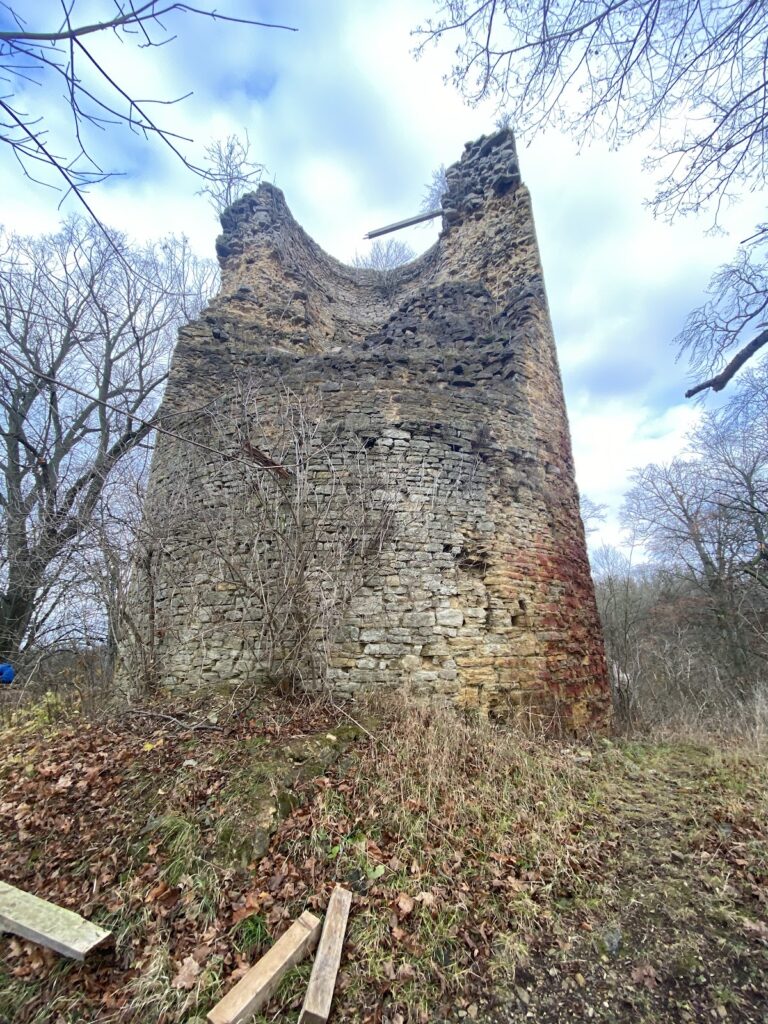
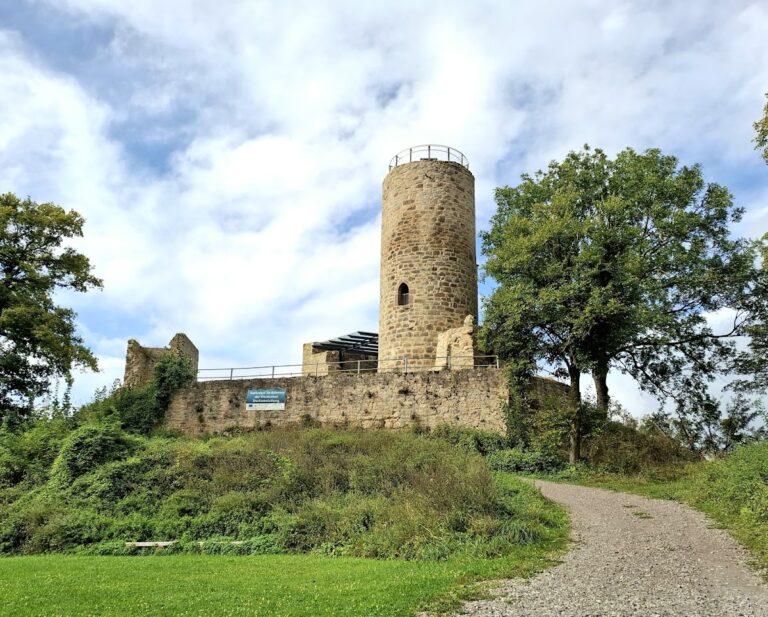
Malsburg was a relatively small fortification with an elongated rectangular main building. Surviving features include sections of the castle walls, a tower 6.5 metres in diameter with a spiral staircase, and a castle well. The ruins are approximately 5.5 kilometres northwest of central Zierenberg and 1.7 to 2 kilometres southwest of Zierenberg-Hohenborn. Other nearby medieval sites include Schartenberg Castle, 3.8 to 4 kilometres southeast across the Warme, Falkenberg Castle, 2.8 to 3 kilometres south-southeast, Escheberg Castle, 1.5 to 1.6 kilometres south-southwest, and Laar Castle near the village of Laar, about 1.5 kilometres southeast beside the Warme.
Nearby sites