Burgruine Schartenberg: A Medieval Hilltop Castle Ruin in Germany


Site at a Glance
- Rating
- 4.1
- Popularity
- Very Low
- Country
- Germany
- Primary era
- Medieval
- Eras represented
- Medieval
- Civilizations
- Holy Roman Empire
- Site type
- Military
- Remains
- Castle
On this page8 sections
History
Burgruine Schartenberg is the ruin of a medieval hilltop castle near Zierenberg in northern Hesse, Germany. Probably built by a Saxon nobleman at the beginning of the eleventh century after the end of Conradine rule in the Hessengau, it appears in references dated 1020 and 1124. The castle later became a contested fief of Mainz and Paderborn and ultimately formed the center of a Hessian administrative district.
Early foundations and noble ownership
Around 1089, the castle passed by inheritance to Volkold of Malsburg, who took his name from the nearby Malsburg. In 1124, his sons Volkold II and Udalrich transferred both Malsburg and Schartenberg to Archbishop Adalbert I of Mainz as fiefs, meaning estates granted by a superior lord in return for recognized obligations and allegiance. Volkold II had moved to Nidda before 1100, where he succeeded his father as bailiff of the Fulda March, an official responsible for secular administration or protection on behalf of a religious institution. He also founded the Nidda comital family of the Malsburg line.
Mainz enfeoffed the Counts of Dassel with Schartenberg. A castle official named Stephan, or Stefan, from a minor noble family apparently related to the Mainz officers at Malsburg, held office there. His descendants exercised practical control of the castle until the end of the fourteenth century and adopted the name von Schartenberg. A smaller castle on the Schartenberg was separately granted to the Groppe family of Gudenberg, giving rise to the name Groppeschloss, while Schartenberg was also known as Schartenburg.
Feudal disputes and divided lordship
At the beginning of the thirteenth century, an inheritance dispute within the Schartenberg family developed into a violent feud involving other local noble families. Archbishop Siegfried II of Mainz brought the conflict to an end at a reconciliation assembly in Fritzlar in 1213.
Albert of Schartenberg became known for serving Bishop Simon of Paderborn. Simon bought the castle from Count Ludolf V of Dassel in 1267 or 1268, but Archbishop Werner of Eppstein of Mainz opposed the transfer because Schartenberg remained a Mainz fief. In 1279, Werner granted half of the castle to Simon’s successor as bishop of Paderborn, Otto of Rietberg, while retaining the other half for Mainz.
In 1294, Archbishop Gerhard II of Eppstein granted the Mainz half to Elisabeth the Middle, daughter of Landgrave Henry I of Hesse, as a fief and wedding gift for her marriage to Count Gerhard V of Eppstein. Their childless marriage led to an agreement returning the half to Elisabeth’s brother, Landgrave John of Hesse, in 1307. After John’s death in 1311, Archbishop Matthias of Buchegg demanded the return of Schartenberg in 1325 from John’s half-brother and heir, Otto I of Hesse, treating it as a lapsed fief. The claim lost force after Matthias was defeated by Otto near Wetzlar in 1328 during their long feud and accepted a settlement mediated by King John of Bohemia.
Hessian administration and military use
After 1307, the castle was held for an extended period as a pledge by the castle-officer family of Hertingshausen. The family consequently adopted the name von Schartenberg. Stefan von Schartenberg served Landgrave Henry the Iron and took part in the destruction of the former Mainz castle of Haldessen near Grebenstein. He died childless around 1375. The last member of the family, Hermann, sold his share of Schartenberg to Landgrave Hermann II of Hesse and died in 1382 or 1383.
Hesse then held both halves of the divided castle as fiefs, one from Mainz and the other from Paderborn, although the archbishopric of Mainz could no longer enforce its feudal authority. The Hessian landgraves assigned Schartenberg as a residence to officials or pledged it together with the associated Schartenberg court. Recorded holders included Reinhard IV of Dalwigk, Johann Spiegel, Dietrich von Schachten, and Hermann von der Malsburg. The castle became the center of the Schartenberg administrative district.
Fighting reached the castle during the final phase of the struggle between the Archbishopric of Mainz and the Landgraviate of Hesse for supremacy in Lower and Upper Hesse. In November 1424, Johann Spiegel led Mainz vassals and armed men from the Mainz town of Hofgeismar in raids around Grebenstein and through the Diemel valley. They later attacked Schartenberg at night, but the garrison repelled them. The attackers destroyed economic buildings in front of the castle, probably also the nearby village of Rangen, and set Fürstenwald on fire. Landgrave Ludwig I of Hesse then appeared before Hofgeismar, shelled the town, and ravaged its surroundings.
Schartenberg became Hessian in 1427 after Ludwig’s decisive victories over Archbishop Konrad of Mainz at Fritzlar in July and Fulda in August during the Mainz-Hesse War. Sittich von Berlepsch served as the castle official from 1431. The castle’s final military role came in 1476, when its official, Heinrich von Boineburg, supplied twelve wagons to carry provisions during the landgrave’s campaign against Volkmarsen, a city belonging to the Electorate of Cologne.
Decline and modern securing
By 1490, the castle had deteriorated. Landgrave Wilhelm I ordered its pledge-holder, Dietrich von Schachten, to undertake repairs costing 200 guilders, although it is not known whether the work was completed. In 1518, Schartenberg was described as abandoned and dilapidated. The lords of Malsburg held it from 1519 to 1521, but it was left to decay.
The ruins were not systematically dismantled for building stone because the limestone blocks quickly broke into rubble when removal was attempted. Their destruction therefore resulted from natural deterioration rather than quarrying. Work to secure the masonry of the main tower began in summer 2006. The keep is now inaccessible because of the danger of collapse.
Remains
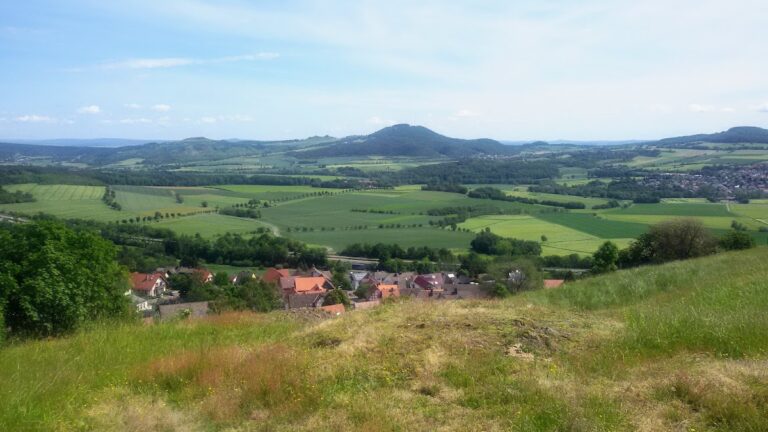
Burgruine Schartenberg occupies a western spur of the Schartenberg in the northern part of Habichtswald Nature Park, about 2.4 kilometers north of Zierenberg. The site lies at approximately 389.5 meters above sea level, below the mountain’s 403.9-meter summit, between the Nebelbeeke valley to the east and the Warme valley to the west. The castle’s surviving elements are arranged across steep ground and include a round keep, fragmentary walls, a neck ditch, and two northern terraces.
Keep and inner castle area
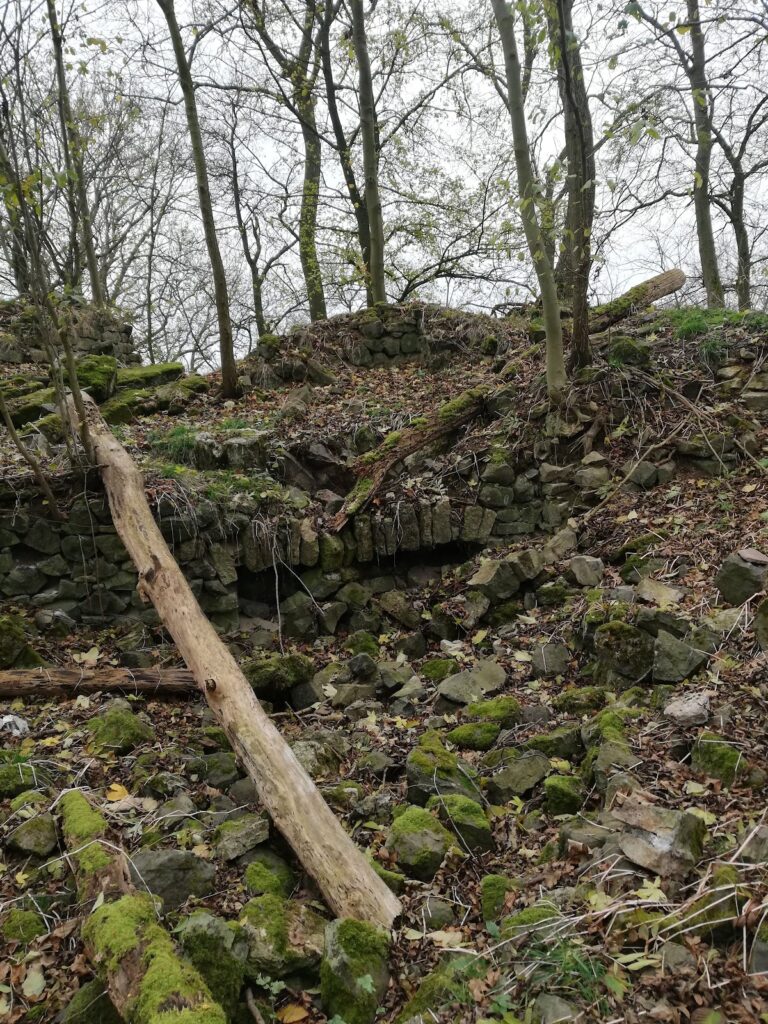
The round keep, or principal defensive tower, is the clearest surviving feature. It reaches up to 8.5 meters in diameter and stands at the highest point of the complex. Its walls are as much as 3 meters thick at the base, then become markedly thinner in successive stages toward the top. Approximately half of the western, weather-facing side has collapsed. The tower is built from locally available limestone ranging in color from bright red to cream white. The collapsed sections were overgrown for a long period before the masonry-security work begun in 2006.
A narrow tunnel was cut into the base of the keep in the late nineteenth century. It is structurally unsafe and closed by a gate. Inside, supports and holes for beams and intermediate floors survive, providing traces of the tower’s former internal construction. To the west, a lower level is bordered by faint, overgrown limestone wall remains that probably formed, or may have formed, a castle courtyard.
Outer defenses and northern section
The original outer wall survives only in fragmentary traces. Within the complex, it is not visible, while from the steep lower slope outside the castle, the remaining sections rise approximately 1 to 2 meters. A deep ditch to the north separates the keep section from the area known as the Groppeschloss. Two terraces extend toward the northwest, where their edges descend steeply toward the Warme valley. Only slight wall remains survive in this northern section, but the shape of the ground preserves clear traces of human modification.
Nearby sites