Kugelsburg: A Medieval Hilltop Castle Ruin in Germany



Site at a Glance
- Rating
- 4.7
- Popularity
- Low
- Country
- Germany
- Primary era
- Medieval
- External website
- Open
- Eras represented
- Medieval
- Civilizations
- Holy Roman Empire
- Site type
- Military
- Remains
- Castle
On this page14 sections
History
Kugelsburg is a hilltop castle ruin in Germany above Volkmarsen, probably built in the late twelfth century in the Romanesque period. First mentioned in 1225, it was commissioned by Witukind, abbot of Corvey, probably constructed by the Lords of Everstein, and is generally attributed to Albrecht III of Everstein. The castle secured a crossing over the Twiste on the old road between Fritzlar and Paderborn. Its purpose was directed less toward protecting Volkmarsen than toward checking the territorial expansion of Mainz.
Corvey and the Eversteins
Corvey was a major Benedictine monastery and ecclesiastical principality in Westphalia, whose abbots controlled extensive lands and used castles to defend their territorial interests. Volkmarsen had entered Corvey’s possession by the mid-twelfth century, a status confirmed by Pope Hadrian IV in 1155. The Lords of Everstein had held Volkmarsen as a fief of the Electorate of Mainz since at least the late eleventh century. Their regional position also grew through the inheritance of the Itter lordship after Konrad I of Everstein married a daughter and heir of the Itter family.
By about 1200, the Eversteins possessed extensive lands around Volkmarsen. In 1198, Abbot Witukind concluded a protection treaty with Adolf I, Archbishop of Cologne, as competition among the regional powers continued. Pope Gregory IX confirmed Corvey’s possession of Kugelsburg and Volkmarsen in 1233. The Eversteins occupied the castle from 1239 to 1293, although disputes repeatedly arose because Volkmarsen was not subject to their authority. In 1255, Konrad III of Everstein transferred part of Cugelenburg as security to Gehrden Monastery.
Destruction, rebuilding, and changing lordship
Raids by the castle garrison led to the punitive destruction of Kugelsburg in 1260. The castle was rebuilt soon afterward. Otto of Everstein renounced his share to Wigbold, Archbishop of Cologne, in 1297 or 1303. Corvey placed itself under Cologne’s protection in 1298 and transferred its share of the castle to the archbishop for two years. In 1304, Corvey again pledged its half, and the Archbishop of Cologne strengthened Kugelsburg and built its keep.
On 1 February 1335, Archbishop Walram of Cologne granted Cologne’s half of Kugelsburg and Volkmarsen as a fief, a grant of rights in return for service, to Berthold von Büren, Marshal of Westphalia and a member of another Everstein branch. In 1336, Corvey pledged its remaining share in the castle and town to Herbold of nearby Mederich, Johann Runst, and the Volkmarsen town council.
In 1339, Archbishop Walram granted the pledged castle and town to the Westphalian brothers Rabe von Canstein, descendants of Rave von Papenheim. Their family had been hereditary seneschals of Corvey since at least 1106. From 1346 to 1530, members of the family lived at Kugelsburg as part of its garrison and soon adopted the name Rabe von Coglenberg. The late Gothic residential palace was built during this period.
Hessian and Cologne control
The Landgraves of Hesse held pledge rights from 1351, while Cologne acquired the pledge rights to the castle’s other half around 1440. In 1474, Hermann IV, Archbishop of Cologne and Bishop of Paderborn, pledged the castle and town to his brother, Landgrave Heinrich III of Hesse. Kugelsburg and Volkmarsen refused to pay homage to the landgrave. Heinrich captured the castle in 1475 after shelling it, and in 1477 he captured and burned Volkmarsen.
Archbishop Hermann renewed the Hessian pledge in 1484, and Hessian forces occupied the castle and town into the early sixteenth century. In 1503 or 1507, Corvey finally renounced its rights to Kugelsburg and Volkmarsen in favor of Cologne. Cologne remained the sole owner until the Electorate of Cologne was abolished in 1802. Volkmarsen and its administrative district belonged to the Duchy of Westphalia, a territory governed by the Archbishops of Cologne.
Religious conflict and military destruction
Volkmarsen followed the conversion of Gebhard I of Waldburg, Archbishop of Cologne, to Protestantism in 1582. His successor, Ernst of Bavaria, re-Catholicized the town in 1590.
During the Thirty Years’ War, the major European conflict of 1618 to 1648 involving religious, dynastic, and territorial struggles, Bavarian mercenaries reinforced the garrison of Kugelsburg and Volkmarsen in 1622 against Christian of Brunswick-Wolfenbüttel, known as the Mad Christian. After Christian’s defeat, imperial troops entered the area. Hessian forces captured the castle and town in 1632, plundered and burned the town, and destroyed the fortifications.
French troops occupied and partly destroyed Kugelsburg during the Seven Years’ War, a European conflict fought from 1756 to 1763, in 1758. The ruin then deteriorated and was partly dismantled for building materials during the nineteenth century.
Transfer to Hesse and early stabilization
After the secularization of the Electorate of Cologne and the Duchy of Westphalia, Volkmarsen was occupied successively by Hesse-Darmstadt on 31 August 1802, by Landgrave Wilhelm IX of Hesse-Kassel on 20 September, and again by Hesse-Darmstadt on 13 November. Under the Imperial Deputation Act of 25 February 1803, Volkmarsen and Kugelsburg passed to Hesse-Darmstadt. On 13 March 1806, Hereditary Prince Wilhelm of Nassau-Orange, Prince of Fulda and Corvey, transferred them to Landgrave Ludwig X of Hesse-Darmstadt. The city of Volkmarsen bought the surviving castle remains and associated land in 1885 for 6,000 marks and began the first stabilization work.
Remains
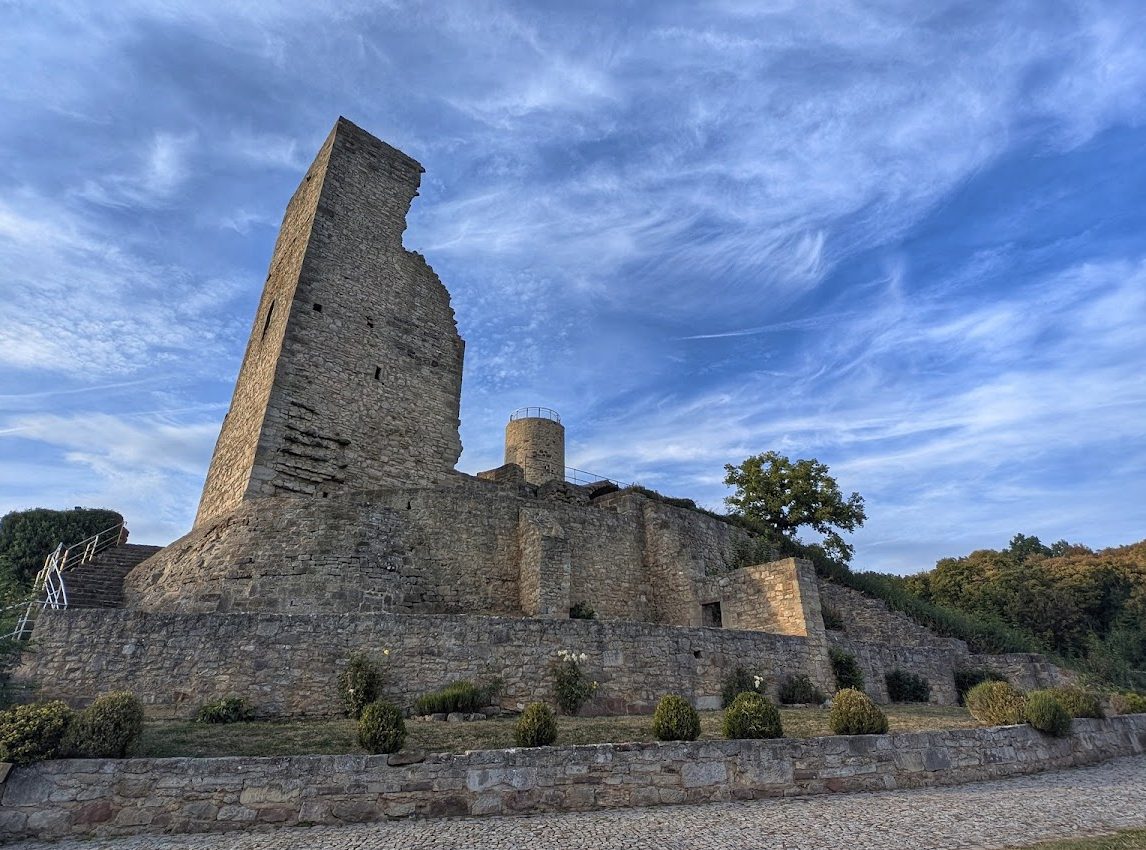
Kugelsburg occupies the western summit of Kugelsberg, about 270 meters above sea level. The hill rises directly east of the Erpe valley, approximately 1.2 kilometers south-southeast of the Erpe’s confluence with the Twiste. The main castle stands on the hilltop, with steep ground at its southwest corner, a northern defensive front, surviving curtain walls, and a deep rock-cut ditch before the keep. The remains combine the Romanesque core with later medieval defensive and residential structures.
Fortifications and towers
Residential tower
A square residential tower occupies the steep southwest corner of the castle. Dating from the thirteenth century, it is almost completely preserved and forms one of the principal surviving structures of the castle’s earlier residential complex.
Round keep and curtain wall
The round keep stands on the northern side, where an attack was expected. Built at the beginning of the fourteenth century, it is almost completely preserved. Large sections of the curtain wall remain around the castle, and a deep ditch cut into the rock runs in front of the keep. The keep served primarily for defense and refuge rather than as an ordinary residence.
Residential buildings and outer areas
Late Gothic residential palace
Beside the keep are the remains of a late Gothic, two-storey residential palace built during the period when the Rabe von Coglenberg family lived at Kugelsburg. The surviving fabric includes the walls of the ground and upper floors, a chimney, a stair tower, and an accessible basement known as the Witches’ Cellar.
Ancillary buildings and cellars
Remains of ancillary buildings and cellars survive within the castle area. Together with the residential tower, palace walls, stair tower, and defensive structures, they show how domestic and military spaces occupied the hilltop complex.
Former outer bailey
The former outer bailey stood on a plateau southwest of the main castle. This lower area formed part of the wider arrangement of the fortified site, separate from the principal hilltop enclosure.
Nearby sites