Castel Barco: A Medieval Hilltop Castle in Italy


Site at a Glance
- Rating
- 4.1
- Popularity
- Very Low
- Country
- Italy
- Primary era
- Medieval
- Eras represented
- Medieval
- Civilizations
- Holy Roman Empire, Venetian
- Site type
- Military
- Remains
- Castle
On this page8 sections
History
Castel Barco is a medieval hilltop castle in Italy, above Chiusole, a hamlet of Pomarolo in Trentino. Built during the twelfth century, it became the ancestral castle of the Castelbarco noble family and controlled a difficult passage in the Vallagarina, where a loop of the Adige narrowed movement through the valley.
Foundation and episcopal authority
The castle was first mentioned in 1171 and was probably built in the twelfth century by Briano and Tisolino de Bunixolo. Briano, also known as Abriano, appears in documents from 1155, before the Castelbarco name was used. A tradition connects the family’s earlier rise with Emperor Lothar III, who was said to have entrusted their ancestors with control of the strategic bottleneck where the castle was later established.
Castel Barco also supervised the route below and provided a place from which tolls could be collected. This income helped increase the wealth of its lords. The castle had been built without the permission of the bishop of Trent, creating a lasting dispute between the family and the bishopric.
Aldrighetto I of Castelbarco, a Ghibelline, meaning a supporter of the imperial side in medieval conflicts between the Holy Roman Emperor and the papacy, remained in continual conflict with the bishop. In 1172 he murdered Bishop Adalbert II. Whether the bishop had previously besieged Castel Barco is uncertain.
In 1198, Aldrighetto’s son Briano I formally transferred the castle to Bishop Conrad II of Beseno. The dispute was resolved when the bishop granted the Castelbarco family an investiture, the formal grant of a fief and its associated rights by a bishop to a secular lord. Castel Barco consequently remained in the family’s possession while being held as an episcopal fief.
Family possession and expansion
At first, ownership was divided proportionally among several branches of the Castelbarco family and the Bunixolo family. The last recorded member of the Bunixolo line appears in 1220. In the middle of the fourteenth century, Guglielmo III of Castelbarco received sole investiture of the castle from Prince-Bishop Meinhard of Neuhaus, consolidating the family’s control.
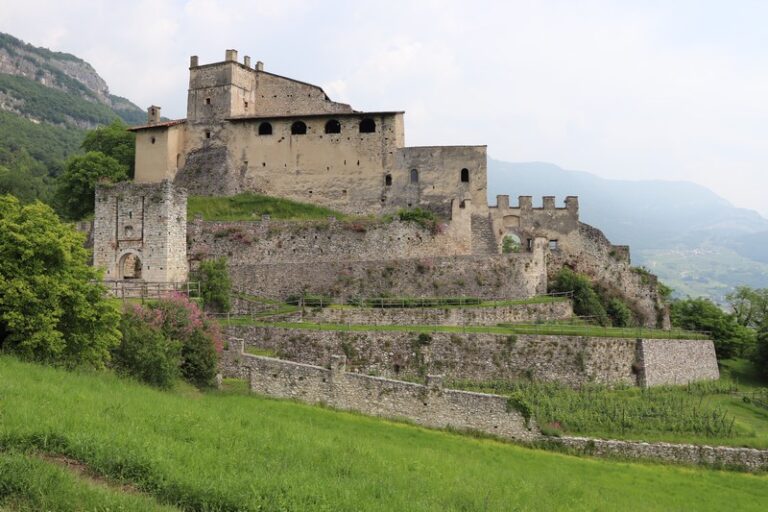
By the fifteenth century, Castel Barco had grown beyond its earliest form. The original stronghold had been expanded with a second circuit of walls and residential buildings. This enlargement reflected the castle’s continuing role as a family residence and as a position controlling the route through the valley.
Venetian occupation and imperial capture
During the mid-fifteenth-century expansion of the Republic of Venice onto the Italian mainland, Venetian troops occupied Castel Barco. Venice used the castle chiefly to control the episcopal castles of Beseno and Pietra on the opposite side of the valley. The transfer was formalized in 1442 in a document signed by Doge Francesco Foscari, and it took place without bloodshed. The surrounding villages were spared attacks by Venetian troops.
Venice modernized the castle to help it withstand firearms. Its legal status, however, remained that of an episcopal fief, and the bishops continued to grant investitures to members of the Castelbarco family. Bishop Alexander of Masovia granted one in 1440, while Bishop Georg II Haak of Themeswald granted another in 1447.
In March 1508, during Emperor Maximilian I’s campaign against Venice, imperial troops reached Castel Barco on 2 March. About 50 knights and 600 Landsknechte, German-speaking professional infantry of the late medieval and early modern period, surrounded the castle. After a two-day siege, during which Francesco Guicciardini says that imperial artillery bombarded the stronghold, the imperial forces captured it.
The troops plundered Castel Barco and largely destroyed it. In autumn 1508, Maximilian I granted the ruins as a fief to the Castelbarco-Gresta branch, but the family did not rebuild the castle. The remaining structures were later quarried for building material, and the site continued as a ruin.
Remains
Setting and surviving defenses
The ruins occupy a rocky promontory on the orographic right side of the Adige in the upper Vallagarina, about 4 kilometres north-northeast of Rovereto. The castle stood on a small ridge on the eastern foothills of Monte Corona-Zimana, above Chiusole, at an elevation of 461 metres. Its site covers approximately 5,000 square metres.
Coppice woodland, rubble, humus, and dense vegetation now cover much of the site, making the former complex difficult to outline. Fragments of both the outer and inner defensive walls survive. The castle ditch is partly buried and difficult to identify, although it can be seen most clearly along the western side.
Keep and central structures
At the centre of the site stands the stump of the former keep, slightly more than 7 metres high. Its northern end narrowed toward a spur. The keep formed the central feature of the early castle, which consisted of a polygonal tower-house enclosed by defensive walls.
East of and below the keep is a cistern. It was later altered with a lateral opening and subsequently adapted for other purposes. The feature preserves evidence of changing use within the castle after its original defensive and domestic arrangements had developed.
Inner wall and courtyard traces
On the western side of the keep, a wall section extends for about 10 metres and reaches up to 1.90 metres in thickness. It joins the inner castle wall and contains a masonry passage. Beneath the humus and vegetation near this passage are traces of walls that may represent the foundations of smaller buildings in the castle courtyard.
The surviving fabric is made of rubble stone. Together, the wall fragments, buried ditch, keep stump, cistern, passage, and possible courtyard foundations preserve parts of a complex that developed from a compact tower-house and enclosure into a larger fifteenth-century castle with additional defenses and residential buildings.
Nearby sites