Schatzberg Castle: A Medieval Noble Fortress in Baden-Württemberg


Site at a Glance
- Rating
- 4.1
- Popularity
- Very Low
- Country
- Germany
- Primary era
- Medieval
- External website
- Open
- Eras represented
- Medieval
- Civilizations
- Holy Roman Empire
- Site type
- Military
- Remains
- Castle
On this page10 sections
History
Schatzberg Castle, also called Schatzburg, is a medieval noble castle ruin near Egelfingen in Baden-Württemberg, Germany. Built in the Middle Ages on a hilltop spur, it belonged to a branch of the Lords of Hornstein and formed part of the Wilflingen knightly lordship. The castle’s construction date is uncertain, although it is generally placed around 1267.
Origins and the Hornstein family
The first documented member of the Schatzberg line was the knight Konrad von Hornstein zu Schatzberg, mentioned in 1250. The castle was associated with an estate leased to the people of Egelfingen for an annual payment, together with a large area of forest. Peasant holdings connected with the estate were held as either forfeitable or hereditary fiefs. A fief was land held in return for service or allegiance, while a forfeitable fief could revert to a superior lord under specified conditions. The lords of the Wilflingen lordship held their position as vassals of the counts of Veringen.
Schatzberg was one of three castles near the ancestral Hornstein Castle occupied at the same time by collateral branches of the Lords of Hornstein. The other two were Bittelschieß and Hertenstein. Because the village of Wülflingen belonged to Schatzberg, its family branch also used the name von Wülflingen.
Konrad von Schatzberg, recorded between 1250 and 1267, was a vassal of Count Hartmann I von Grüningen. Johannes, a knight at Schatzberg documented from 1282 to 1323, was also known as von Wülflingen. He acted as an adjudicator in matters concerning the rights of the counts of Heiligenberg and held Schatzberg as an Austrian fief in 1313. His brothers Peter von Hornstein and Hermann von Hornstein were also active in the region. Peter was a knight, while Hermann was a parish priest at Blochingen and Seekirch and held nearby estates.
The castle in the fourteenth and fifteenth centuries
Heinrich von Hornstein zu Wilflingen probably owned Schatzberg between 1327 and 1350. His son Hans III von Hornstein zu Schatzberg, recorded from 1339 to 1412, held a share of Hornstein Castle as well. He sold Hasenweiler and Ilmensee and strengthened his finances through feuds with the Geroldseck family. In 1385, Hans became a citizen of Rottweil for five years, opened Schatzberg fortress to others, and was living at Wilflingen in 1394.
On 21 September 1400, Duke Leopold of Austria and Hans von Schatzberg reached an agreement concerning access to the church at Bingen, also rendered Büngen. Hans was married to Agnes von Neuneck, the daughter of Volz von Neuneck of Glatten at Neckarburg. Hans IV von Hornstein zu Schatzberg, a son of Hans III, is recorded between 1399 and 1440. Another son, Heinrich von Hornstein, lived at Hornstein, married Agnes von Seckendorf, and purchased the tower at Hornstein.
Jos von Hornstein zu Schatzberg, the son of Hans IV, was the last knight at Schatzberg. He is recorded from 1438 to 1485 and also held the pledge lordship of Hohenberg Castle near Spaichingen. A pledge lordship was territory held as security for money or another obligation. After the sale of Wülflingen and Emerfeld, Jos inherited the remaining Schatzberg estate, including Egelfingen and holdings at Langenenslingen. Through its fortress, the Schatzberg family served the dukes of Austria.
Destruction and transfer of ownership
Jos was frequently involved in feuds. Together with Konrad Scharpf von Freudenberg and other knights, he attacked the bishop of Augsburg. The bishop obtained assistance from the empire, and Counts Ludwig and Ulrich of Württemberg commissioned Count Friedrich von Helfenstein to burn Schatzberg, the fortress from which the attack had been launched. There appears to have been neither a siege nor a defense. Jos’s cousin Konrad later complained that the castle had been burned while Jos was helpless.
After the destruction, Jos led an unsettled life and sold the remains of his property, including the castle site, to his cousin Konrad von Hornstein. In 1454, the destroyed Schatzberg fortress was sold to Konrad von Hornstein zu Grüningen. Jos was placed under the imperial ban in 1455 and remained under it in 1461. The imperial ban was formal exclusion from the protection of the Holy Roman Empire, exposing the condemned person to legal seizure and other sanctions.
Through Konrad’s daughter, the property passed to Georg I von Hornstein, called Hertenstein, zu Grüningen. He sold it in 1487 to Hans von Mulfingen, the bailiff of Sigmaringen. Sebastian Schenk von Stauffenberg acquired the property in 1538, after which it remained with that family.
Jos von Hornstein and later tradition
Jos continued his feuding career after the destruction of Schatzberg. In 1458, he assisted the nuns of Sonnenberg in Tyrol after they appealed for help, but an official of Cardinal Nicholas of Cusa captured him. Nicholas of Cusa was a fifteenth-century German churchman, theologian, and cardinal. After his release, Jos joined his cousin Hug in a feud with Berthold von Stain.
Jos spent much of his final years in Switzerland and died during a feud against the counts of Werdenberg and Heiligenberg on the Dominican Island at Constance. Whether he was murdered or died in combat is uncertain. His feuds with his son Wendel had disturbed the Lake Constance region and prompted correspondence between Constance and Zurich. Jos was buried at Magdenau Abbey near St. Gallen. His wife Anna was last recorded in 1453, and the Schatzberg line ended with their son Wendel.
The tradition of Hans Hödiö is probably based on Hans III von Hornstein, who was known for his conflicts with the Geroldseck family. The legend describes Hans Hödiö as an outlawed knight who built a rocky stronghold between Hitzkofen and Egelfingen, raided farms, travelers, and castles, and later constructed Schatzberg. It says that noble knights led by Count Wolfrad von Veringen stormed and burned the castle, causing its masonry to collapse over Hans and his followers. The tale also claims that a ghostly light and Hans’s cry can still be heard around the ruins at night.
Remains
Hilltop layout and defenses
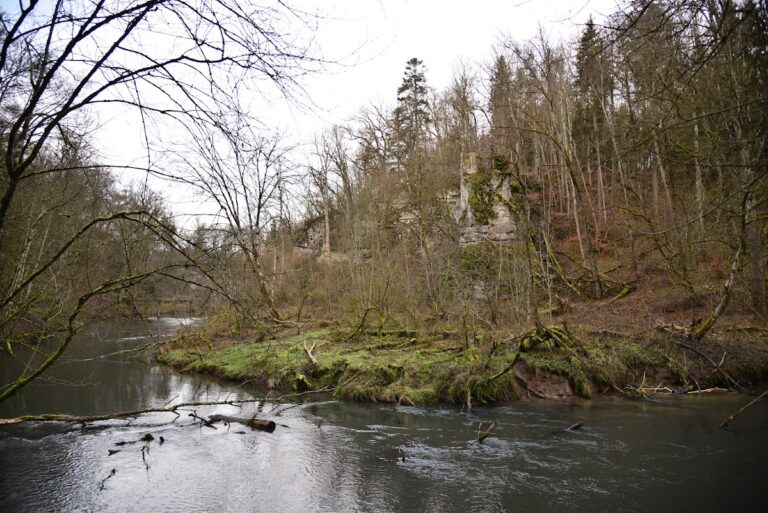
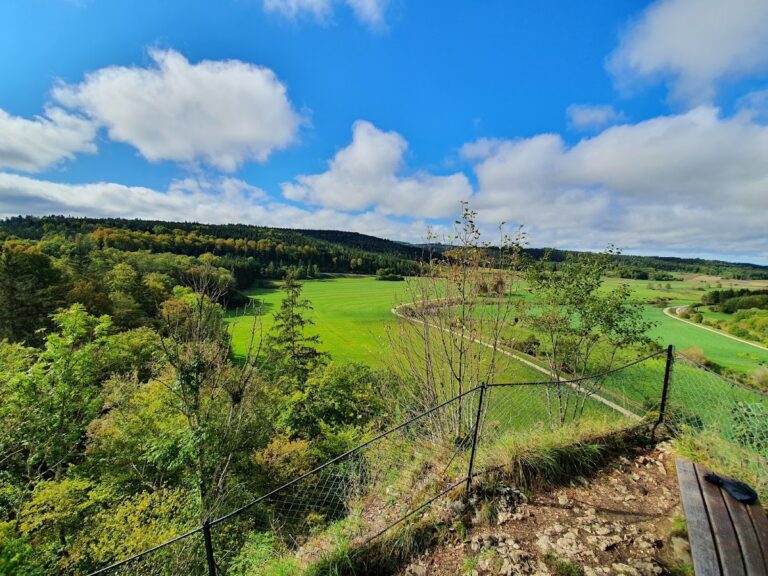
Schatzberg occupies a 703-metre-high projecting spur at the outer boundary toward Sigmaringen. This type of fortress, known as a spur castle, used a projecting ridge to strengthen its defenses. The elevated position provides a broad southern view extending to the Alps. The former complex was enclosed by a ring wall, and a neck ditch cut across the connection between the spur and the adjoining high ground.
Ring wall
The castle’s ring wall was approximately 0.9 metres thick. The surviving site consists only of wall remains, preserving part of the enclosure that defined the medieval fortress.
Keep
The keep measured approximately 9.5 by 7.5 metres at ground level and had walls about 2 metres thick. A keep, or principal castle tower, normally served as a strong defensive structure and refuge rather than as an ordinary residence. The surviving masonry represents the remaining physical evidence of this tower and its substantial construction.
Neck ditch
A neck ditch is identified across the narrow connection between a spur and higher ground. At Schatzberg, this feature formed part of the site’s defensive setting, working with the elevated terrain and enclosing wall to protect the castle approach.