Tilurium: An Illyrian Hill-Fort and Roman Military Fortress in Croatia
Site at a Glance
- Rating
- 4.5
- Popularity
- Very Low
- Country
- Croatia
- Primary era
- Classical
- Eras represented
- Classical
- Civilizations
- Roman
- Site type
- Military
- Remains
- Fort
On this page13 sections
History
Tilurium is an ancient fortified site in Croatia, located at Gardun above modern Trilj, where an Illyrian hill-fort became a Roman military fortress after the conquest of the Delmatae. The site occupied a strategic position above the Cetina River and formed part of Rome’s frontier-defence system in Dalmatia.
Delmataean Hill-Fort
Tilurium began as a fortified hilltop settlement of the Delmatae, an Illyrian people of the Dalmatian hinterland. Before Roman rule, such enclosures served as tribal centres and places of refuge during warfare. Conflict in the region involved both fighting between local communities and resistance to Rome.
Roman Conquest and Legionary Fortress
One of the final phases of the Great Illyrian Revolt of AD 6 to 9 took place between Burnum and Tilurium. Rome’s victory in AD 9 ended organized Illyrian resistance and allowed a permanent Roman military presence to be established at the site. Rome then incorporated Tilurium into its frontier system and built a legionary fortress on the Gardun plateau. From there, the garrison controlled the Cetina valley, the Pons Tiluri river crossing, inland routes through Dalmatia, and communications with Salona through the Roman road network.
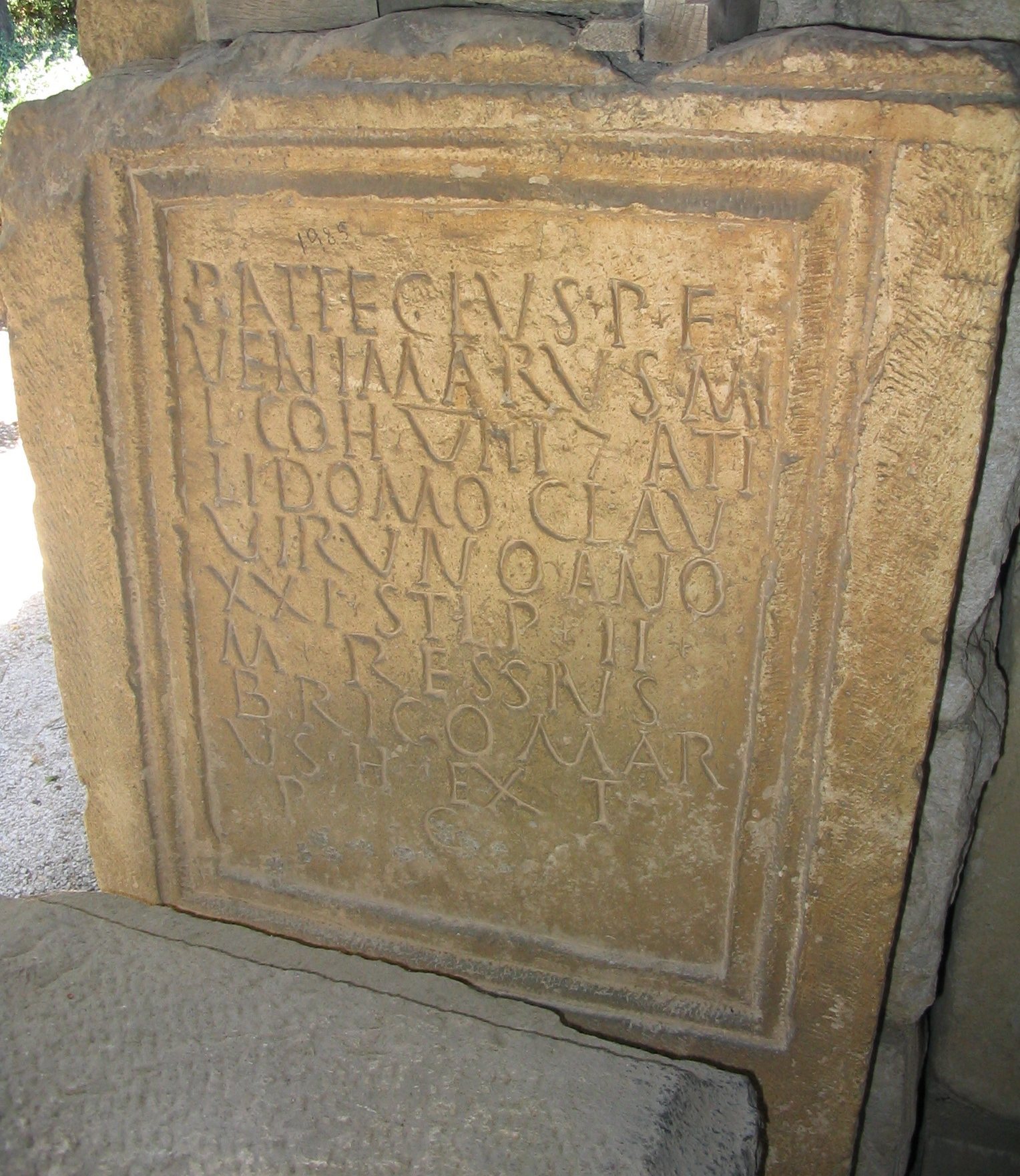
The early garrison was associated with Legio IX Hispana and Legio VII Claudia, Roman legions that were large professional military formations. Legio VII Claudia arrived from Macedonia during or soon after the revolt and strengthened the fortress, which remained its base for several decades. Tilurium was also associated with Legio XI Claudia. After AD 45, veterans of Legio VII Claudia received land north of Tilurium and founded Colonia Claudia Aequum at modern Čitluk near Sinj. By approximately AD 45 to 58, the legion had been withdrawn to Viminacium in Moesia.
Auxiliary Garrison and Late Roman Use
Auxiliary troops, recruited outside the citizen legions, occupied Tilurium or its immediate surroundings after the legionary withdrawal. An inscription places Cohors III Alpinorum at or near the site in AD 75. The later auxiliary castellum, a smaller fortified post, housed Cohors VIII Voluntariorum Philippiana during the reigns of Antoninus Pius and Caracalla and at least until the reign of Philip the Arab.
During the third and fourth centuries, Tilurium probably served as a logistics station and defensive strongpoint on the route between the Dalmatian coast and the interior. Occupation continued into the Late Roman period. In Late Antiquity, the settlement had become a smaller fort or castellum, repaired or maintained as a refuge against renewed threats. Coins and weapons from the reign of Justinian I, dated AD 527 to 565, belong to this later phase.
Excavation and geophysical investigation have taken place at Tilurium since 1997. This work has clarified the fortress layout and identified the positions of its principal gateways. The modern village of Gardun occupies part of the ancient remains, while the archaeological site covers approximately 12 hectares.
Remains
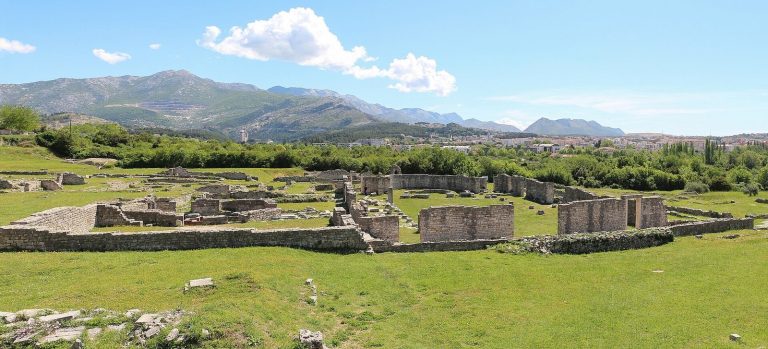
Tilurium occupied a plateau about 339 metres above sea level on the northeastern side of the Cetina River, known in antiquity as Hippos. The position provided a commanding view and field of fire over the surrounding valleys, as well as control of the Pons Tiluri bridge. The camp had a roughly rectangular enclosure adapted to the terrain, with its principal gate probably facing south or west toward the river crossing. Inside, the decumanus maximus, the main east-west road of the fortress, formed a major line of the settlement.
Walls, Gates, and Defensive Structures
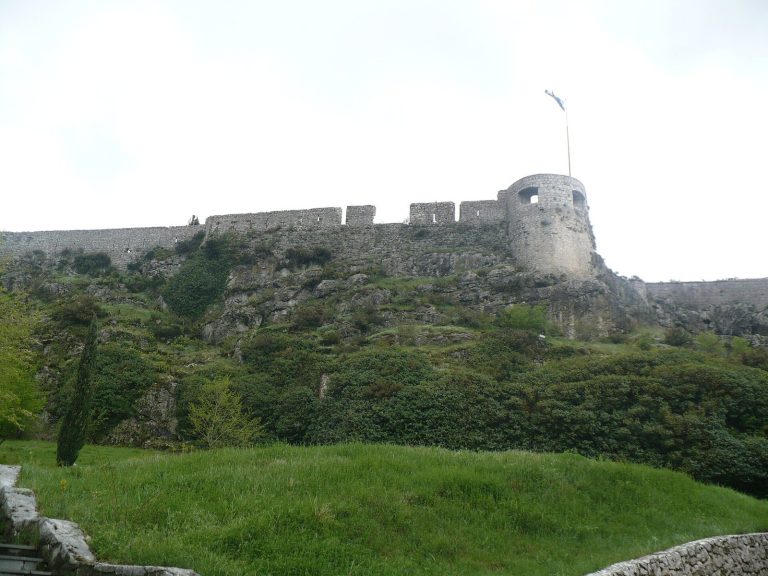
The perimeter walls were built from local limestone, either as dry-stone construction or with mortar. Surviving sections are especially visible on the western and northern sides. Parts of corner towers and buttresses reinforced the curtain walls. Excavated trenches and geophysical surveys have located breaks in the ramparts belonging to the porta praetoria, the principal gate, and to other entrances. The gate buildings survive only in fragmentary form, while their positions remain identifiable within the defensive circuit.
Buildings within the Fortress
Amphitheatre and Bathhouse
An amphitheatre and a bathhouse stood immediately south of the decumanus maximus. Their position formed part of the built interior of the fortress and illustrates the range of structures associated with the Roman military settlement.
Monumental Building and Cistern
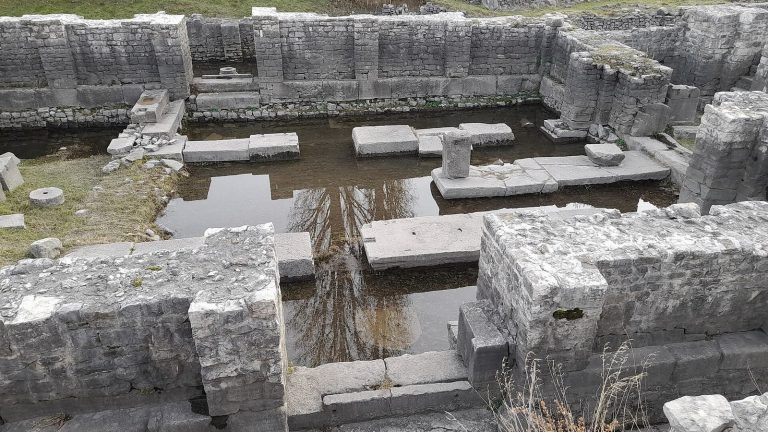
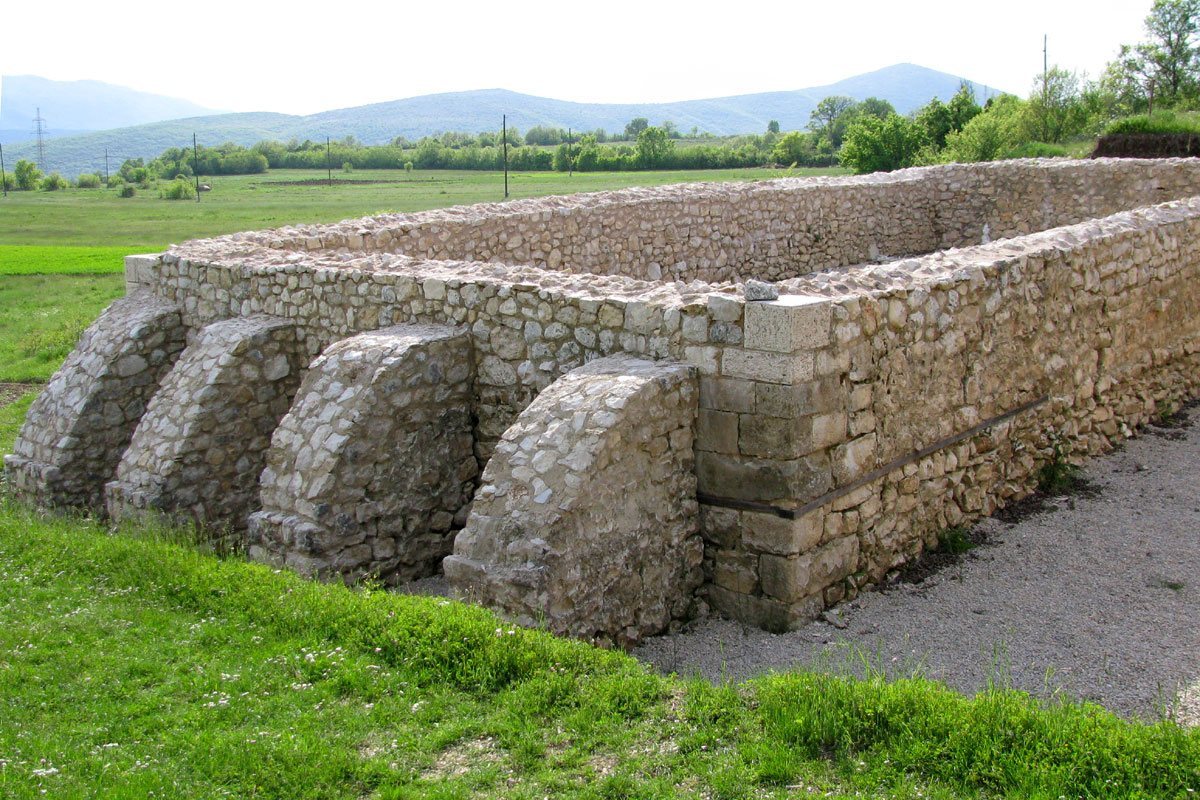
Other remains include a monumental ancient building reinforced with buttresses and a water cistern. These structures form part of the excavated architectural record of the camp and reflect its substantial internal construction.
Mosaic Building
A central building contained fragments of three mosaic floors. Two earlier pavements survive in smaller pieces, while a later floor once covered almost 120 square metres and survives in five fragments of about 12 square metres each. The mosaics date to the transition between the first century BC and the first century AD. The later pavement used white, pink, and grey-black tesserae to form alternating squares or rhombi in black and white. Its central field included a figure, represented among the surviving fragments by the rear part of a bull on a black background. The earlier floors used blue curls on a white ground and alternating rectangular fields in different colours.
Monument and Excavated Finds
Roman Victory Monument
Part of a Roman tropaion, a victory monument representing the subjugation of an enemy, survives within the camp. It depicts conquered Illyrians and commemorates the Roman victory over the Delmatae.
Objects and Military Production
Excavations have produced fragments of high-quality ceramics and glassware, jewellery, everyday objects, military equipment, tools, weapons, coins, inscriptions, and sculptures. Workshops at Tilurium also made stone-carved tombstones and other monuments for Legio VII Claudia.