Dunmore Castle: A Medieval Keep and National Monument in Ireland


Site at a Glance
- Rating
- 4.4
- Popularity
- Very Low
- Country
- Ireland
- Primary era
- Medieval
- Eras represented
- Medieval, Early Modern, Modern
- Civilizations
- English
- Site type
- Military
- Remains
- Castle
On this page7 sections
History
Dunmore Castle is a medieval castle in Ireland, located near Dunmore in County Galway. Built by the de Bermingham family in the early thirteenth century, it formed part of the medieval English presence in Ireland and stood as a bulwark against attacks by Gaelic Irish forces.
Early Medieval Stronghold
Dunmore, a name meaning “great hillfort,” is traditionally associated with a lesser residence of the ancient Kings of Connacht, one of Ireland’s historic provinces whose medieval rulers belonged to Gaelic dynasties. The first castle was constructed by the de Berminghams in the early 1200s. Its position on the north bank of the Sinking River, about 1 km northwest of Dunmore, placed it within a contested landscape.
The castle suffered repeated attacks during the thirteenth and early fourteenth centuries. The O’Conors attacked and burned it in 1249. In 1284, it was besieged by the Síol Maelruain under Fiachra O’Flynn, a Gaelic leader. Rory O’Conor damaged the castle in 1315 during the Bruce campaign, the military intervention in Ireland led by Edward Bruce of Scotland.
Fourteenth-Century Reconstruction
Most of the present castle dates from the early fourteenth century, during the reigns of Edward II and Edward III. These English monarchs also held the title Lord of Ireland, which expressed the English crown’s authority over Ireland before the creation of the Kingdom of Ireland. At this stage, Dunmore was a two-storey hall keep, combining a principal residential hall with the defensive form of a fortified tower.
The de Berminghams later rebelled against Elizabeth I. In 1569, Sir Henry Sidney, the queen’s Lord Deputy of Ireland, took the castle from the family, although it was subsequently returned to them. During the Cromwellian era in the 1650s, a period associated with Oliver Cromwell’s conquest and administration in Ireland, the castle was permanently seized from the de Berminghams.
Later Occupation and Protection
The Ouseley family occupied Dunmore Castle after the confiscation. Their occupants included the preacher Gideon Ouseley, and the family retained the castle until the nineteenth century. A lime kiln was built on the site during that century. Dunmore Castle is now state-owned and protected by the Office of Public Works. It is also designated as a National Monument of Ireland.
Remains
The Keep
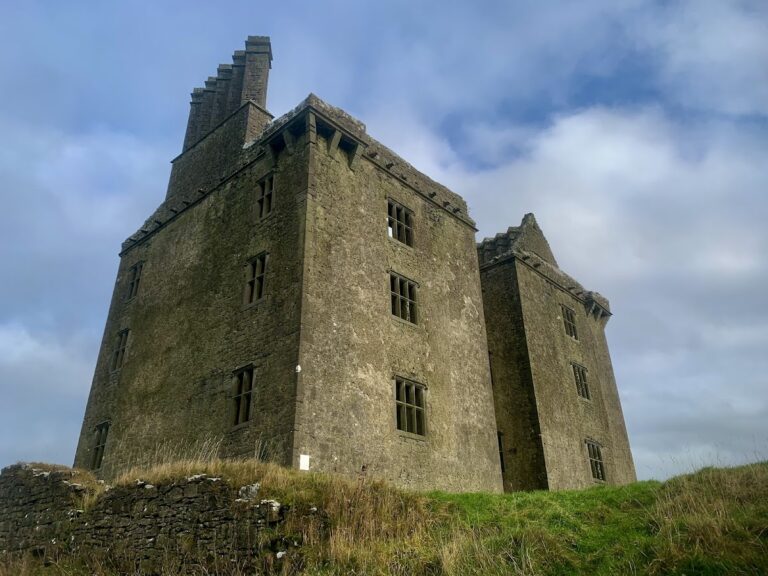
The principal surviving structure is a rectangular keep measuring 14 m by 8.2 m at its base. It rises through five storeys and has a large base-batter, a sloping and thickened lower section of wall that strengthens the structure and makes attack more difficult.
The keep incorporates several types of medieval defensive and domestic opening. Its windows include an oculus, or circular window, mullioned windows divided by vertical members, and arrowslits, which are narrow openings used by defenders to observe or shoot. Evidence for a garderobe, a medieval castle latrine, survives at the northwest of the keep.
The earlier hall-keep arrangement was altered in the sixteenth century. Additional floors, roof gables, chimneys, windows, and a ground-floor entrance changed the building’s appearance and internal organization. These elements remain part of the castle’s architectural development from a two-storey residential fortress into the five-storey keep visible today.
Outer Defences and Industrial Feature
Part of the curtain wall survives around the keep, preserving evidence of the castle’s wider defensive enclosure. The nineteenth-century lime kiln adds a later industrial feature to the site and reflects continued use of the castle grounds after the medieval and early modern phases.
Nearby sites