Ross Errilly Friary: A Medieval Franciscan Monastery in Ireland

Site at a Glance
- Rating
- 4.8
- Popularity
- Very Low
- Country
- Ireland
- Primary era
- Medieval
- External website
- Open
- Eras represented
- Medieval, Early Modern
- Civilizations
- English
- Site type
- Religious
- Remains
- Monastery
On this page14 sections
History
Ross Errilly Friary is a former Franciscan monastery in Ireland near Headford, County Galway, founded in the mid-fifteenth century by the Franciscans, a Catholic mendicant order established by Francis of Assisi. The community is often called Ross Abbey, but its members were friars rather than monks governed by an abbot, making “friary” the more accurate term. Traditionally dated to 1351, the foundation is now generally placed around 1460, when an earlier religious establishment may have been substantially enlarged. The friary became one of Ireland’s most enduring medieval monastic sites and is now a National Monument of Ireland.
Foundation and expansion
The Four Masters, Irish annalists whose chronicle covered major events in medieval and early modern Ireland, and the Franciscan historian Luke Wadding both gave 1351 as the foundation date. Tradition attributed the foundation to Raymond de Burgh of the local Cambro-Norman de Burgh family. Architectural and documentary evidence instead points to a mid-fifteenth-century foundation, perhaps around 1460, with any earlier religious building enlarged during that century.
The earliest surviving documentary reference appears in the 1469 will of John Blake, son of Henry Blake, who left the friary 40 pence. Around 1473, Franciscans from Ross Errilly travelled to Donegal at the request of the Tyrconnell clan, a Gaelic ruling dynasty based in Donegal, and founded Donegal Friary.
Reformation and repeated confiscation
The English Reformation, the sixteenth-century break between the English Crown and the Roman Catholic Church, brought severe disruption to Catholic religious houses in Ireland. In 1538, English authorities imprisoned 200 monks at Ross Errilly and banished or killed an undetermined number of others. The community then faced repeated expulsions and persecution.
At the beginning of Elizabeth I’s reign, the Crown confiscated the friary and granted it to Richard Burgh, 2nd Earl of Clanrickarde. As a descendant of the de Burgh family associated with the foundation, he quietly returned the property to the Franciscans. An enclosing ditch and wall were built around the friary in 1572.
The Crown confiscated the monastery again in 1584, granted it to an English nobleman, and allowed the friars to be evicted while the building’s contents were plundered. Ulick Burke, 3rd Earl of Clanrickarde, purchased the monastery in 1586 and restored it to the Franciscans. By the end of the century, the Crown had expelled the friars again, reportedly for the seventh time, and the monastery became an English garrison during the Nine Years’ War, the conflict from 1593 to 1603 between forces loyal to the English Crown and a coalition of Gaelic and other Irish leaders.
Seventeenth-century conflict and recovery
Ulick Burke financed the friary’s rehabilitation and reoccupation in 1604. In 1612, Arthur Chichester, Lord Deputy of Ireland, ordered William Daniel, the Protestant archbishop of Tuam, to expel the Franciscans and demolish the altars. Daniel apparently carried out the order but warned the residents beforehand, enabling them to remove their most valuable possessions.
The Franciscans returned in 1626 and enjoyed about 25 years of relative peace. The community then comprised six priests and two brothers. A handwritten document dated 27 November 1636 bears the signature of Boetius Mac Egan, a prelate residing at the friary.
On 18 February 1642, during the uprising that began in Ireland the previous year, Ulick Burke and the friars helped rescue about 40 Protestant refugees, including the family of John Maxwell, Protestant bishop of Killala. The survivors were sheltered in the Headford area until passage to England could be arranged.
During Oliver Cromwell’s conquest of Ireland, Ross Errilly became an informal refuge for Catholic clergy expelled from other parts of the country. Cromwellian forces, the armies associated with that campaign, reached the friary on 10 August 1656, only a few hours after the 140 Franciscans living there had fled. The soldiers ransacked the grounds, destroyed crosses and other religious images, and defiled tombs while looking for valuables.
Local tradition holds that the departing friars removed the bell from the bell tower and sank it in the nearby Black River. After the restoration of Charles II in 1660, the friary was reoccupied and repaired in 1664.
Final abandonment
The Glorious Revolution of 1688 to 1691, the upheaval that brought William III and Mary II to the English throne, and the Popery Act of 1698 renewed pressure on Catholic clergy and religious practice in Ireland. The Franciscans abandoned Ross Errilly again. Records show that they had returned by 1712, may have departed again in 1731 for uncertain reasons, and had certainly returned by 1753.
By 1753, the property belonged to Lord St. George, a local nobleman who secretly supported the Franciscans despite the Penal Laws. These laws restricted the political, civil, and religious rights of Catholics in Ireland. After a family that had lost a lawsuit against St. George reported that he was sheltering Catholic religious, the friars evacuated the monastery for the last time.
St. George had the interior whitewashed and installed weavers and their looms so that the building would appear to be a factory. The inquiry ended without further incident, but the makeshift factory soon closed, and the Franciscans did not return.
Dispersal and decline
The dispossessed friars built wooden and stone cabins on a small island in the Black River about one mile, or 1.6 kilometres, downstream. The island was informally known as Friars Island and later disappeared. Local supporters supplied the community with food, fuel, and clothing across a wooden drawbridge.
The friars continued to celebrate Sunday Mass in the deteriorating monastery for 36 years. In 1789, Henry Lynch of Ballycurrin leased them 16 acres, approximately 65,000 square metres, at Kilroe near Headford. Three friars remained by 1801, and Mass continued at Kilroe until 1804. The community finally closed in 1832.
After abandonment, Ross Errilly declined into ruin. In 1835, John Barrow described it as a fine but neglected ruin and noted extensive unburied human remains. Samuel Lewis recorded in 1837 that the roof had collapsed in 1812 and that ivy partly covered the site, although one window remained intact.
William Wilde visited in July 1866 and again described large heaps of skulls and bones. He reported that sheep and cattle entered the ruins and credited the nearby resident Oliver Burke with clearing obstructions from the window mullions and repairing the tower. Mullions are the vertical divisions that support sections of a window. Oliver Burke, a barrister, published his own account of the friary’s history in 1868. The Office of Public Works now maintains the ruin.
Remains
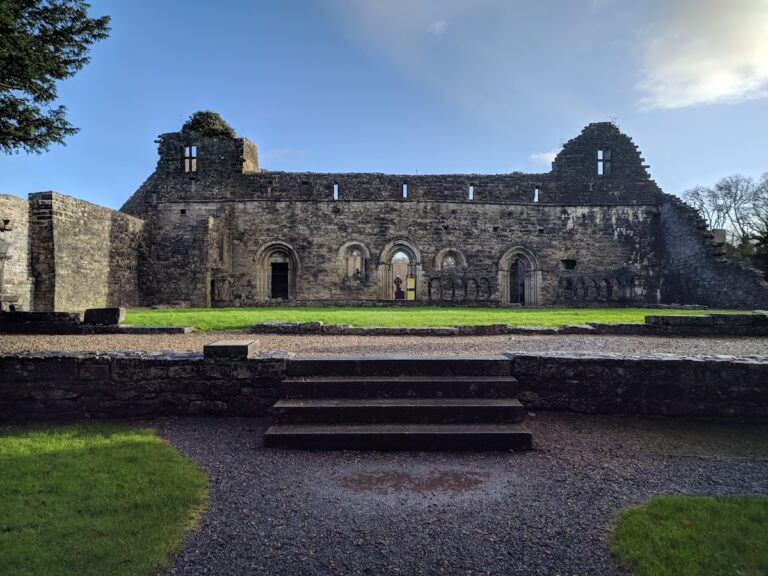
Ross Errilly stands about 150 metres from the Black River, which forms the boundary between Counties Galway and Mayo before flowing roughly six kilometres farther into Lough Corrib. The surviving complex is arranged around a small, well-preserved central cloister, a covered walkway enclosing an open courtyard and linking the main parts of a religious community. The church and bell tower lie to the south, while the domestic range occupies the north. A second courtyard was later added as the friary population grew, an unusual arrangement among Franciscan friaries.
Church and cloisters
Church and bell tower
The church forms the southern part of the complex and is joined to a central square bell tower dated to 1498. The tower was repaired by 1866, when Oliver Burke cleared obstructions from its window mullions. Its history also belongs to the local tradition that the friars sank the church bell in the Black River while fleeing Cromwellian troops in 1656.
Central and second courtyards
The small central cloister remains well preserved and organizes the relationship between the church and the domestic buildings. A second cloister or courtyard was added to accommodate the growing community. This additional court gives the complex an unusual plan among Franciscan friaries.
Domestic buildings
Kitchen and service rooms
The ground-floor exterior walls of the northern domestic range survive almost completely. The rooms can be identified as a kitchen, bakehouse, and refectory, the communal dining room of the friars. The kitchen contained an oven, a monumental fireplace, and a water tank designed to keep live fish.
Dormitories and later alterations
The friars’ dormitories occupied the upper levels of the domestic range. Later changes to the building included the whitewashing of the interior and its temporary conversion into a factory with weavers and looms after the final Franciscan evacuation. By the nineteenth century, the roof had collapsed, ivy partly covered the ruin, and one window remained intact.
Burial ground
After the friary was abandoned, the church precinct became a burial ground. It contains tombs from the period of Franciscan occupation as well as graves dating from the eighteenth through the twentieth centuries. Some tombstones and grave slabs were reused as floors in walkways and crawlspaces, while the nineteenth-century ruin also retained the human remains described by John Barrow and William Wilde.
Nearby sites