Castle of Montesperello: A Medieval Fortified Settlement in Italy


Site at a Glance
- Rating
- 4.7
- Popularity
- Very Low
- Country
- Italy
- Primary era
- Medieval
- External website
- Open
- Eras represented
- Medieval, Modern
- Civilizations
- Carolingian, Papal States
- Site type
- Domestic
- Remains
- Castle
On this page14 sections
History
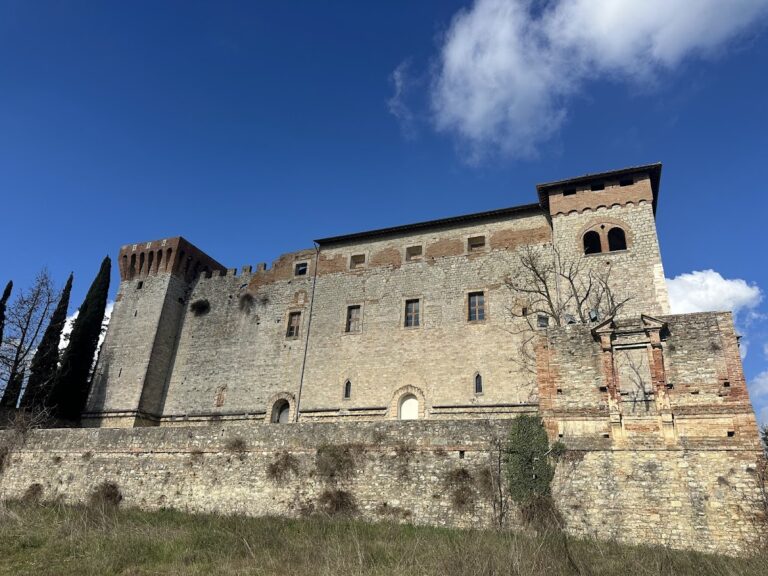
Castle of Montesperello is a medieval fortified complex in Italy, located at Monte Sperello about one kilometre southeast of Magione in Umbria. Its development is associated with the Carolingian period, although activity on the hill is much older. The site became a defensive settlement because of its elevated position and its importance in the landscape between Perugia, the Trasimeno area, and Arezzo.
From Etruscan settlement to Byzantine defence
Archaeological traces place an Etruscan settlement at Monte Sperello in 210–214 BC. The Etruscans were an ancient people of central Italy who preceded Roman political dominance in the region. After Rome conquered Italy, the need for local defensive positions declined, and the hill developed into a rural settlement with farms dispersed among the fields.
Defensive concerns returned after the imperial Roman period as invasions and the Lombard conquest altered the political balance of Italy. The Lombards established a kingdom across much of the peninsula after the decline of imperial Roman authority. Monte Sperello then formed part of the Byzantine defensive line against Lombard attacks and was administered by Perugia’s military authorities. The Byzantine Empire was the eastern continuation of the Roman Empire, governed from Constantinople.
The Montesperelli foundation and medieval lordship
In 608, Bernardo Montesperli founded a villa on the site. It initially had no boundary wall, but it later became the nucleus of the castle. The Montesperelli family was among the oldest families of Perugia, and documents from the twelfth century identify people subject to the family. The development of the urban commune began in the tenth century, when a local consortium of nobles was linked to feudalism through a largely peaceful process of conquest.
After the creation of the Carolingian Empire, the political realm established by Charlemagne and his successors in western and central Europe during the late eighth and ninth centuries, Monte Sperello became imperial property. In 997, Emperor Otto III donated it to the Benedictine monastery of San Gennaro di Campoleone at the request of Hugh the Great, abbot and margrave of Tuscany. A Benedictine monastery followed the Rule of Saint Benedict, while a margrave was a frontier military governor or territorial ruler.
The settlement remained small. It contained 30 inhabitants in 1282 and 24 in 1410. In 1380, the castle was destroyed and reverted to the status of a simple villa. Perugia financed its rebuilding in 1439 because it considered Montesperello an important defensive point toward the Trasimeno and Arezzo areas.
Reconstruction and later transformation
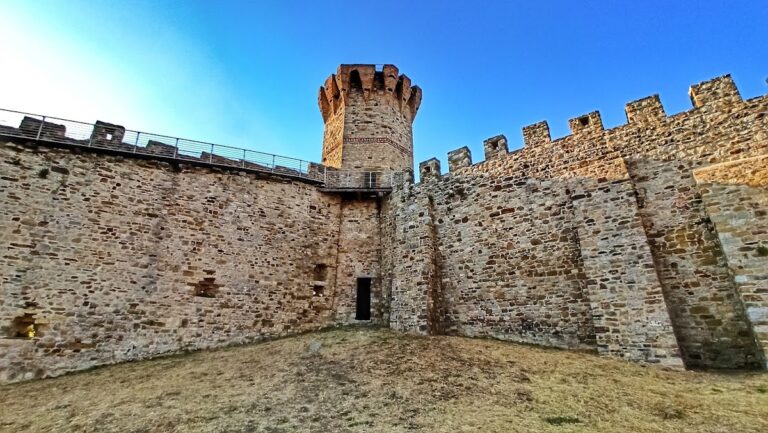
The War of 1479 between Florence and the Papal State, a conflict that brought the two powers into direct military confrontation, left the castle almost destroyed. Its final reconstruction took place in 1495, when the defences were adapted to the use of firearms. This rebuilding established the late medieval and early modern form of the fortified settlement.
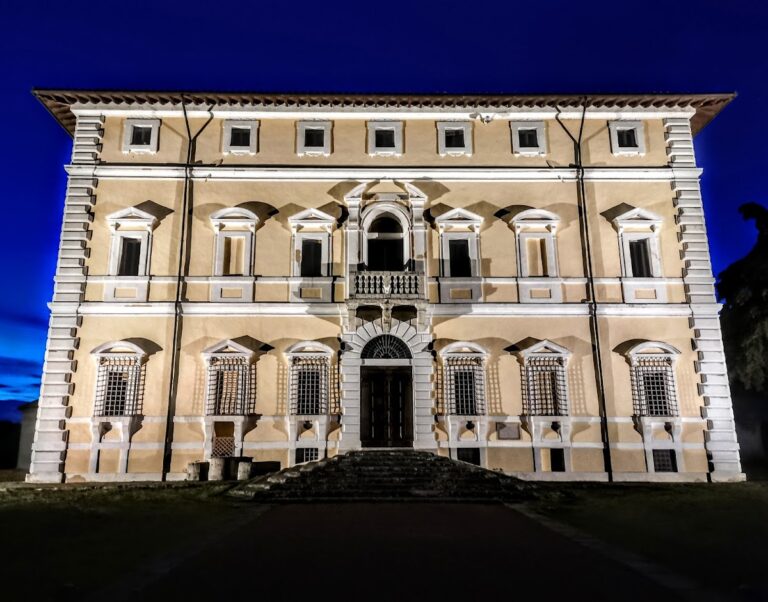
A renovation in the nineteenth century transformed the castle into a residential villa. Ownership later became associated with the Pesciarelli family and EOS S.A.S. The complex is now used as a residential and hospitality development, with a hotel occupying three buildings.
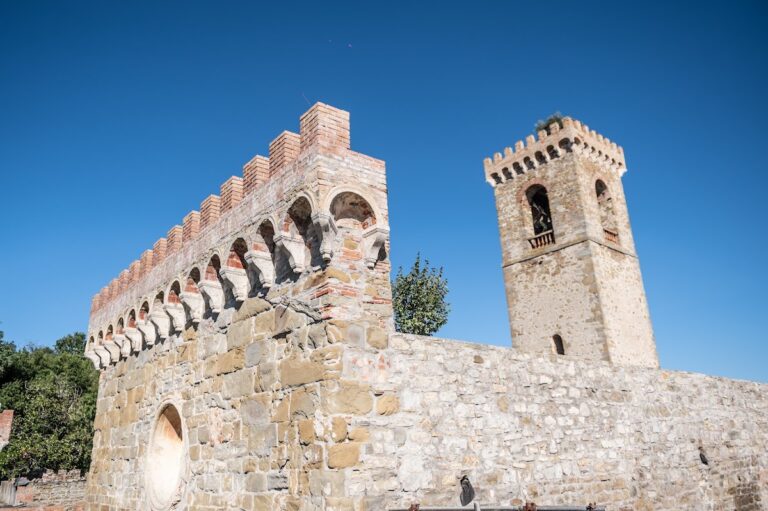
The adjoining parish church of Saint Christopher has its own long history. It was recorded in the Liber beneficiorum in 1350 and rebuilt between 1400 and 1450. The Liber beneficiorum was a register of ecclesiastical benefices and the institutions or properties connected with them. The church’s present bell tower dates from 1797. In the early 1930s, a chapel dedicated to Saint Francis of Assisi was built in place of the church sacristy. On 3 July 1949, Gerardo Dottori completed an apse triptych dedicated to Saint Christopher. A triptych is an artwork made of three panels.
Remains
Castle of Montesperello occupies the elevated ground of Mountain Penna, about one kilometre southeast of Magione. Its position supplied natural protection, while the fertile valley around the hill supported agricultural development. The complex combines the castle buildings, the church outside the walls, underground features, and archaeological material connected with earlier occupation.
Castle buildings and underground passage
Residential houses and escape passage
A concealed passage runs through the basements of the castle houses and continues beyond the walls. It served as an escape route for occupants during a siege. Fifteenth-century land registers identify the people living in these houses as members of the Montesperelli family, linking the underground feature to the medieval residential community within the fortified settlement.
Present hotel buildings
The castle complex contains three hotel buildings with 130 rooms and approximately 30–40 apartments. Their present residential and hospitality use reflects the nineteenth-century conversion of the fortified site into a villa and its later adaptation to modern accommodation.
Church and chapels
Church of Saint Christopher
The parish church of Saint Christopher adjoins the castle but stands outside its walls. It has an external bell tower, whose present form dates to 1797. The church’s apse contains the triptych completed by Gerardo Dottori in 1949. Its three panels depict the conversion of Saint Christopher, the saint carrying Jesus, and his martyrdom. Saint Christopher is traditionally associated with carrying Christ across a river.
Chapel of Saint Francis of Assisi
The chapel built in the early 1930s in place of the church sacristy contains three paintings by Tito Tedeschi. They depict Saint Francis together with buildings in Assisi and Montesperello. Saint Francis of Assisi was the thirteenth-century founder of the Franciscan movement.
Earlier archaeological features
Etruscan funerary evidence
Etruscan cinerary urns were found during the nineteenth century in the walls of two houses within the castle area and along the hill. A cinerary urn is a vessel used to contain cremated human remains. One of the urns bears a carved Medusa head, providing material evidence of the site’s pre-Roman occupation.
Cave of the Mysteries
A cave lies a few metres north of the Church of Saint Christopher, within a modern residential building. Locally called the Cave of the Mysteries, it contains a staircase and an area extending several metres. Its original function remains uncertain. It has been interpreted as an Etruscan tomb, a cellar, or a tomb later reused as a cellar. An inscription on the wall gives the date 1628, which may refer either to the discovery of a tomb or to the excavation of an underground cellar.
Nearby sites