Little Cumbrae Castle: A Fortified Tower House on Castle Island


Site at a Glance
- Rating
- 4.8
- Popularity
- Very Low
- Country
- United Kingdom
- Primary era
- Early Modern
- Eras represented
- Early Modern
- Civilizations
- Kingdom of Scotland
- Site type
- Military
- Remains
- Castle
On this page9 sections
History
Little Cumbrae Castle is a fortified tower house on Castle Island, a small tidal islet off the east coast of Little Cumbrae in the Firth of Clyde, United Kingdom. The surviving building is associated with Lord Eglinton, although its construction date is uncertain. Its position and defensive character made it an important stronghold for the Eglinton family, while the wider island was connected with royal hunting, hereditary foresters, and disputes over access and poaching.
Royal Hunting and Earlier Buildings
Little Cumbrae had a predecessor building, possibly a castle or hunting lodge erected by Walter Stewart, the Scottish nobleman who was the husband of Marjorie Bruce and father of Robert II. His son, Robert II, used the “Auld Castle” during hunting expeditions in 1375 and 1384, and Robert III, his son and successor, also visited the island. The island’s name appeared in several forms, including Kumbrey around 1300, Cumbraye around 1330, and Litill Comeray in 1515. Its Gaelic name referred to an islet of the nobles’ tower.
The Eglinton Estate and Control of the Island
The surviving tower house may have been built for Lord Eglinton as a base for controlling deer and rabbit poaching. The Hunters of Hunterston served for centuries as hereditary foresters of Little Cumbrae and the island’s royal lands. In 1515 Hugh, Earl of Eglinton, was appointed keeper after the Privy Council judged Robert Hunter unable to suppress poaching. Robert Hunter secured a royal charter for the island in 1527, but the Crown soon sold it to the Earl of Eglinton. James V confirmed the earl’s rights in 1555.
The castle continued to be used as part of the estate’s management. In 1568 George Elphinstoun, a glasswright, was employed by the Earl of Eglinton to install glass windows in the building. The small harbour at Brigurd Point on Hunterston Sands was said to have served the island’s lairds on journeys to and from Little Cumbrae. In 1609 Robert Hunter faced a Privy Council complaint after travelling to the island and taking hawks.
Conflict and Destruction
In 1599 Robert Boyd of Badenheath lived in the castle and planned a harbour intended to encourage trade. Several Montgomery families on Little Cumbrae opposed better communication with the outside world, apparently because the island provided refuge for rebels, fugitives, and people who had been excommunicated. About thirty Montgomery men broke into the castle, destroyed the harbour materials, smashed the furniture, expelled Boyd, and occupied the building.
During the conflicts of the mid-seventeenth century, the Earl of Eglinton sent his wife, Lady Montgomerie, to the castle with a garrison of forty men for her protection. The fortifications were strengthened, and the castle became the earl’s principal stronghold because nearby Ardrossan Castle was vulnerable to artillery. In 1651 Charles II authorized the maintenance of forty men raised by Lord Montgomerie on Little Cumbrae. Charles II was the Stuart king whose claim to the Scottish, English, and Irish thrones was supported by Royalist forces after the execution of his father, Charles I.
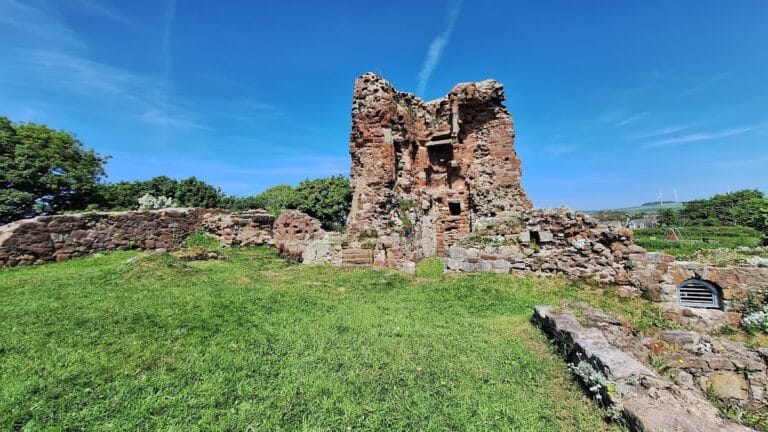
The earl was captured while fighting Oliver Cromwell at the Battle of Worcester on 3 September 1651. Cromwell was the English parliamentary military and political leader whose forces defeated Royalist supporters during the Wars of the Three Kingdoms. After the capture, the Marquis of Argyll advised Lady Montgomerie either to surrender the castle or demolish it after removing its guns and ammunition. The castle was taken by surprise and destroyed by Cromwellian forces in 1653, possibly in retaliation for the imprisonment and later execution of Archibald Hamilton. Hamilton, a friend and correspondent of Cromwell, had been imprisoned in the castle’s dungeon by the sixth Earl of Eglinton before being taken to Stirling and hanged.
The castle was not restored or reoccupied after its destruction. Another tradition says that the Earl of Eglinton himself took refuge there when Cromwell’s troops threatened Ardrossan Castle. The island retained associations with hunting in later centuries. The sixth Earl of Eglinton was an active huntsman and may have brought deer from Ireland to improve the island’s stock. In the 1850s the fifteenth Earl, George Montgomerie, reintroduced rabbits. Around 5,000 were bred each year, eventually becoming a pest, while the island also generated income through leases to shooting parties.
Protection and Ownership
Little Cumbrae Castle remains privately owned and is controlled by the Montgomery clan. It has been a scheduled monument since 1962. This status protects sites of national archaeological or historic importance under Scottish law and restricts unauthorized damage or alteration. The castle’s former Category A listed-building designation, applied in 1971, was withdrawn in 2018.
Remains
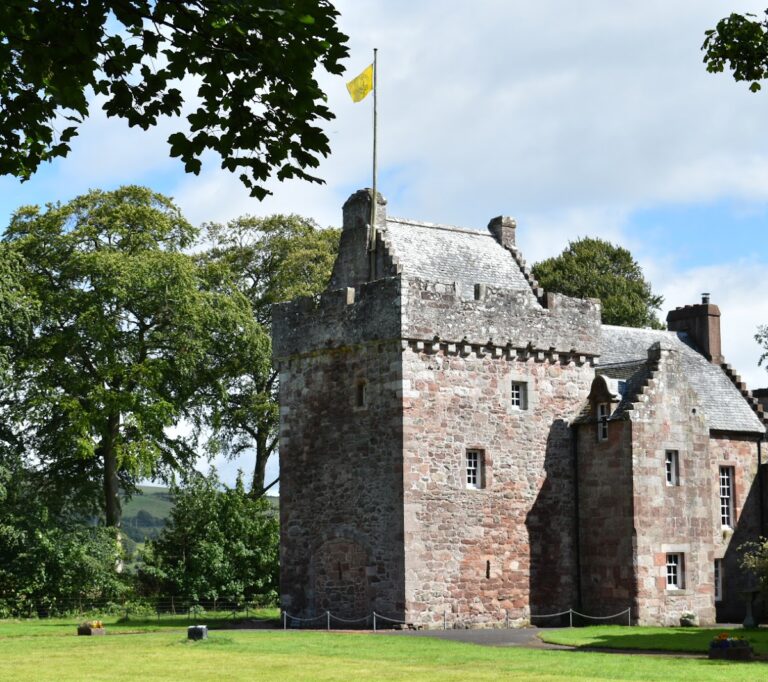
Little Cumbrae Castle is a small stone tower house measuring approximately 12.5 metres by 9 metres. It rises about 13.5 to 14 metres to the wall-walk, a passage along the top of a fortified building. The tower once stood within a rampart and ditch or enclosing wall. Today it survives as a substantial ruin, although its condition has also been described as relatively good.
Tower House
The building has three main storeys. On the first floor, a vaulted great hall and kitchen formed the principal domestic rooms, while two vaulted cellars occupied the levels below. The first-floor entrance was originally reached by a removable wooden ladder, an arrangement that helped make the doorway defensible. A stone fore-step now provides the approach to the entrance.
Small original windows and arrow slits remain in the walls, together with numerous ground-floor gunloops, narrow openings through which firearms could be used. These features combine the requirements of a fortified residence with those of a domestic building. The tower has been described as architecturally similar to Fairlie, Law, and Skelmorlie castles.
Upper Defences
A wall-walk crowns the tower. Its continuous chequered corbel course uses projecting stones to support the upper structure, and a customary watchhouse provided a small place for observation or guard duty. Round angle turrets occupy three of the four corners, strengthening the upper defensive line and giving the tower its distinctive outline.
Local Tradition
A local legend attributes the castle’s construction to the Devil’s son. In the story, the Old Devil was building a castle at Portencross while another castle was being built on Little Cumbrae. The only hammer was lost in the Firth of Clyde when tools were thrown between the two sites, and both castles were consequently left unfinished.