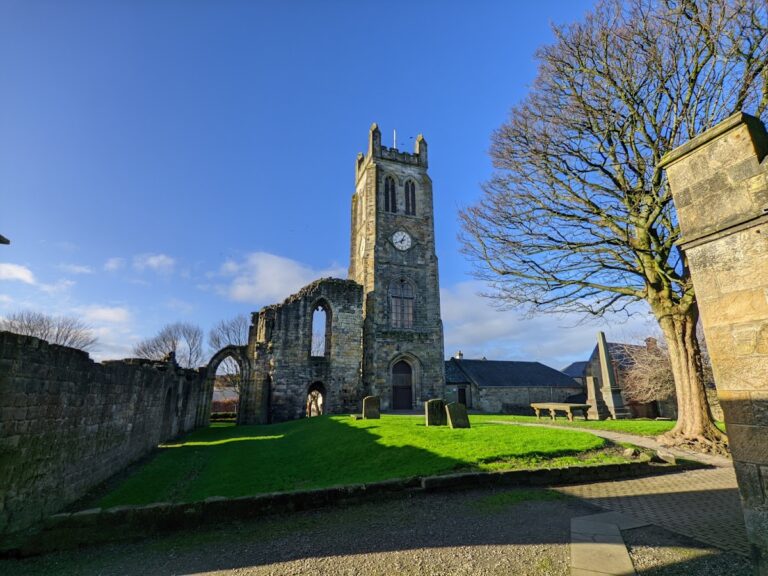
Portencross Castle: Medieval Seat of the Barony of Ardneil


Site at a Glance
- Rating
- 4.7
- Popularity
- Low
- Country
- United Kingdom
- Primary era
- Medieval
- External website
- Open
- Eras represented
- Medieval
- Civilizations
- Kingdom of Scotland
- Site type
- Military
- Remains
- Castle
On this page8 sections
History
Portencross Castle in the United Kingdom is a medieval castle at Portencross, on the Firth of Clyde. The site had been fortified since the eleventh century and became the principal seat of the Barony of Ardneil during the later Middle Ages. Its earliest recorded name was Arneil, also written as Arnele or Ardneil, and the estate was originally held by the de Ross family.
From Arneil to the Boyd family
In the early fourteenth century, the estate passed to the Boyd family of Kilmarnock after the family supported Robert the Bruce, the Scottish king whose victory over the English at Bannockburn in 1314 helped secure his position. The present castle replaced a smaller building on Auld Hill and was rebuilt on a nearby coastal rock promontory during the mid- to late fourteenth century, probably by Robert Boyd, a grandson of Sir Robert Boyd.
Robert II, the first Scottish king of the House of Stewart, probably signed 15 charters at Arnele between 1371 and 1390. Written evidence that specifically identifies the castle dates from 1572. The Boyd family retained the castle and estate until 1737, while the building continued to serve as the family residence until about 1660. The family then moved to another building at Portencross.
Decline and changing ownership
The castle remained in use until a severe storm in 1739 removed its roof. After that damage, it gradually became ruinous. Local fishermen continued to use the building and may have made minor alterations. William Adams purchased the castle in 1900 and arranged for its roof to be reconstructed in 1910.
Ownership later passed to the South of Scotland Electricity Board and then to British Nuclear Fuels Limited, which reinforced the surrounding walls during the 1980s. Friends of Portencross Castle, a nonprofit organization formed to secure the building’s future, acquired it from British Nuclear Fuels Limited on 22 December 2005. Restoration began in February 2009 and continued during the 2010s. The organization now maintains the castle as a museum.
Heritage and public recognition
Portencross Castle was designated a scheduled monument in 1955. Its former Category A listed-building status was removed in 2015. The castle also appeared in the 2004 series of the BBC television programme Restoration.
Remains
Coastal setting and plan
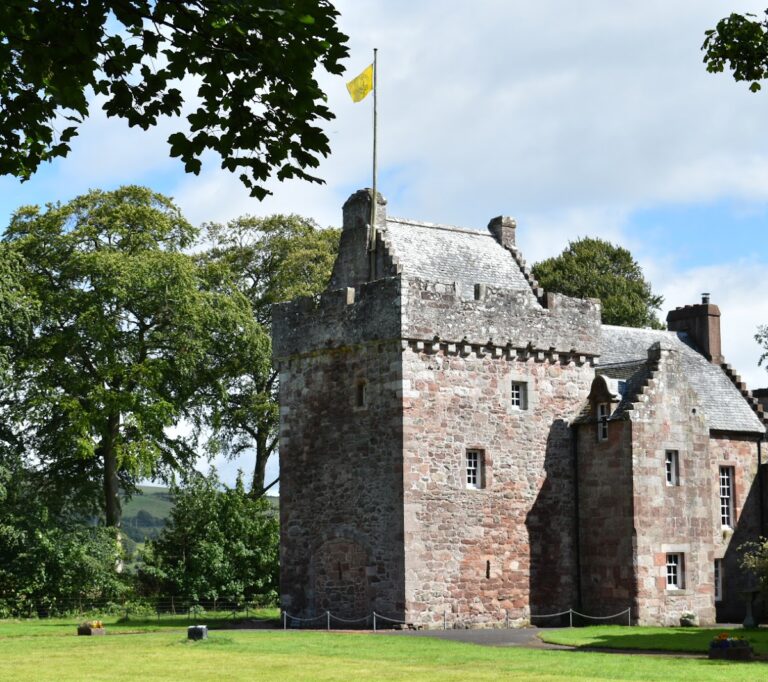
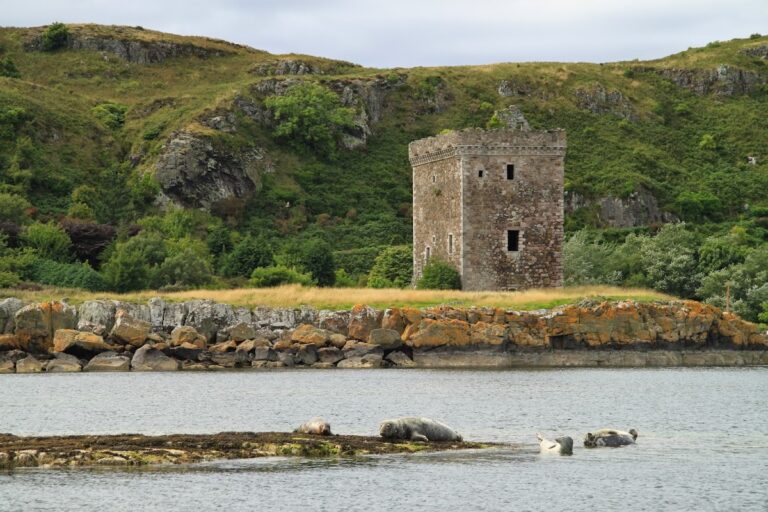
The castle stands on a rock promontory at the foot of Auld Hill, overlooking the southern shore of the Firth of Clyde and facing Little Cumbrae. The village of Portencross lies directly to the east. Its L-shaped plan consists of an elongated three-storey keep with a garret, an upper attic or loft space, and a wing attached to one end rather than along its side. The wing rises one storey higher than the keep.
Entrances and vaulted rooms
The castle has two entrance portals, one at ground level and another on the first floor. Its entire ground floor is vaulted, and vaulted halls survive on both the ground and first floors. The building also contains two kitchen areas, an unusual arrangement for a structure of this size.
Medieval enlargement
The earliest form was probably a stone-built hall house, possibly enclosed by a barmkin, a defensive wall surrounding a building or group of buildings. During the late fifteenth century, the castle was enlarged with additional upper storeys and an attic, while a ground-floor entrance was added during approximately the same phase. A large entrance hall was also constructed in the western wing.
Later Boyd alterations added further attic rooms and extended the spiral staircase so that it could reach them. The surviving structure reflects these successive changes, together with the loss of the roof in 1739, its reconstruction in 1910, and later reinforcement, restoration, and maintenance work.