Duntrune Castle: A Medieval Fortress and Clan Residence in Scotland


Site at a Glance
- Rating
- 4.6
- Popularity
- Very Low
- Country
- United Kingdom
- Primary era
- Early Modern
- External website
- Open
- Eras represented
- Medieval, Early Modern
- Civilizations
- Kingdom of Scotland
- Site type
- Domestic
- Remains
- Castle
On this page11 sections
History
Duntrune Castle is a medieval fortress in the United Kingdom, standing on the north side of Loch Crinan in western Scotland. Clan MacDougall built its first stone fortification in the thirteenth century as part of a regional network of castles intended to protect MacDougall landholdings from attacks by sea. The castle is regarded as the oldest continuously inhabited castle on mainland Scotland.
MacDougall and Campbell control
Duntrune belonged to the MacDougalls’ chain of strongholds, which also included Dunollie Castle near Oban. After prolonged conflict among regional clans, Clan Campbell captured the fortress following a siege. It then became the principal residence of the Duntroon branch of the Campbells, who held it until 1792.
In 1644, during the Scottish Civil War, rival MacDonald forces commanded by Alasdair MacColla besieged Duntrune. MacColla was a MacDonald military commander associated with the Royalist side in the conflict, but the Campbells retained control of their residence.
From stronghold to private estate
Negotiations during the second half of the eighteenth century led to the sale of Duntrune in 1792 to the Malcolms of Poltalloch, a family also associated with the MacCallums. After the sale, the castle was no longer exposed to military action and developed from a fortified stronghold into a more comfortable residential estate.
Duntrune remains a private residence owned by Robin Neill Malcolm, the official chief of Clan Malcolm. Members of his family live there throughout the year. The castle was renovated in 1954 and designated a Category B listed building in 1971. Its entrance gate received separate Category B protection, while the surrounding designed grounds were added to Scotland’s Inventory of Gardens and Designed Landscapes in 1987.
The piper tradition
Duntrune is associated with a legend concerning a handless MacDonald piper. In one version, he was sent as a spy, discovered and imprisoned, then played a warning tune that caused MacColla’s attacking force to withdraw. The Campbells are said to have cut off his hands afterward.
Another version places the piper among a small MacDonald garrison left at Duntrune when MacColla departed. After the Campbells retook the castle, they spared him because he was a musician and used him to lure MacColla’s returning force into a trap. When the piper played a warning rather than a welcoming tune, the force withdrew. The Campbells then cut off his hands, and he died from his injuries.
During restoration work in the early 1950s, workers found a human skeleton beneath stone flooring. The remains showed apparent clean severing at the wrists, leading to their interpretation as possible indirect evidence for the piper legend. The burial has also been considered episcopal. This interpretation carries a religious dimension because the Campbells involved in the conflict supported the Presbyterian Covenanter cause, while episcopal church organization is governed through bishops.
Remains
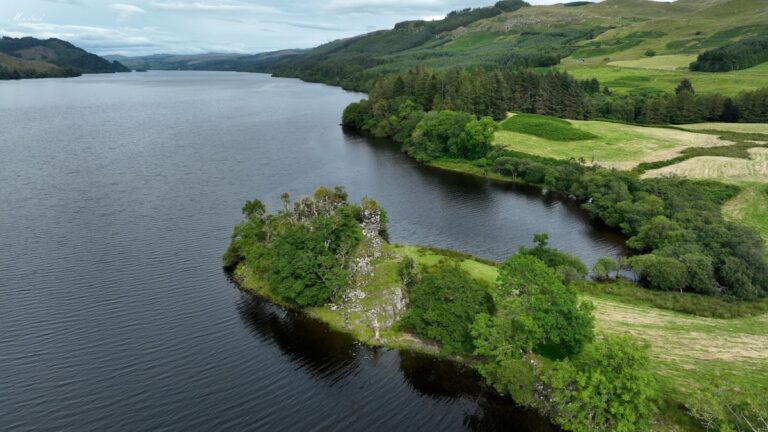
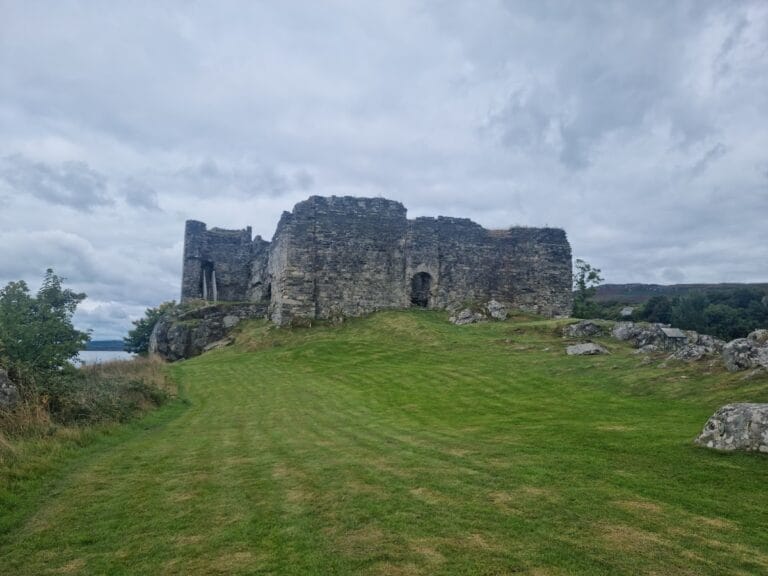
Duntrune Castle occupies a rocky rise beside the deep inlet of Loch Crinan, which opens toward the Atlantic Ocean, opposite the village of Crinan in Argyll and Bute. The complex is built of stone and brick. Its principal elements enclose a small courtyard, while the surviving foundations of an outer enclosure extend the evidence for the castle’s earlier defensive arrangement.
Residence and inner defenses
Tower house
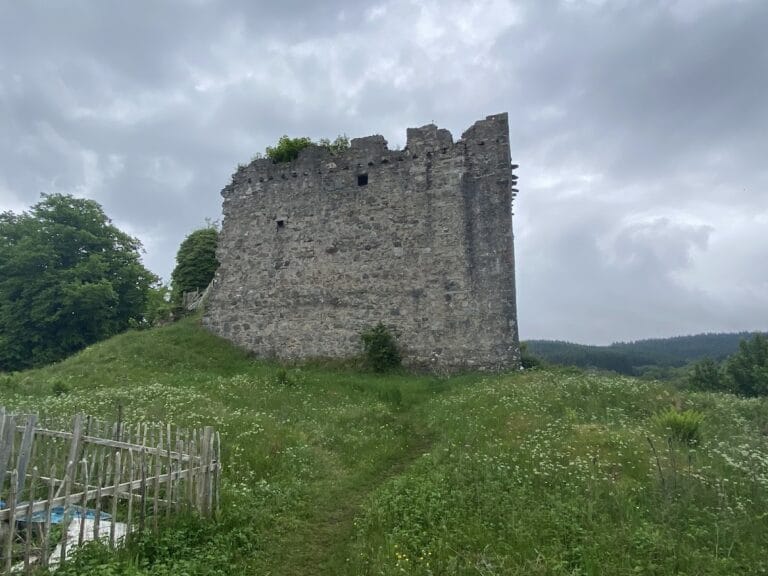
The principal building is a rectangular stone tower house, a fortified residential tower combining domestic accommodation with defensive features. The tower itself dates to the seventeenth century, although its present appearance results from an eighteenth-century reconstruction. It has a high, pitched gabled roof, and a smaller building adjoins it.
Courtyard curtain wall
A crenellated stone curtain wall, a defensive wall enclosing a fortified compound, surrounds the main residence. Its oldest surviving sections date from the thirteenth century. The wall and the two principal buildings enclose the small courtyard on all sides.
Outer enclosure and designed grounds
Outer court
The castle formerly possessed a second outer wall enclosing a spacious outer court, also called a bailey. Foundations and small sections of masonry from this enclosure survive, indicating the former extent of the outer defensive compound.
Estate park and entrance gates
A designed estate park lies north of the castle, farther from the sea winds and sheltered by hills. Its entrance gates include bronze deer figures and are recognized as a separate feature within the protected estate. The gateposts also provided the model for the entrance to the fictional Skyfall Lodge, James Bond’s childhood home in the film Skyfall. A photograph of Duntrune appeared on the original inner-sleeve artwork of Blue Öyster Cult’s album Imaginos.
Nearby sites