Junkernschloss: A Medieval Water Castle in Driedorf, Germany


Site at a Glance
- Rating
- 4.1
- Popularity
- Very Low
- Country
- Germany
- Primary era
- Medieval
- Eras represented
- Medieval
- Civilizations
- Holy Roman Empire
- Site type
- Military
- Remains
- Castle
On this page7 sections
History
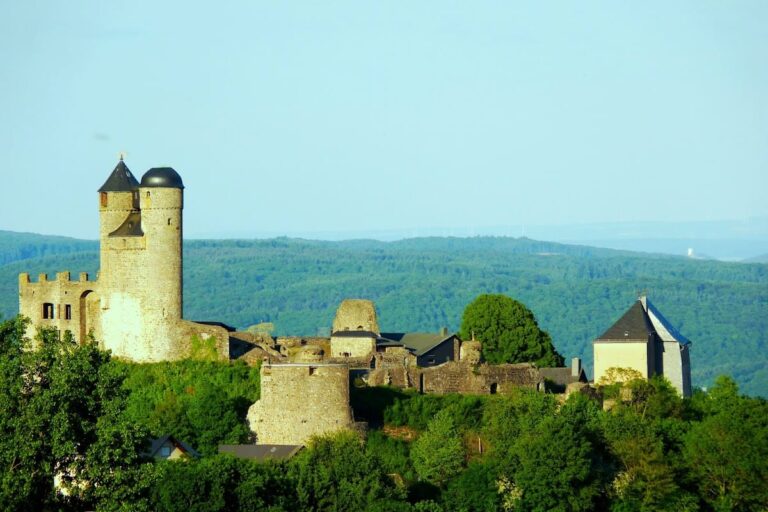
Junkernschloss is the ruin of a former water castle in Driedorf, Germany, built by Otto I of Nassau between 1280 and 1290. A water castle was a fortified residence protected by a surrounding moat or other water barrier. The castle replaced an earlier seat of the Lords of Greifenstein in the Rehbach–Mühlbach valley and initially held strategic importance.
From Greifenstein seat to Nassau residence
Before 1280, the Lords of Greifenstein maintained a seat in the valley. After the earlier complex changed hands during a conflict, Otto I of Nassau established a square water castle on its remains. From 1303, the castle served as the residence of Count Emich I of Nassau-Hadamar. In 1305, he obtained town rights for the settlement that had developed in front of the castle.
Otto II of Nassau-Dillenburg later acquired the castle by purchase. In 1347, he granted it as a fief, meaning property held from a superior lord in return for service, to the Junkers Johann and Wiegand of Mudersbach. The castle has been called Junkernschloss since this grant.
Changing territorial lords
In 1348, Junkernschloss passed to the Landgraviate of Hesse, a territorial lordship that controlled the castle during part of its later medieval history. Hesse granted it as a fief to the County of Katzenelnbogen in 1398. By 1408, the castle and town appear to have been in the complete possession of the Katzenelnbogen family.
In 1437, Daniel II of Mudersbach became a Hessian castleman, an official responsible for a castle’s defence and administration. He received the water castle, its moat, and the land toward the town as a fief. The Mudersbach family subsequently provided the castlemen while territorial control changed between different lords.
Return to Nassau and decline
After lengthy inheritance disputes, the castle and settlement returned to Wilhelm of Nassau-Dillenburg in 1557. Daniel III of Mudersbach died in 1600, ending the family’s male line. His only daughter and her husband, Hardmut of Cronberg, then used the castle as their residence after Johann VI, Count of Nassau-Dillenburg, granted it to them.
Johann VI’s death, no later than 1606, ended Nassau-Dillenburg’s feudal authority over the castle. In 1610, Junkernschloss was sold to the House of Nassau-Beilstein. The castle later lost its importance and fell into ruin. Its main tower was demolished in 1780, and the moat was filled in.
Restoration began in 1990, followed by the redesign of the surrounding grounds, completed in 2004. The surviving ruin and its landscaped grounds are also used for events.
Remains
Layout and setting
Junkernschloss was a simple, nearly square water-castle complex oriented from northeast to southwest. Its moat received water from the nearby Rehbach. An internal wall divided the southern part of the castle into sections of approximately one-quarter and three-quarters. The smaller southern section was probably the palas, the principal residential and representative building of a medieval castle.
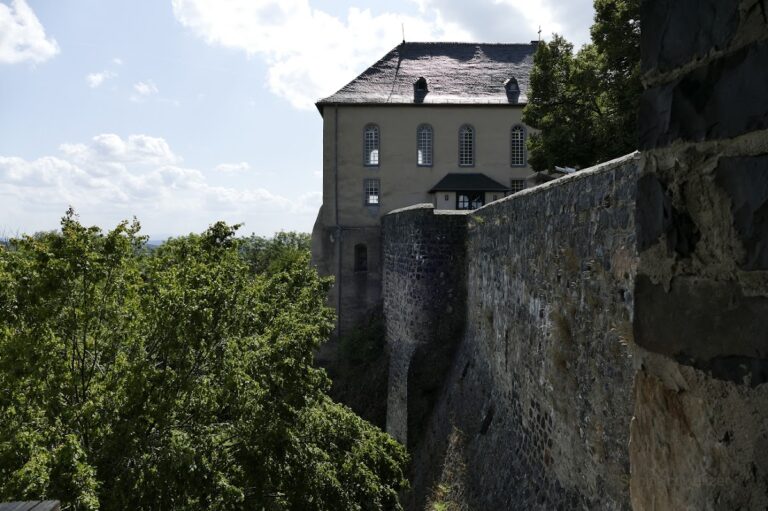
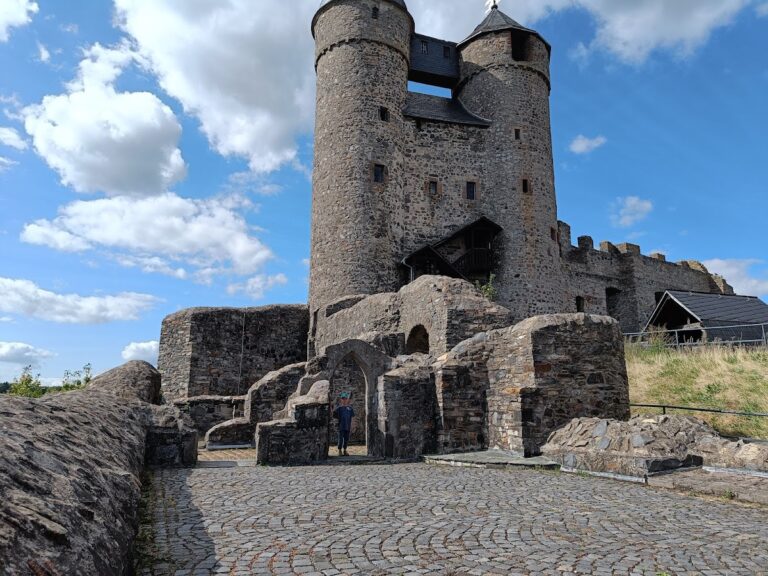
The ruin stands near the Rehbach within landscaped park grounds at approximately 490 metres above sea level. The surviving layout includes parts of the enclosing wall, the entrance gate, and the castle courtyard, allowing the principal elements of the former fortified residence to be identified.
Surviving structural features
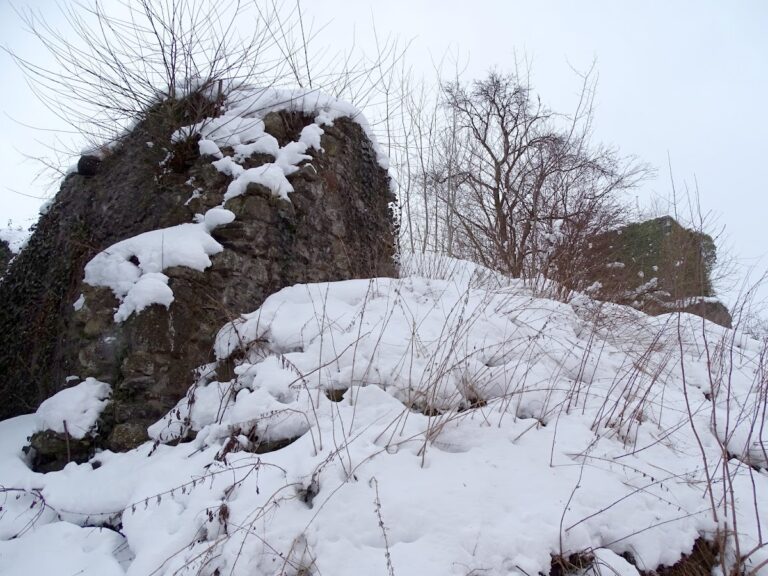
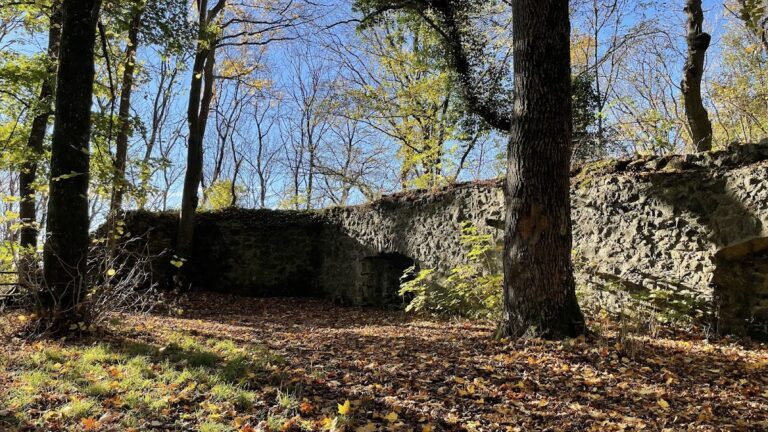
Parts of the enclosing wall remain, together with segmental-arch-like window openings. Other visible or restored elements include corbels that supported beams and fireplaces fitted with monolithic caps, each made from a single stone. These features form part of the surviving fabric of the castle and its restored presentation.
At the northeastern corner, the foundations of the keep known as the “Hohe Warte” survive. A keep was the main fortified tower used chiefly for defence and refuge. The tower itself was demolished in 1780, while its foundations remain within the castle grounds.
Nearby sites