Nonnenfels: A Medieval Rock Castle and Natural Monument in Germany


Site at a Glance
- Rating
- 4.4
- Popularity
- Very Low
- Country
- Germany
- Primary era
- Medieval
- External website
- Open
- Eras represented
- Medieval
- Civilizations
- Holy Roman Empire
- Site type
- Military
- Remains
- Castle
On this page7 sections
History
Nonnenfels is a natural monument in Germany on a southeastern spur of the Schlawiesener Berg, west of Bad Dürkheim, where the remains of a small medieval rock castle occupy a sandstone outcrop. The castle’s builder, inhabitants, original name, and exact date remain unknown. Proposed origins range from a wooden stronghold built between 1000 and 1200 to a thirteenth-century outer bailey associated with nearby Hardenburg, a medieval hilltop castle in the Palatinate region of southwestern Germany.
Origins and Uncertain Fate
The site’s history is difficult to establish because later quarrying removed parts of the sandstone rock and rockfalls altered the remains. These changes prevent more precise dating of the castle. The circumstances of its destruction and abandonment are also unknown, although destruction during the seventeenth century has been suggested. Nonnenfels and its castle ruins now form part of a regional legend, while the wider rock formation is protected as an extensive natural monument.
The Legend of Adelinde
According to local tradition, Adelinde, the daughter of the Count of Leiningen, built the small castle. She had lived at Hardenburg and fallen in love with a squire named Otto, or Ruprecht. Her father rejected the relationship and sent the squire on a crusade, a medieval Christian military expedition often directed toward the Holy Land and the eastern Mediterranean.
A fellow soldier later reported that the squire had been killed fighting the Saracens, a medieval European term for Muslim peoples encountered in the eastern Mediterranean and the Middle East. Adelinde entered a convent, where prayer and caring for the sick brought her consolation. She eventually left the convent and built a home opposite Hardenburg with a friend. Living there as a nun, she practiced healing and herbal knowledge without being recognized.
When Adelinde’s father suffered a serious hunting injury, people sought the nun’s help. She saved him, and after his recovery he visited the small castle and recognized his daughter. He asked her to return to Hardenburg, but she refused. The legend says that she continued visiting the neighboring castle as a hermit, a person living in religious seclusion while undertaking devotional or charitable work, and helping the sick and poor.
Remains
Rock Castle and Setting
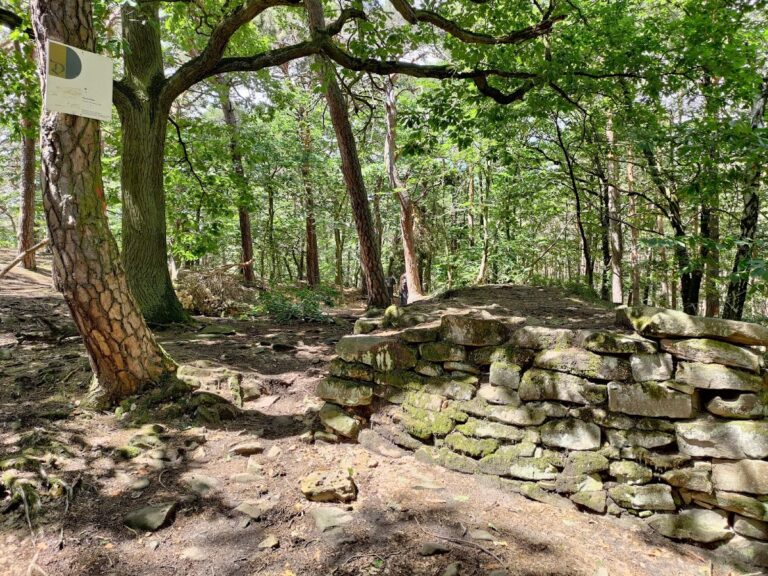
Nonnenfels stands about 195 metres above sea level on a rocky southeastern spur between the Isenach Valley to the south and the Klaustal to the northwest. Hardenburg lies to the east and is directly visible from the site. The former castle was small, measuring approximately 20 metres in length, and was built into sandstone rock formations. Its surviving fabric consists of rock-cut features, slight masonry, and scattered remains integrated into the natural outcrop.
Rock-Cut Features
Door frames, beam holes, and steps remain cut into the rock. A feature interpreted as a stone altar is also present, although that identification is uncertain. Together, these features preserve evidence of the castle’s occupation and the ways its buildings were fitted to the sandstone formation.
Defensive Approach
A natural neck ditch, a defensive ditch cut across the narrow connection between a fortified spur and higher ground, crosses the western side of the site. It was enlarged artificially. The original entrance to the castle was also on the west, while the present approach comes from the east in the direction of the Klaustal.
Nearby sites