Karrasburg: A Medieval Water Castle and Museum in Coswig, Germany
Site at a Glance
- Rating
- 4.5
- Popularity
- Very Low
- Country
- Germany
- Primary era
- Modern
- External website
- Open
- Eras represented
- Medieval, Modern
- Civilizations
- Electorate of Saxony, German, Holy Roman Empire
- Site type
- Domestic
- Remains
- Elite Residence
On this page10 sections
History
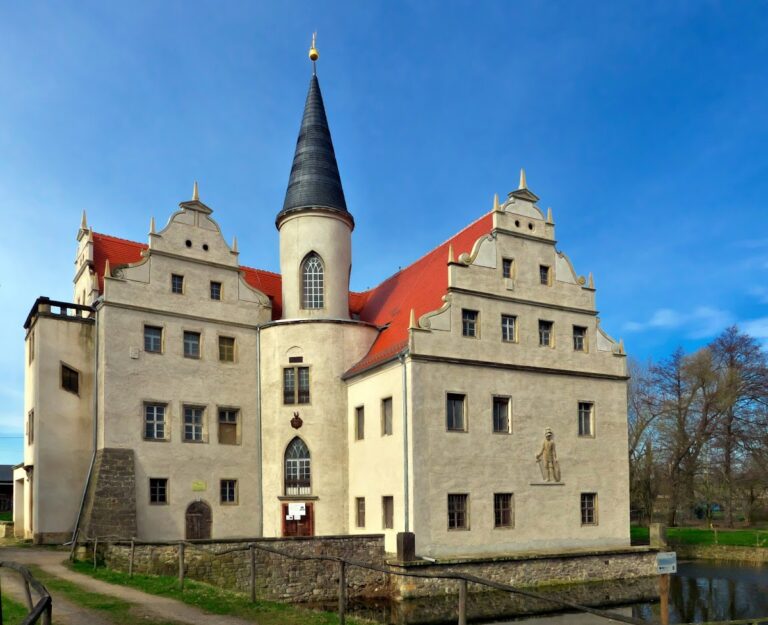
Karrasburg is a medieval water castle in Coswig, Germany, built by the Karras knights and later transformed into a manor house, forestry property, and museum. The site lies in Saxony’s Meißen district, northwest of Dresden, and its history is closely connected with the Karrasse family, who gave the castle its name.
The Karras family and the medieval castle
Around 1420, the Karrasse family, one of the wealthiest noble families in the Electorate of Saxony, became the feudal lords of Coswig. The Electorate was a major territorial state of the Holy Roman Empire, whose elector was entitled to participate in choosing the emperor. During the fifteenth century, the family lived at a castle enclosed by a rampart wall and a water-filled moat.
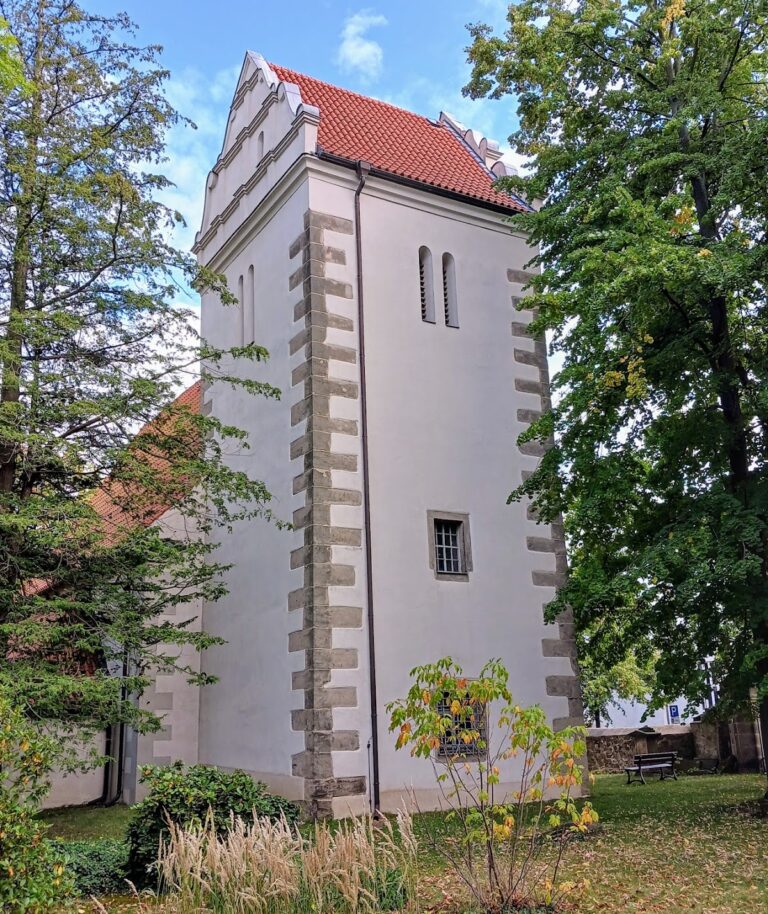
The family also shaped the religious landscape of Coswig. In 1496, Nickel von Karras commissioned the present Alte Kirche for 750 Rhenish guilders. Its entrance portal carries the coats of arms of the Karras and Pöllnitz families.
Electoral ownership and later private owners
Hans and Georg Karras sold the property to Elector August I in 1556 for 15,169 guilders, 11 groschen, and 10 pfennigs. The manor house was converted into a forestry house for the electoral foresters, while P. Körner acquired the electoral hunting lodge in 1557. In 1577, the outbuilding and its water-filled moat were sold for 1,000 guilders. Electoral hunters from the Karras family continued to operate from the property until the foresters moved to Kreyern in 1679.
Ownership changed several times thereafter. Martin Schwedler acquired Karrasburg in 1688, followed by Hanns Christoph Körner in 1706. A fire affected the estate in 1726. Christian Schubert, district judge of the Moritzburg administrative office, later acquired the renovated building and grounds in 1796.
In 1828, Schubert sold the property and part of its land to Dr. Heidenreich of Radeburg for 4,200 thalers. The inheritance passed to Heidenreich’s wife, Friederike Luise Heidenreich, in 1836, and she sold the estate to Dr. Johann Michael Weise in 1844. Weise sold it the following year to Karl Gottfried August Thienemann for 5,150 thalers. After Karl’s death in 1873, his son Carl August Wilhelm Thienemann inherited the property.
The villa and twentieth-century uses
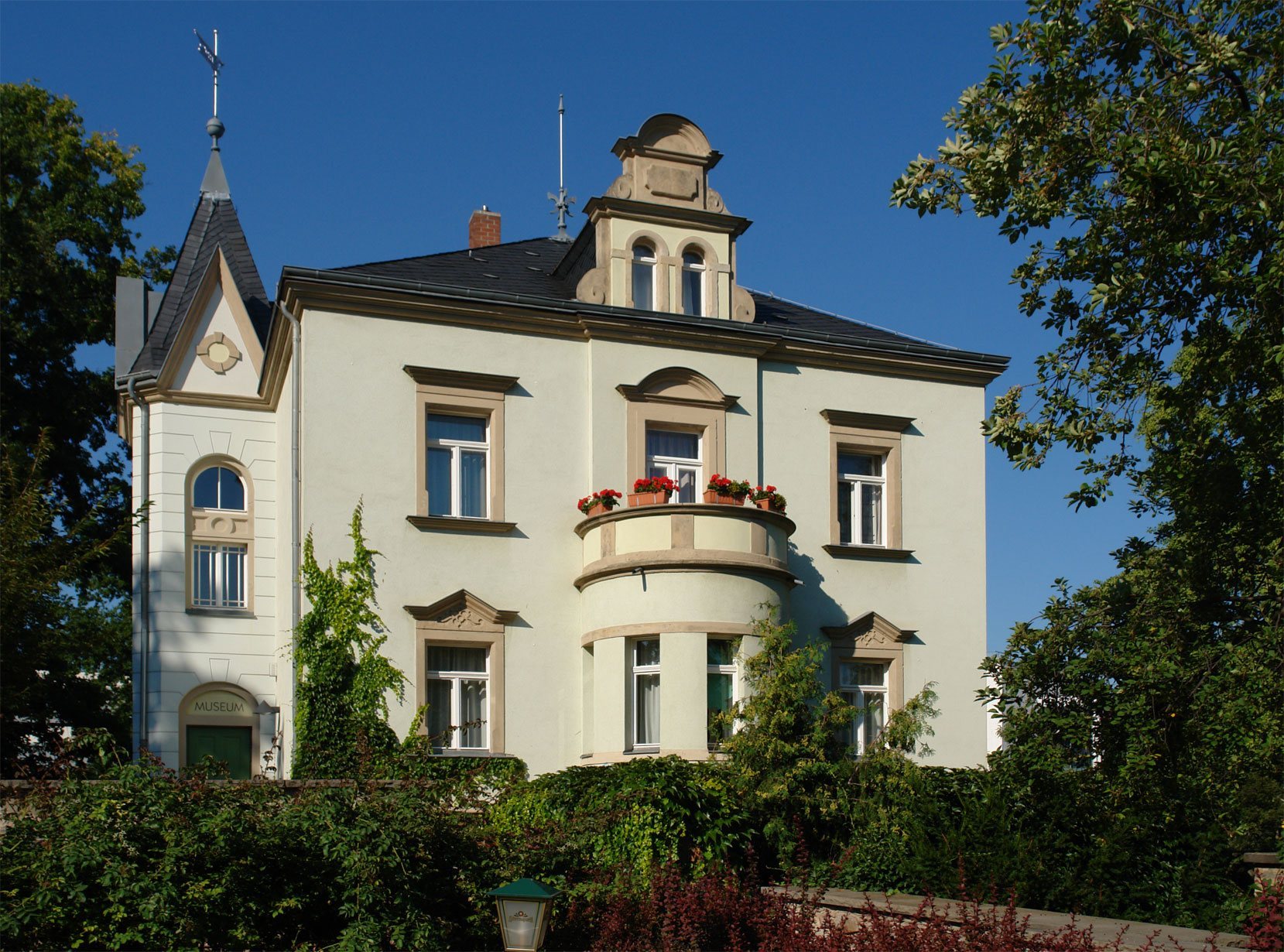
The residential building was remodeled and enlarged for intended rental use. The older house was demolished when the present villa was built in 1897, and the farm buildings on either side were converted for residential purposes. In 1910, the Thienemann properties, including Karrasburg, were assigned to Kirchstraße. Thienemann sold part of the property in 1919, and the estate with its park passed to the Kötitzer Ledertuch- und Wachstuchwerke in 1922. In 1947, the Wittke family registered a bag-production business there.
The villa later served several public and institutional purposes. Coswig’s town council took it over in 1952 and established a youth center. At the end of the 1950s, it was assigned to VEG Nieschütz, a state-owned agricultural enterprise in East Germany. In 1961, it became a dormitory for trainee gardeners and received an extension.
The museum at Karrasburg
The Association for Folk and Local Studies of Coswig and the Surrounding Area was founded in 1904. It documented the region and collected ethnographic objects as well as prehistoric and early historic finds. In 1937, the association transferred its collection to the local authorities. The holdings were first displayed in the meeting room of the former Kötitz town hall, then stored temporarily in the Coswig schoolhouse after that room was cleared in 1951.
A former Karrasse stable or farm building immediately beside Karrasburg housed the local museum from 1957. It was closed in 1983 because the building had become unsafe, and the collection moved in 1992 to basement rooms in a former polyclinic. The municipal council decided in 1993 to restore Karrasburg according to monument-preservation requirements and to use it for the school authority and the museum.
Restoration took place from 1993 to 1996 with support from the federal-state Urban Renewal program. The completed work transferred Karrasburg to the Coswig Museum, which was inaugurated there in October 1996. After Coswig’s new town hall was built, the museum also received the upper floor of Karrasburg. Following further remodeling, its expanded permanent exhibition reopened across two floors in December 2000.
Remains
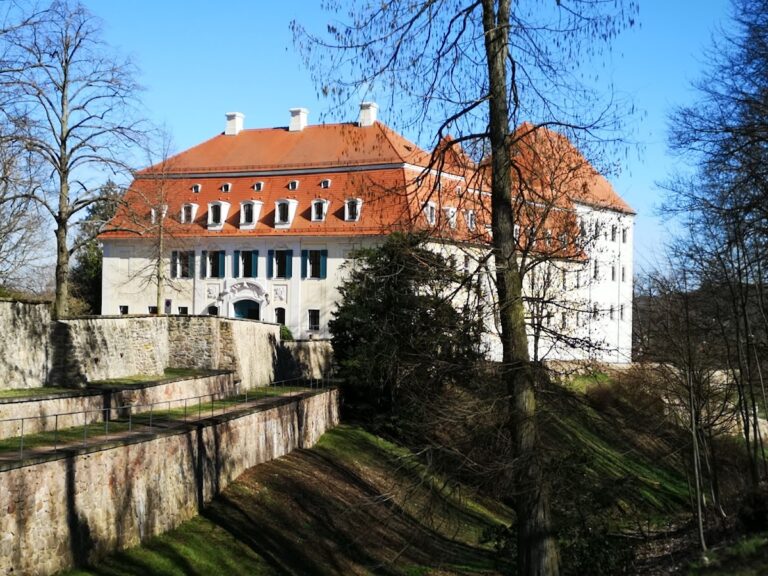
Karrasburg survives as a lowland water-castle complex later adapted into a manor and then a museum. The historic site was protected by a rampart wall and water-filled moat. The old retaining walls of the former castle remain clearly visible, while sparse remnants of the defensive walls also survive.
Water-castle remains
The surviving retaining walls provide the clearest physical evidence of the medieval water castle. They belong to the earlier fortified complex, whose position on relatively level ground was strengthened by surrounding waterworks. Parts of the former defensive walls remain in fragmentary form, preserving traces of the castle’s earlier enclosure.
The 1897 villa
The present villa dates from 1897 and replaced the older residential building, which was demolished. The two farm buildings flanking the villa were converted for residential use. An extension was added in 1961, when the building served as a dormitory for trainee gardeners. Between 1993 and 1996, the villa was restored in accordance with monument-preservation requirements and adapted for museum use. Its exhibition spaces now occupy two floors.
The former Karrasse farm building
The former stable or farm building of the Karrasse family stands immediately beside Karrasburg. It housed the local museum from 1957 until safety concerns led to its closure in 1983. The building is now used as a restaurant.
Associated church and underground tradition
The entrance portal of the associated Alte Kirche preserves the coats of arms of the Karras and Pöllnitz families. Local tradition tells of underground passages connecting Karrasburg with the church and even with Scharfenberg. Earlier alterations revealed vaulted spaces, but these may have been building cellars rather than passages, so the alleged underground links remain unconfirmed.