St. Jacob’s Church, Herxheim am Berg: A Historic Protestant Parish Church in Germany


Site at a Glance
- Rating
- 3.9
- Popularity
- Very Low
- Country
- Germany
- Primary era
- Medieval
- External website
- Open
- Eras represented
- Medieval, Early Modern, Modern
- Civilizations
- Holy Roman Empire
- Site type
- Religious
- Remains
- Church
On this page12 sections
History
St. Jacob’s Church is a Protestant parish church in Herxheim am Berg, Germany, probably founded in the eighth century by Wissembourg Abbey in Alsace, although its foundation is traditionally dated to 1014. The building combines Romanesque, Gothic, and Baroque elements and is regarded as a local landmark and one of the oldest ecclesiastical buildings in the modern Palatinate. It was first documented in 1214.
Roman and medieval origins
Evidence of earlier activity around the church includes a Roman urn containing glass fragments, found in a wall niche in 1874, and another Roman stone discovered in the church. Roman roof tiles collected in nearby gardens during the 1980s date to the fourth century or earlier. Together, these discoveries support the identification of an earlier Roman watchtower on the strategically advantageous hillside. The urn was transferred to the Bad Dürkheim town museum and later held by the Antiquities Association.
Around 1014, an early Romanesque bell tower was built in stone. Its date is associated with the Roman-numeral date MXIV and with masons’ marks from the eleventh century. The lower part of the quire tower and its vaulted chancel, together with the semicircular apse, belong to the early history of the church. The site may therefore preserve elements of both an earlier Roman presence and a medieval Christian foundation.
In 1241, Höningen Abbey acquired the church’s patronage rights from Murbach Abbey in Alsace through an exchange. Patronage gave the monastery religious and administrative rights connected with the church, while Höningen thereafter received the tithe, a payment traditionally made to support the church. A formal papal document issued by Pope Innocent IV between 1243 and 1245 confirmed the transfer of the tithe.
A parish is documented from 1379. In 1496, when the church belonged to the Diocese of Worms, it was recorded as the parish church of St. Jacob and contained an altar dedicated to St. Mary. Leistadt had originally been the mother church, but the parish seat moved from Leistadt to Herxheim in 1551.
Destruction, Lutheran reform, and rebuilding
In May 1461, troops of Elector Frederick I almost completely destroyed the fortified settlement then called Hangend during a feud. The church and one dwelling were the only buildings to survive. The Reformation, the sixteenth-century movement that established Protestant churches including Lutheran churches, brought Lutheran teaching to the County of Leiningen in 1566. Leistadt then became a subsidiary church, and both churches received Johannes Diether as their first Lutheran pastor. He was dismissed for misconduct in 1571.
Around 1570, the church received a stone baptismal font and two chancel windows intended to improve the interior lighting. A one-handed church clock was installed in the bell tower in 1609. A fire in 1674 was followed by a renovation in Baroque form, and the present nave was built in 1729. Its wooden gallery provided seating for approximately 225 people.
During the French occupation beginning in 1794, villagers buried two bells to prevent their seizure. They were not recovered after the occupiers withdrew in 1816. Two further bells were surrendered for armaments production in 1917, showing how the church’s bells were repeatedly affected by military circumstances.
Fire and twentieth-century reconstruction
During the night of 4 to 5 August 1934, arson almost completely destroyed the church. A village schoolteacher set the fire during a local festival because of a personal relationship dispute. The church, tower, bells, carved pews, organ, and gallery burned, while the outer walls remained standing. Several furnishings and memorial objects survived, including the chancel paintings, pulpit, baptismal font, altar, altar cloth, open Bible, confirmation kneeling bench, and memorial plaques for those killed in the wars of 1870 to 1871 and 1914 to 1918.
Three replacement bells were installed on 18 December 1934, and extensive rebuilding was completed in 1935. The church was rededicated on 27 October that year. Richard Troll restored the damaged wall paintings. The rebuilding added a northern entrance with a concrete staircase and buttresses on both sides of the bell tower. A clock with four faces replaced the earlier clock. Gothic windows were also inserted into the tower in place of its original Romanesque windows, an error introduced during the restoration.
In 1942, two of the three 1934 bells were removed and melted down. The smallest bell remained, and the peal was complete again with three bells by 1951. The surviving 1934 alarm bell later became the focus of a public controversy because it bears a swastika and an inscription identifying Adolf Hitler and National Socialism, the dictatorship and political movement led by Hitler in Germany from 1933 to 1945.
Controversy, protection, and interpretation
After the bell’s continued use became widely known in 2017, disputes arose over whether it should be removed, preserved, or rung. In September 2017, the local council and the church governing body decided that it would no longer be rung. On 12 March 2018, the council resolved to retain it in the tower as a memorial against violence and injustice and to permit its future use. The church governing body accepted its retention on 7 June 2018 but decided that it should not be rung. A heritage assessment classified the bell as a monument and recommended either placing it in a museum or retaining it in the tower. A proposal by the Protestant church to fund a replacement bell was not accepted.
Legal challenges to the council’s decision were rejected by the Administrative Court of Neustadt an der Weinstraße on 22 October 2018 and by the Higher Administrative Court of Rhineland-Palatinate on 25 January 2019. The courts found the decision legally permissible because it acknowledged Nazi injustice and distanced the church from it. Two inconspicuous swastikas carved into the tower’s corner stones were examined by prosecutors in 2018, but no criminal proceedings followed because they could not be seen with the naked eye. The carvings were removed in September 2021.
The church, its former cemetery, and the cemetery’s war memorials and historic gravestones are protected under Rhineland-Palatinate heritage law. A research project carried out for the Protestant regional church between 2023 and 2025 examined historically burdened monuments, artworks, and other objects in and around Protestant churches in the Palatinate.
Remains
The surviving complex brings together an early stone tower and chancel, a semicircular Romanesque apse, a Baroque nave, later tower alterations, and the former cemetery with its memorials and protected trees. The 1934 fire left the outer walls standing, so the present building combines surviving historic fabric with reconstruction and later restoration.
Early church fabric
Quire tower and chancel
The lower section of the quire tower rises at the eastern end of the church. A quire or chancel tower is incorporated into, or rises above, the eastern end of a church. The chancel has a groin-vaulted ceiling, formed where two barrel vaults intersect, and is joined to a semicircular Romanesque apse traditionally attributed to 1014. The tower was built in stone around that date, while its present windows are Gothic replacements inserted during the rebuilding after the 1934 fire. Buttresses were added to the north and south sides of the tower.
Baroque nave and gallery
The nave dates from 1729 and represents the church’s Baroque rebuilding after the fire of 1674. Its wooden rear gallery was designed to seat approximately 225 people. The gallery and organ were destroyed in 1934, and the present rear gallery contains an organ built by the Walcker company in 1993. The organ has 10, alternatively reported as 14, stops on two manuals and a pedal.
Medieval wall paintings
The chancel contains wall paintings of the Four Evangelists, shown both as winged human figures and with the heads of their symbolic creatures. The apse vault carries a representation of the Last Judgement, while the south wall depicts the Apostle Paul. The paintings are generally dated to the second half of the fourteenth century. When they were uncovered during the 1925 restoration, Richard Troll dated the dry-plaster paintings, known as secco paintings, to the twelfth century.
An 1885 renovation had covered the murals with oil paint. They were uncovered again in 1925, restored after the 1934 fire by Troll, and extensively restored in 2013 and 2014. Their survival provides a visible medieval element within a church whose nave and much of its interior were reshaped in later periods.
Bells and clock
The three-bell peal consists of two bells owned by the Protestant parish and one owned by the municipality. The municipal bell was historically called the alarm bell and was intended for aircraft or fire emergencies rather than ordinary church services. It bears a swastika and the inscription “ALL FOR THE FATHERLAND. ADOLF HITLER.” The bell remained in the tower after the other two bells were melted down in 1942 and is protected as a monument. It is no longer to be rung.
The original one-handed clock was installed in 1609. After the 1934 reconstruction, it was replaced by a clock with four faces. The clock and bell tower therefore preserve evidence of the church’s changing civic and religious functions, as well as of the rebuilding that followed the fire.
Former cemetery and churchyard
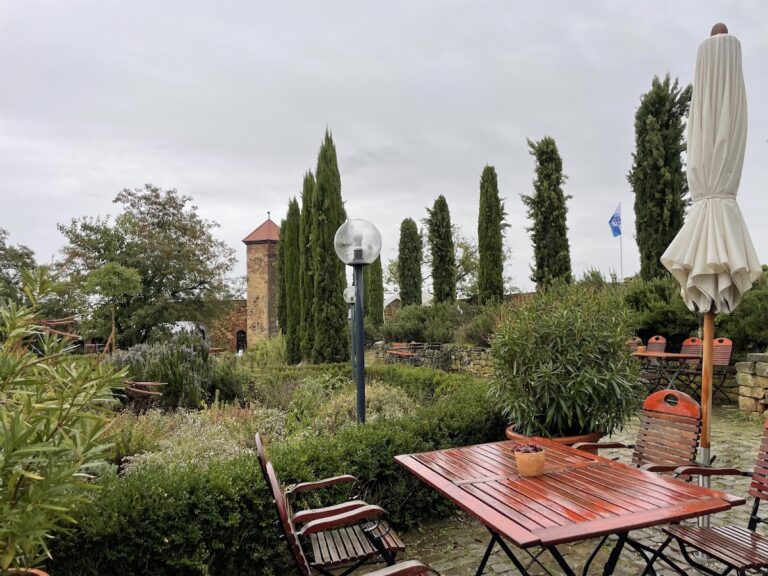
The former cemetery and adjoining churchyard, known as the Schlossgarten, contain memorials to those killed in the Franco-Prussian War of 1870 to 1871 and the First World War. Two historic gravestones also survive there. Thirty-five old trees in the former cemetery and adjoining Schlossgarten are protected as natural monuments, forming part of the historic setting around the church.
Nearby sites