Alcázar de Arriba y Puerta de Marchena: Royal Palace and Fortress in Carmona


Site at a Glance
- Rating
- 4.3
- Popularity
- Low
- Country
- Spain
- Primary era
- Medieval
- External website
- Open
- Eras represented
- Medieval, Modern
- Civilizations
- Crown of Castile, Spanish
- Site type
- Domestic
- Remains
- Palace
On this page7 sections
History
Muslim origins and Christian rebuilding
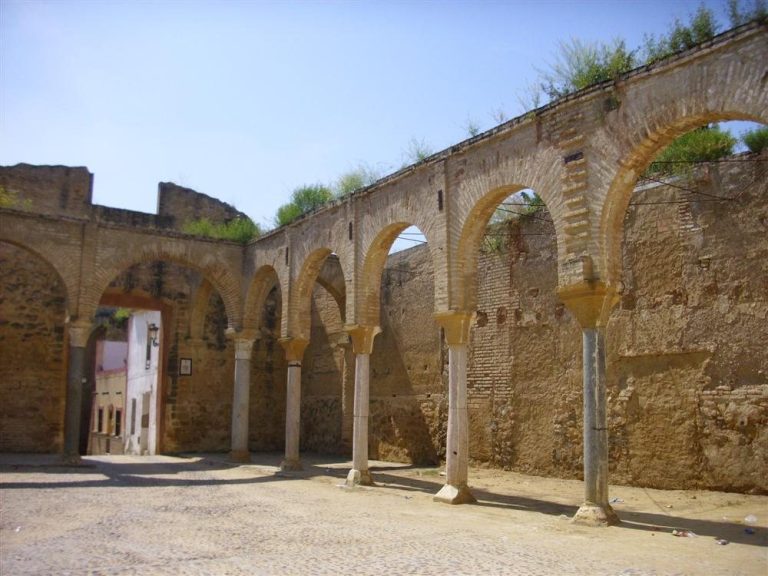
The Alcázar de Arriba y Puerta de Marchena is the Royal Alcázar of Carmona in Spain, a fortress and royal palace at the highest point of the town. The complex probably originated under Muslim rule, and the fortress may have been used by the Birzalids to threaten the Taifa of Seville, one of the independent Muslim kingdoms that emerged in Iberia during a period of political fragmentation.
After the Christian Reconquest, the fortress was taken by Christian forces and rebuilt. Its position on the western side of Carmona’s walled enclosure gave it an important place within the town’s defenses and helped establish its later role as a royal residence.
Pedro I and the royal palace
In the fourteenth century, Pedro I of Castile restored the complex and converted it into one of his preferred palaces. Pedro I was a Castilian king who supported major palace works in the Mudéjar tradition. The palace closely resembled the Royal Alcázar of Seville, reflecting his enthusiasm for Mudéjar architecture, a medieval Iberian tradition that used Islamic forms, craftsmanship, and decorative techniques in Christian buildings.
The Catholic Monarchs, Isabella I of Castile and Ferdinand II of Aragon, later intervened at the complex. They erected the cubete, a small fortified defensive structure, and embellished the royal apartments.
Damage, changing uses, and modern protection
The Alcázar suffered severe damage in the Carmona earthquake of 1504 and again in the Lisbon earthquake of 1755. During the plague epidemic that devastated Seville in 1649, the complex was used as a hospital and as a cemetery for the victims. A bullring was built inside the complex in 1871, adding a later civic and architectural use to the former fortress and palace.
The Parador Nacional de Turismo Alcázar del Rey Don Pedro was established in the military courtyard in 1976. A Parador is a Spanish state-affiliated hotel located in a building or setting of historic, architectural, or scenic interest. The complex was declared a monument of historical-artistic interest on 3 June 1931 and became a Bien de Interés Cultural on 22 June 1993. It is also listed under heritage code RI-51-0008118, with a declaration dated 29 June 1985.
Remains
Fortress and palace layout
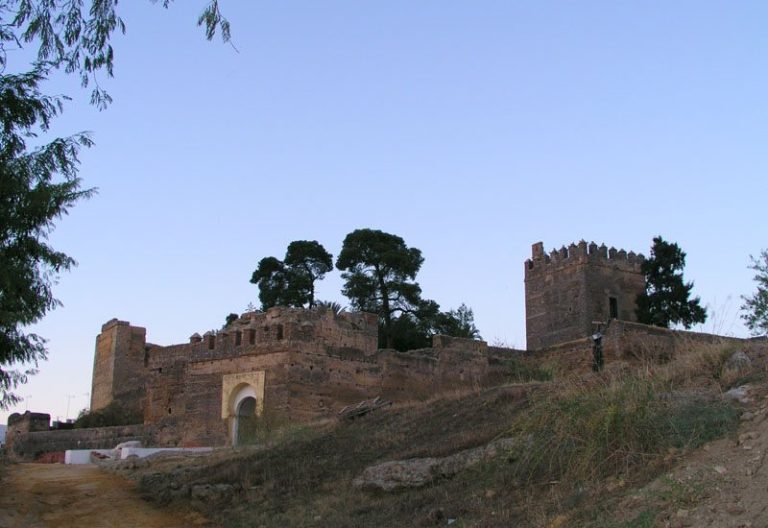
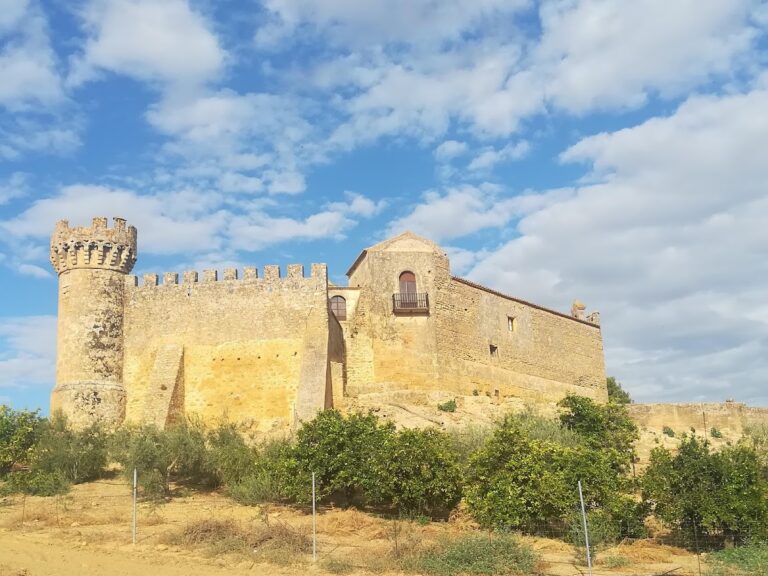
The complex occupies the highest point of Carmona, west of the town’s walled enclosure. Its surviving arrangement combines the defensive character of a fortress with the formal character of a royal palace. Access is through a large pointed horseshoe arch, while the military courtyard is defended by three towers. A terrace extends from the complex and provides a broad view over the Vega of Carmona.
The palace’s architectural character is closely related to that of the Royal Alcázar of Seville and is associated with the Mudéjar style. The cubete erected during the period of the Catholic Monarchs forms part of the fortification, while the royal apartments retain the memory of their embellishment during the same intervention.
Later architectural additions
A bullring constructed within the complex in 1871 forms part of its later physical development. Its presence records the transformation of the site beyond its earlier military and residential functions and contributes to the layered character of the surviving Alcázar.