Burg Hartenfels: A Medieval Hilltop Castle Ruin in Germany


Site at a Glance
- Rating
- 4.4
- Popularity
- Low
- Country
- Germany
- Primary era
- Medieval
- Eras represented
- Medieval
- Civilizations
- Holy Roman Empire
- Site type
- Military
- Remains
- Castle
On this page7 sections
History
Burg Hartenfels is a medieval hilltop castle ruin in Germany, built to defend the Hohe Straße, a long-distance commercial route connecting the Frankfurt and Cologne regions. The castle occupied an elevated position above Hartenfels and controlled an important line of movement later followed by the modern B8.
Medieval origins and destruction
Burg Hartenfels first appears in history in 1249, when its owner, Countess Mechthild of Sayn, sold it to the Archbishop of Trier. The archbishop was both the senior Catholic authority in the Archdiocese of Trier and a major territorial prince within the Holy Roman Empire. The castle’s position gave it a defensive role over the Hohe Straße.
The castle was destroyed during the fifteenth century and later rebuilt. In 1594, Count Wilhelm of Nassau destroyed it again. Burg Hartenfels was not rebuilt after this second destruction, and it subsequently survived as a ruin.
Legends and local names
A local legend tells of a secret tunnel linking Burg Hartenfels with Arx Hergispach, about 4 kilometres away. Arx Hergispach is now identified with Marienheim Monastery in Herschbach, although the supposed destination is said to have been demolished.
The ruin is locally known as Harbelser Schmanddippe, with related forms including Schmanddeppen and Schmanddippe. One explanation connects the name with a French soldier who asked a woman for the tower’s name. His question was allegedly misunderstood because the local dialect word also referred to a butter churn. Another explanation holds that the castle’s shape inspired the name.
Remains
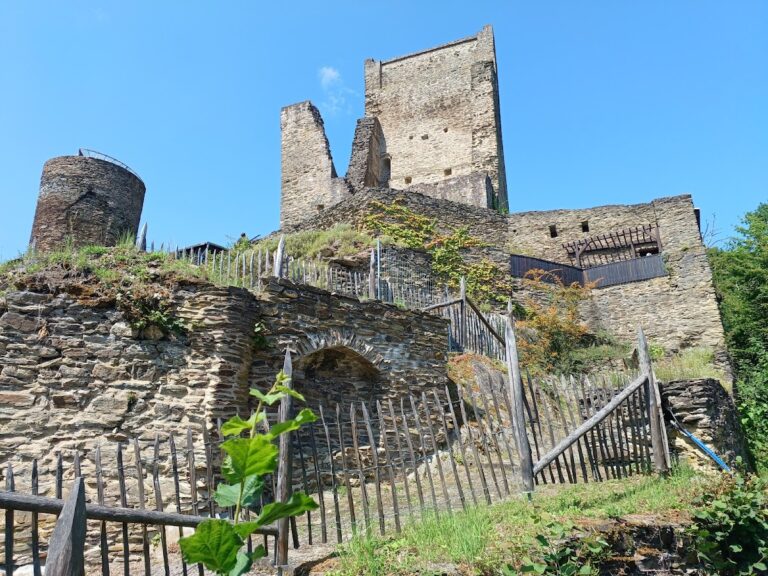
Burg Hartenfels stands on a basalt-cone hill at an elevation of 368 metres above sea level. Built of rubble stone, the ruined castle covers an area of approximately 60 by 40 metres. Its surviving layout is defined mainly by sections of the surrounding defensive wall and by the tall defensive tower that remains above the castle hill.
Castle defenses
Surrounding defensive wall
The principal surviving remains are portions of the continuous wall that enclosed the castle complex. These fragments outline the ruined enclosure and preserve part of the defensive construction that once surrounded the hilltop stronghold.
Defensive tower
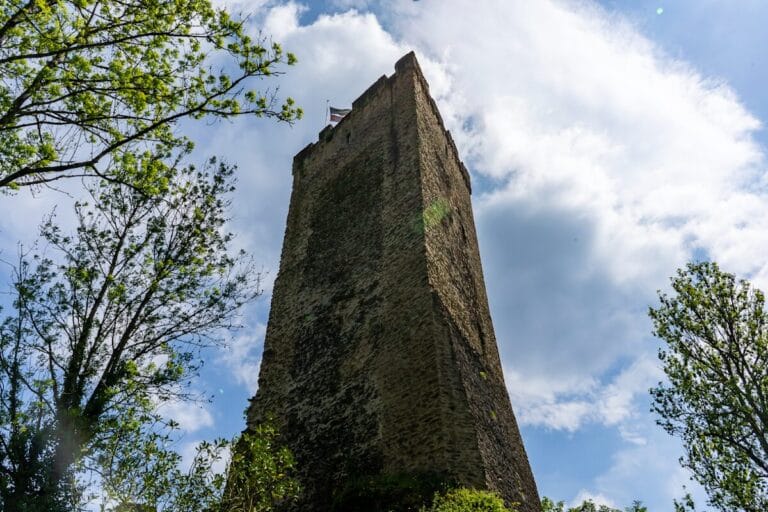
The castle’s defensive tower still rises just over 23 metres above the hill. It probably stood more than 28 metres high originally and forms the most substantial vertical element of the ruin. The tower cannot be climbed. Together with the surviving wall sections, it contributes to Burg Hartenfels’s reputation as one of the most prominent castle complexes in the Westerwald.