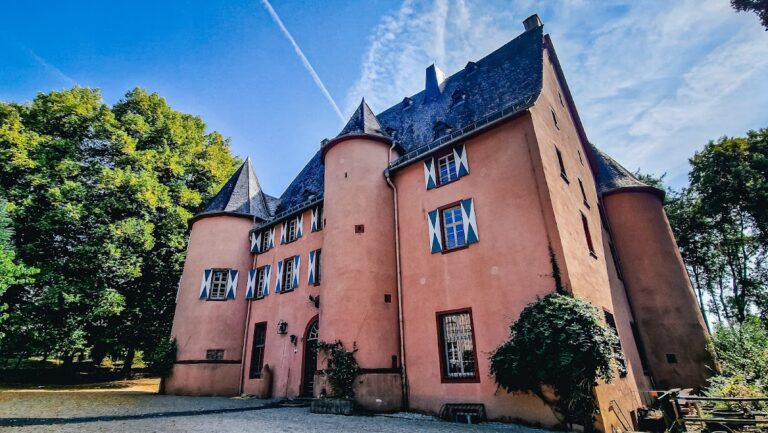
Hofgut Langwiesen: A Former Water Castle and Agricultural Estate in Germany


Site at a Glance
- Rating
- 4.7
- Popularity
- Very Low
- Country
- Germany
- Primary era
- Early Modern
- Eras represented
- Early Modern, Modern
- Civilizations
- Holy Roman Empire
- Site type
- Domestic
- Remains
- Castle
On this page8 sections
History
Hofgut Langwiesen is a former low-noble residence and agricultural estate in Germany, between Boden and Ruppach-Goldhausen northeast of Montabaur, within the municipality of Meudt. Its origins are associated with the settlement of Langewiese, first recorded in 1444, when the site formed part of the rural history of the Westerwald.
From settlement to estate
As Langewiese declined, its agricultural estate remained. By 1525, Hof Langwiesen included two mills, a chapel, and a priest. One of the mills was later demolished after becoming structurally unsound, while the surviving estate continued to develop as a landed residence and farming complex.
The water castle and palace
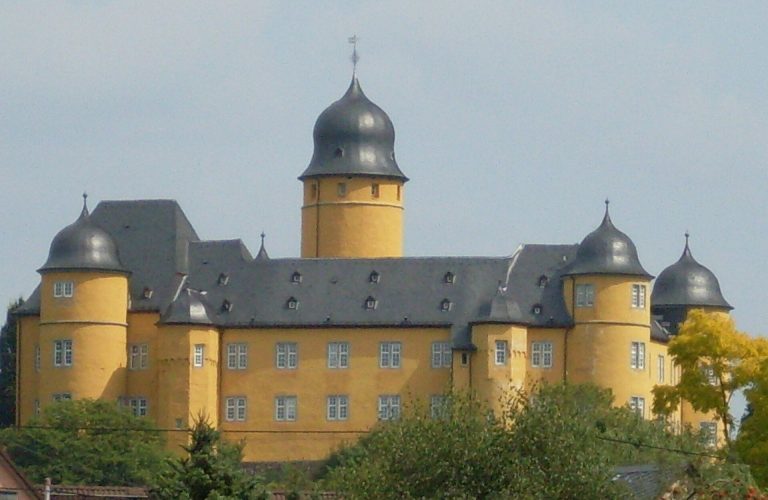
In the mid-sixteenth century, the estate passed by marriage from the Frei von Dehrn family to the von Irmtraut family. Soon afterward, the von Irmtrauts built a water castle, a fortified residence surrounded by a moat or other body of water, with four corner towers.
The castle was later converted into a small palace. In 1680, it was sold to Eremund von Esch for 6,000 Reichstaler, a large silver currency used in the German territories during the early modern period. Emperor Leopold I had raised von Esch to the rank of Imperial Baron in 1679, and in 1684 he became commandant of Ehrenbreitstein Fortress. He subsequently purchased the remaining farms in the settlement.
The Walderdorff estate
Carl Wilderich, Count of Walderdorff, acquired the entire Langwiesen estate, including the water castle, in 1837. He had the surrounding moat drained and expanded and remodelled the agricultural buildings. Walderdorff later served as a state minister of the Duchy of Nassau.
Clay deposits covering more than 250 hectares and reaching depths of up to 100 metres were found on the estate. Their exploitation led to the establishment of the Walderdorff clay pits. The castle and farm buildings are no longer owned by the Walderdorff family, and the former water castle requires restoration.
Remains
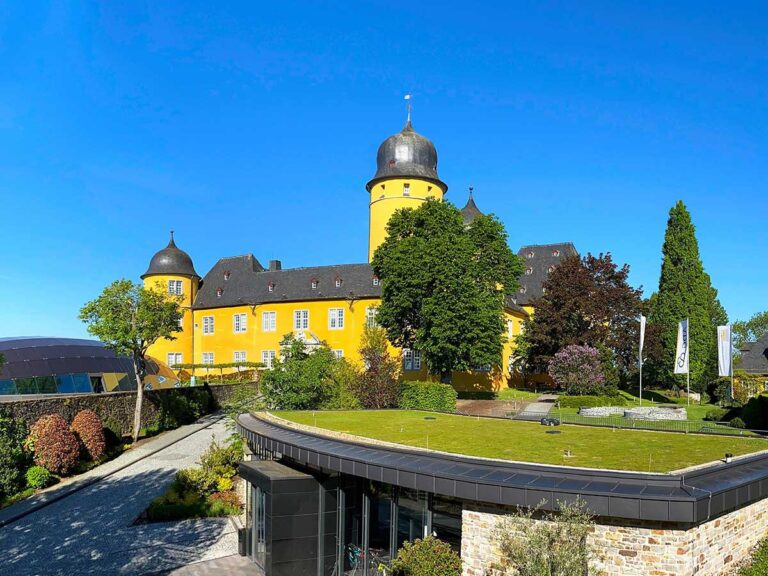
Hofgut Langwiesen retains a compact group of buildings centred on the small rectangular palace, formerly a water castle. The palace is built of stone, and its four corners are marked by thick round towers. The drained moat belongs to the later transformation of the site from a fortified residence into an estate shaped around agricultural use.
Palace and agricultural buildings
Former water castle
The principal building preserves the form of a small rectangular palace with round corner towers. A stair tower projects in front of the northern long side and bears the date 1608, providing a surviving marker of the building’s early modern development. The former castle remains part of the estate but is in need of restoration.
Barn and stables
The agricultural group includes a barn dated 1750 and stables built somewhat later. A niche in the barn wall contains an eighteenth-century stone statue of Saint Aloysius, referring to Aloysius Gonzaga, the Italian Jesuit venerated in the Catholic Church. The statue overlooks the courtyard as part of the surviving farm buildings.