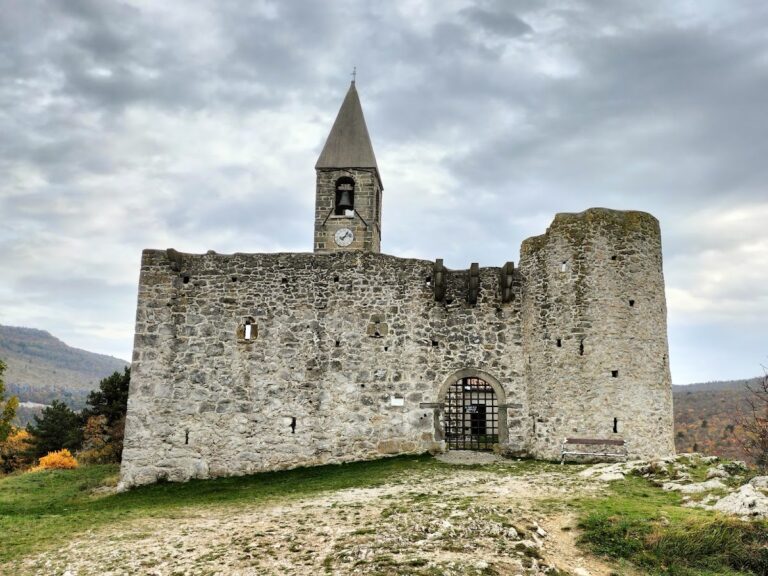
Socerb Castle: Medieval Fortress in Slovenia


Site at a Glance
- Rating
- 4.5
- Popularity
- Medium
- Country
- Slovenia
- Primary era
- Medieval
- Eras represented
- Medieval
- Civilizations
- Carolingian
- Site type
- Military
- Remains
- Castle
On this page4 sections
History
Socerb Castle is a medieval fortress in Slovenia, near the village of Socerb in the Municipality of Koper, close to the Italian-Slovenian border. Its initial core probably dates to the ninth century, when it was built to defend the territory against the Hungarians. The fortress was enlarged through successive building phases and later became an important military and administrative centre.
Venetian and Austrian Rivalry
From 1463 to 1511, Venice controlled Socerb Castle and used it as a final defensive position against the Turks and the Austrian Empire. The fortress also witnessed repeated conflict between Austrian and Venetian forces at the beginning of the sixteenth century. These struggles were connected with the salt trade, including salt produced in the Zaule salt pans and carried through the Val Rosandra.
In 1521, ownership passed to Nicolò Rauber, a captain and nobleman from Trieste. Socerb then served as the seat of a feudal captaincy, a territorial military and administrative jurisdiction governed by a captain. Its authority extended over the surrounding district, including Socerb, Kastelec, Črnotiče, Podgorje, Petrinje, Klanec, Ocizla, Beka, Prebeneg, Vodice, and Črni Kal.
Petazzi Rule and Later Decline
At the beginning of the seventeenth century, during the Uskok War of 1615 to 1617, a conflict in the northern Adriatic involving the Uskoks, a military community based mainly at Senj, the castle belonged to the Trieste nobleman Benvenuto Petazzi. The Petazzi counts retained the Socerb captaincy until 1688, when they returned it to the Archduke of Graz and moved to Zaule.
In 1689, the Carniolan historian Janez Vajkard Valvasor visited, described, and depicted the castle. During the first half of the eighteenth century, the Socerb captaincy passed to the de Priè marquises. The Montecuccoli counts of Modena acquired the castle in 1768 and continued to own it after the abolition of serfdom in 1848.
Lightning caused a fire that damaged the castle in 1780, and the fortress fell into ruins at the beginning of the nineteenth century. Count Girolamo Agapito described the surviving remains in 1823, while August Tischbein depicted them in 1842. Demetrio Economo, a baron from Trieste, purchased the remains in 1907 and renovated the site in 1925. During that work, the surrounding wall was repaired and the other remaining ruins were removed.
During the Second World War, the castle served as a military headquarters first for partisan militias and later for the German army, which captured it in autumn 1944. The site underwent another renovation after the war.
Remains
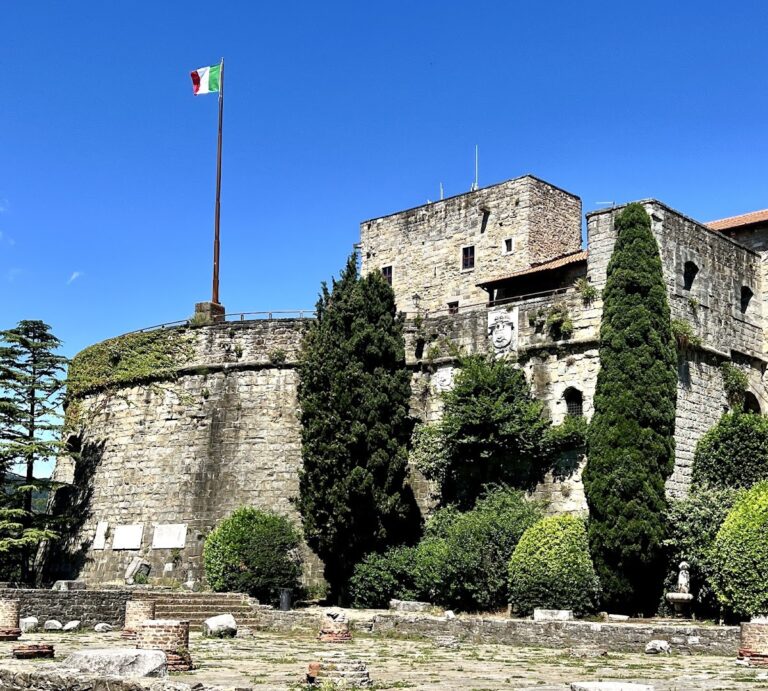
Socerb Castle occupies a cliff rising more than 350 metres above the Zaule plain. The fortress developed from an earlier core that was enlarged in successive phases, although the individual additions and their architectural forms are not specified. The surviving complex includes the surrounding wall, repaired during the 1925 renovation. The other remaining ruins were removed during that intervention, leaving the repaired wall as the principal surviving element of the castle complex.